

Bread takes up more counter than it deserves. A loaf, a bag of rolls, and yesterday’s pastries can claim a full prep zone in a small kitchen — and pushing them into a cabinet usually means forgotten bread. A countertop bread box solves that only if the box itself fits. In a shallow kitchen, the deciding factor is rarely capacity. It is depth, and how the door moves.
This guide is organized by door style, because door style decides how much counter you really need. A box can look compact in a product photo and still demand extra inches every time you open it. Below, five bread boxes are compared on listed footprint, door clearance, and usable height — so you can match a box to the counter you actually have, not the counter in the photo.
As an Amazon Associate, HomeXWander earns from qualifying purchases made through links on this page — at no extra cost to you.
Measure first: depth is the whole game
Most standard kitchen counters are about 25 to 25.5 inches deep from the wall to the front edge, built on 24-inch-deep base cabinets. Small galley kitchens and older apartments often run shallower — 20 to 24 inches is common, and some compact runs go to about 21 inches. That difference decides whether a bread box leaves you any prep space in front of it.
Do not stop at total depth. The usable strip at the back of the counter is what matters, because the front edge has to stay clear for cutting boards and your hands. Place your toaster where it normally lives, then measure the clear rectangle left beside or behind it. That rectangle — width by depth — is the largest footprint you can live with.
Next, measure height from the counter surface to the underside of the cabinet, leaving room to lift a lid or open a door. A low box fits under a cabinet; a tall two-tier box may need an open stretch with no cabinet above it.
Finally, measure your loaf. Listing dimensions are exterior figures, and walls and hardware take space inside, so the loaf needs clearance on every side — a box that exactly matches your loaf on paper will press on the crust in practice.

Door styles: where the extra inches hide
Lift-off lids (including cutting-board lids) need no swing room in front, which suits shallow counters. The catch is vertical: you need clear air above the box and somewhere to set the lid down — usually the sink or stovetop. Canisters stored on top make a lift-off lid inconvenient.
Front doors that flip up or lift need a clear stretch in front of the box. Anything stored there has to move first, so check how far the door travels when open, not just the closed footprint.
Side-hinged doors swing sideways and need width clearance beside the box. In a corner that can work; on a straight run between a toaster and a wall, it can be blocked on day one.
Roll-top doors travel up and back inside the box, needing no extra counter in front. None of the five boxes below uses a true roll-top — worth stating plainly. If zero front clearance is your top priority, look for that style, but measure depth carefully: the rolling track lives inside and reduces usable space.
On a shallow counter, prefer a door that moves up or back over one that swings out.
The five boxes, measured
1. Baking & Beyond Bread Box with Bamboo Cutting Board Lid — the shallowest footprint
If depth is your tightest constraint, start here. The listing gives this iron-and-bamboo box at 13 inches long × 7.09 inches wide × 5.90 inches high, at about 2.2 pounds. That 7-inch depth is the shallowest in this guide, which leaves the most prep space in front of the box on a narrow counter.
The bamboo lid lifts off and doubles as a cutting board, so one object handles storage and slicing — a real advantage when drawer space for boards is limited. The trade-off is height. At under 6 inches tall on the outside, the interior suits a sandwich loaf lying flat, rolls, or pastries better than a tall round boule. Measure your usual loaf height before choosing this one. You also need somewhere to put the lid while the box is open.
Check latest price on Amazon
2. ZICOTO Bread Box with Wooden Lid — compact, with a dimension conflict to check
The ZICOTO is another lift-off-lid design: a compact box with a wooden cutting-board lid, listed for homemade bread, muffins, and bagels. Its small footprint is the appeal for a one- or two-person kitchen that buys one loaf at a time.
One caution, stated plainly because it affects fit: the listing’s dimension fields do not agree with each other. One field gives the size as 11.5 × 5 × 9 inches, while the product-dimensions field gives 11.5 × 9 × 5 inches. Those are the same three numbers in a different order, which means the height and depth could be swapped. On a shallow counter, that difference matters — a 9-inch-deep box and a 5-inch-deep box are very different purchases. Confirm the exact depth and height on the live listing before you order, and measure your loaf against the smaller interior figure to be safe.
Check latest price on Amazon
3. ETMI Bamboo Bread Box — front window, standard depth, check the length
The ETMI is a bamboo box with a transparent wave-pattern acrylic door, so you can see what is inside without opening it. The listing gives exterior dimensions of about 15.74 inches long × 9.84 inches wide × 8.26 inches high, with an internal storage size of about 15.74 × 9.45 × 6.69 inches. A specification line elsewhere on the same listing gives the length as 16.53 inches instead of 15.74 — a small conflict, but worth knowing if your clear rectangle is tight. Plan around the larger figure.
At roughly 10 inches deep, this box needs a standard-depth counter or a clear back strip, and the front door needs room to open. In return, you get the most loaf-friendly interior height in this group and a flat top that can hold light items. The brand describes the design as stackable, with non-slip foot pads, though most small kitchens will use a single layer. Assembly is required — the listing describes installing boards, foot pads, and a handle — and care is hand wash only.
Check latest price on Amazon
4. HOOBRO Bamboo Corner Bread Box — uses the dead corner
Corners are the most wasted space in a small kitchen, and this HOOBRO box is shaped to sit in one. The listing gives it at 12.6 inches long × 12.6 inches wide × 9.4 inches high, in bamboo with a rippled acrylic door and a latch closure, at about 5 pounds.
The square footprint is the point and the catch. In a corner, a 12.6-inch square can tuck into space that straight boxes waste. On a straight shallow run, that same square is deeper than every other box here and will eat your prep space. The door faces the room from the corner, so check that you can reach it without leaning across the counter — a corner box you have to stretch for gets bypassed within weeks. Choose this one only if you have a genuinely dead corner and the diagonal reach works in your layout.
Check latest price on Amazon

5. TidyBa Stackable 2-Tier Bamboo Bread Box — shallow depth, serious height
The TidyBa takes the opposite approach to saving space: it goes up instead of out. The listing gives the two-tier stack at 15.7 inches long × 8.3 inches wide × 17.3 inches high, at about 9.2 pounds, with acrylic windows and a lift-up lid. That 8.3-inch depth is friendly to shallow counters, and two tiers separate loaves from rolls and snacks so flavors do not mix.
The height is the decision. At over 17 inches tall, this stack will not fit under most wall cabinets. It needs an open stretch of counter, a pantry shelf with tall clearance, or a spot beside the fridge with nothing above it. Measure from the counter to the cabinet underside before considering it — if that gap is under 18 inches, this box is out, no matter how well the depth works. Assembly hardware is included, and the care instructions call for wiping clean and drying immediately, with no dishwasher use.
Check latest price on Amazon
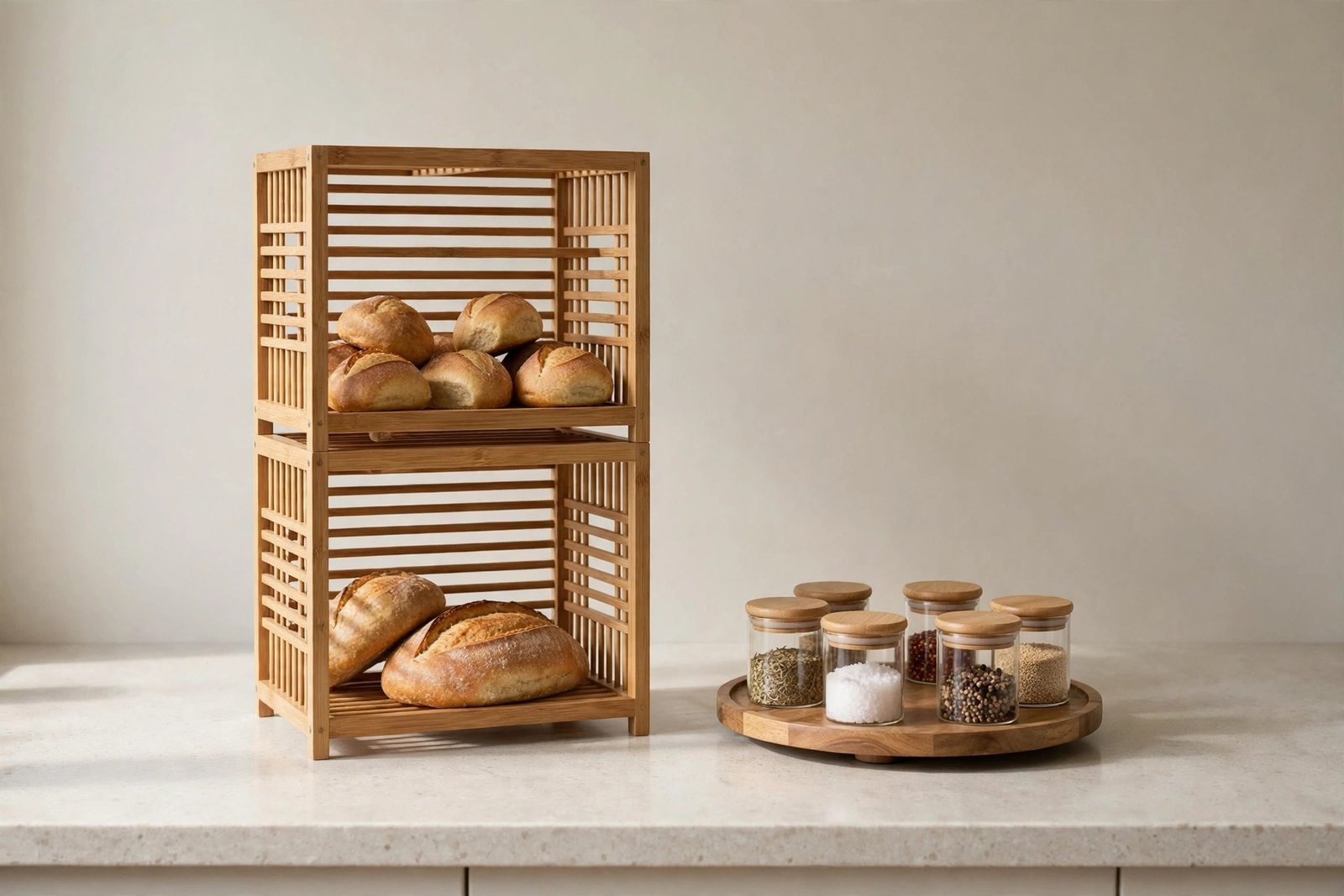
Side by side
Swipe sideways to see all columns →
| Product | Door style | Listed footprint L × W × H (in) | Depth (in) | Best for | Main compromise |
|---|---|---|---|---|---|
| Baking & Beyond with Cutting Board Lid | Lift-off lid (cutting board) | 13 × 7.09 × 5.90 | 7.09 | Shallowest counters, sandwich loaves | Low interior height; lid needs a landing spot |
| ZICOTO with Wooden Lid | Lift-off lid (cutting board) | 11.5 × 9 × 5 (fields conflict — see text) | 5 or 9 (confirm) | One-loaf households | Dimension order conflicts on listing |
| ETMI Bamboo with Window | Front acrylic door | ~15.74–16.53 × 9.84 × 8.26 | 9.84 | Seeing contents; taller loaves | Needs front clearance; assembly required |
| HOOBRO Corner Bamboo | Front acrylic door, latch | 12.6 × 12.6 × 9.4 | 12.6 (square) | Dead corners | Too deep for straight shallow runs |
| TidyBa Stackable 2-Tier | Lift-up lid, acrylic windows | 15.7 × 8.3 × 17.3 | 8.3 | More storage per counter inch | 17.3 in tall — needs open height |
All five: Check latest price on Amazon. Prices are not shown here because none could be verified at the time of writing — see the note below.
A note on prices
No prices appear in this guide. That is deliberate. Each product was checked through our usual price-verification route on 23 November 2026, and none returned a verified live price, so no price is quoted anywhere in the article. Use the “Check latest price on Amazon” line under each product to see the current figure on the live listing. If a price matters to your decision, check it there on the day you buy — bread box prices move with promotions, and a stale number would be worse than none.
When to skip a bread box
Skip the countertop box if your clear rectangle is smaller than the smallest footprint here — a bread bag in a cabinet you open daily beats a box that blocks your only prep space. Skip it if you bake tall boules several times a week and none of the interior heights clear your loaf; a large lidded container in a pantry may serve you better. And skip it if your kitchen runs hot and humid with no cool spot — bread boxes slow staling, they do not stop it, and warm storage shortens the window either way.
Measurement checklist
- Counter depth: wall to front edge, in inches — 25+ is standard, 20–24 is shallow.
- Clear rectangle: the width × depth left after your toaster and kettle are in place.
- Height: counter surface to cabinet underside; note any open stretch with no cabinet.
- Door clearance: for front doors, the clear inches in front of the box; for lift-off lids, a landing spot for the lid.
- Loaf size: length and height of your usual loaf, plus at least an inch of clearance on each side.
- Corner check (corner boxes only): can you reach the door without leaning across the counter?
- Top use: if you plan to store canisters on top, confirm the lid or door still opens with them there.
FAQs
What depth bread box fits a shallow counter? Look for a listed depth of about 9 inches or less, and confirm whether that figure is the closed footprint. The Baking & Beyond box lists about 7.1 inches deep, and the TidyBa stack lists 8.3 inches — both leave prep room in front on a 20- to 24-inch counter. Always leave a few clear inches in front for hands and a cutting board.
Which door style needs the least extra room? A lift-off lid needs no swing room in front, but it needs clear space above and a place to set the lid down. A true roll-top needs no front clearance either, though none of the five boxes in this guide uses one. Front doors that flip up or out need the most guaranteed clear space in front of the box.
Will a bread box fit under my wall cabinets? Measure the gap from the counter to the cabinet underside. Low boxes around 6 to 9 inches tall usually fit comfortably. A two-tier stack over 17 inches tall, like the TidyBa, generally needs an open stretch of counter with no cabinet above it.
How much bigger than my loaf should the box be? Allow at least an inch of clearance around the loaf so air can circulate and the door or lid does not press on the crust. Exterior dimensions overstate usable space — walls and hardware take room — so compare your loaf against interior figures where the listing gives them, as the ETMI listing does.
Can I store canisters on top of the bread box? Only if the door still opens fully with them there. Flat-top front-door boxes handle light items on top best. Lift-off lids and lift-up doors become awkward the moment something sits on them, so test the full open-and-close motion before committing.
Keep Reading
- Will It Fit? The Cabinet Measurement Worksheet — the measure-first method used throughout this guide.
- Galley Kitchen Organization Zones — zoning a narrow kitchen so every appliance earns its footprint.
- Best Pantry Organizer for a Small Kitchen — when bread storage belongs in the pantry instead of on the counter.
- Organize a Small Kitchen Without Drilling — renter-safe fixes that need no landlord permission.
- Best Narrow Pantry Cabinet for a Small Kitchen — adding storage depth where the counter has none to spare.