

Most small-kitchen advice quietly assumes you own the walls: screw in a rail, mount a shelf, bolt in a pull-out. Renters cannot. So this guide uses only storage that leaves no mark — freestanding, over-the-door, under-shelf, tension, and adhesive — zone by zone. If you remember one thing: gravity and friction do the work screws do in an owned kitchen — but they have weight limits, stated below.
As an Amazon Associate, HomeXWander earns from qualifying purchases made through links on this page — at no extra cost to you.
Can you really organize a kitchen with zero screws?
Yes — with one honest caveat: no-drill storage trades load capacity for reversibility. Freestanding organizers carry real weight because they sit on shelves and floors. Tension rods and adhesive hooks are the weakest link: light items only. So heavy things go on freestanding storage; tension and adhesive get the light stuff.
Measure first: the numbers that decide every zone
Write down six numbers before you buy anything. One: counter depth. Two: cabinet shelf depth and height. Three: the gap under each shelf — an under-shelf basket hangs into it. Four: door opening width — anything entering a corner cabinet must pass through it. Five: the under-sink space — width, depth, and where the pipes and disposal sit. Six: any dead gap beside the fridge or stove, measured at the back wall, because baseboards steal inches.

Zone 1: The counter — keep it clear, park things beside it
The counter is work space, not storage — so store beside it, not on it.
VASAGLE Slim Rolling Cart — best for the dead gap beside the fridge
A narrow four-tier rolling cart turns the useless slot beside a fridge or stove into a pull-out pantry. Published widths for the slim VASAGLE carts run about 5.1 inches for the four-tier version — it fits gaps nothing else fits.
The drawbacks: VASAGLE sells several near-identical slim carts (four- and five-tier, multiple colors) and our research has not yet pinned the exact model — do not order until it is pinned. Measure your gap at the back wall first.
Kitsure Dish Rack — best small-footprint rack when counter space is the whole problem
If dishes dry on your only work surface, a compact rack beside the sink beats a big rack that eats the counter. The Kitsure candidate in our research measures about 12 × 15.5 inches.
The drawback: it is a candidate listing, not a confirmed pick — multiple color variants sit under similar names, and the foldaway alternative (OXO Foldaway) has no dated US price in our sources yet.
Zone 2: Inside cabinets — double the shelf without touching it
Cabinet shelves waste vertical space, and freestanding tricks reclaim it — risers and under-shelf baskets first. None needs a screw; all need your measurements.
SONGMICS Shelf Riser (UKCS02NW) — best for stacking plates and mugs
A shelf riser is a small freestanding step: plates go under it, mugs on top, and one shelf does the work of two. The drawback: it must clear your shelf height with items on top with the exact color listing still to confirm.
Under-Shelf Baskets, 2-Pack — best for the dead air under a shelf
An under-shelf basket slides onto a shelf edge and hangs below it, turning empty air into a drawer for wraps, towels, or packets — no screws, no adhesive.
The drawbacks: it eats headroom below (measure the gap first), it only fits shelves with a suitable edge thickness, and pack counts are muddy, so confirm what is in the box.
Zone 3: Walls without drilling — adhesive and tension, light loads only
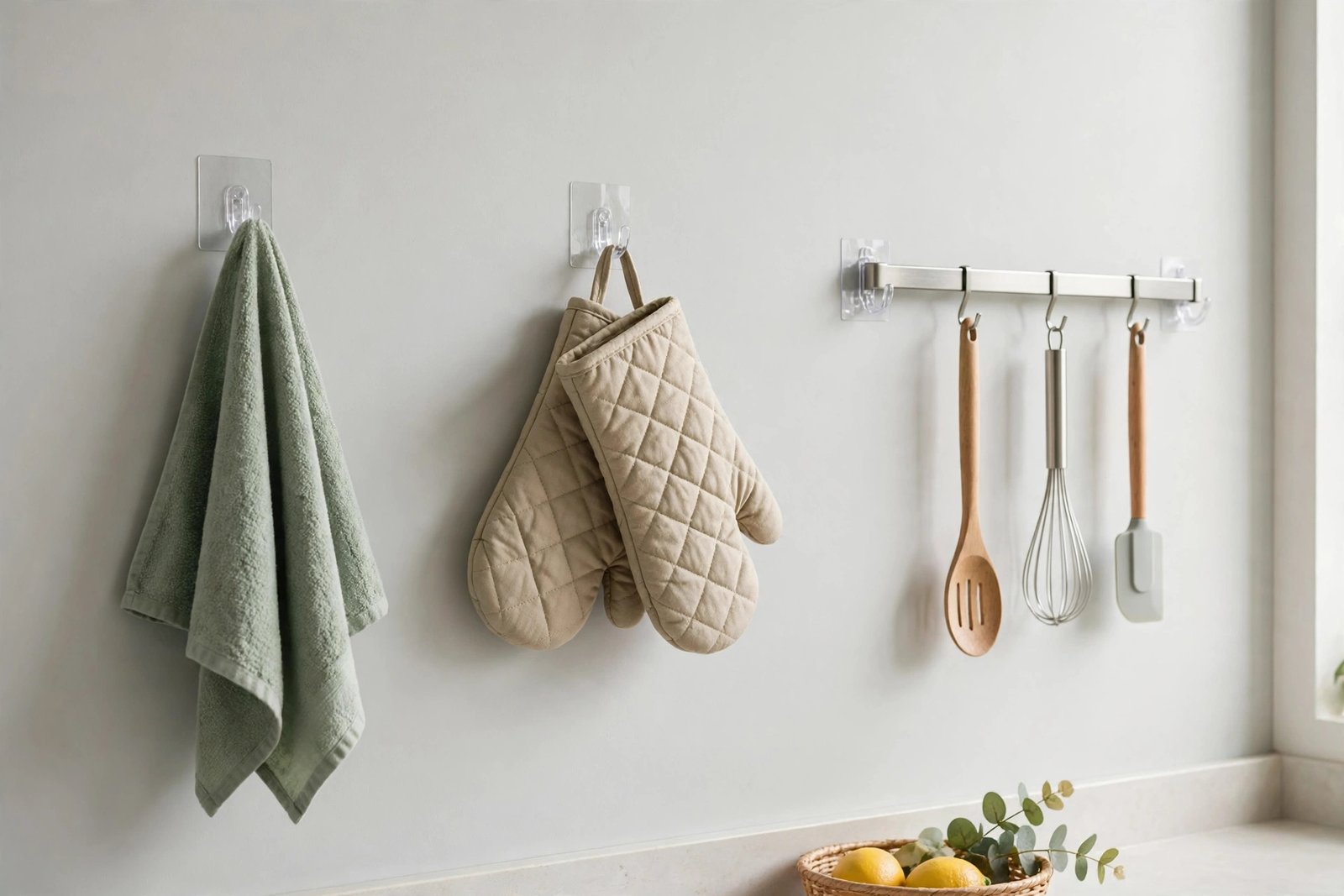
This is the zone where renters get burned, so here are the limits before the ideas. Adhesive hooks (the 3M Command type) are rated by size: roughly 0.5 lb for mini, 1 lb for small, 3 lb for medium, 5 lb for large, and 7.5 lb for jumbo per the manufacturer’s own manuals. Those figures assume a smooth, dry, well-painted wall, cleaned with rubbing alcohol and left an hour before loading. They do not apply to wallpaper, textured walls, or fresh paint — and removal only works damage-free if you stretch the strip slowly straight down, never pull it outward. On an older wall, treat the printed limit as optimistic.
Tension rods follow the same pattern. Published ranges put light-duty rods at about 5–10 lb, standard rods around 20 lb, and heavy-duty steel rods up to roughly 44–45 lb — capacity depends on material, diameter, and span, and longer spans bow. The classic kitchen use is under the sink: a short rod across the cabinet with spray bottles hanging by their triggers. A tension rod is not a shelf, and it is not a pan rail.
Within those limits the wall zone is genuinely useful: hooks for towels and mitts, a tension rod for spray bottles. Past them, things fall at 2 a.m. We have not yet pinned specific rod and hook products to our research standard — flagged in our notes rather than guessed here.
Zone 4: Under the sink — freestanding tiers around the pipes
Under-sink cabinets are where no-drill storage earns its keep: everything is freestanding and nothing touches the plumbing. The constraint is shape — pipes, a disposal, and a filter eat the middle.
Delamu 2-Tier Under-Sink Organizer (2-Pack) — best sliding tiers for a standard cabinet
Two sliding two-tier units give you pull-out access to both sides of the cabinet without mounting anything.
The drawback: a two-tier unit needs the height to clear it, and the pipes decide where units can sit — measure around your disposal and P-trap first.
REALINN L-Shaped Under-Sink Organizer — best shape when the pipes sit off-center
The L-shape is the point: the notch wraps around a pipe or disposal that a rectangular unit would collide with. For off-center plumbing, shape beats size.
Two drawbacks, stated plainly. First, the quality flag: our research records this line at 4.4 stars, below the 4.5-star bar we use as a reference — a shape solution, not a premium build. Second, variants multiply (one- and two-pack, several colors) and price reads conflict by pack size.
YouCopia RollOut Caddy, 8-Inch — best single pull-out for one crowded side
When one side of the under-sink cabinet is usable and the other is plumbing, one narrow rolling caddy is the honest answer. At 8 inches wide it fits a single strip and rolls the back row out.
Zone 5: Corners and the blind corner — freestanding beats screw-in
Blind corner cabinets are where kitchen storage goes to die — and where owned-home advice reaches for screw-in pull-outs renters cannot install. The zero-screw answer is a freestanding turntable sized to the door opening, not the cabinet.
LAMU Turntable 3-Pack — best zero-screw corner fix
Three clear turntables (9.25, 10.6, and 12 inches across per the listing) in one box let you match tray to opening: small tray for the blind corner, larger ones for deep shelves. Each spins 360 degrees on a reinforced base with raised edges; the largest measures about 11.8 inches across and 2.56 inches high per Amazon product data summarized in reviews.
The drawbacks are geometry and missing numbers. A round tray wastes corner space, and the 12-inch tray needs a shelf at least 12 inches deep and wide — plus a door opening that wide to get it in. The listing publishes no weight limit, so keep heavy jars modest.

Zone 6: Doors — the storage surface renters forget
Cabinet and pantry doors are free vertical space, and over-door organizers use them with hooks, not screws. A pocket organizer inside a door holds packets, wraps, and small bottles that eat shelf depth.
Over-the-Door 24-Pocket Organizer — best for packets and small bottles
Twenty-four mesh pockets turn a door into a visible, sorted wall of small items.
The drawbacks: door clearance decides everything (hooks must clear the frame; pockets must not collide with shelf contents), mesh pockets suit light items only, and our research has not yet pinned a current price — only stale reads exist, so we quote none.
How we chose these: we do not buy and bench-test every product, and never claim we did. We shortlist on published dimensions and fit, state drawbacks, and re-check prices before publishing.
The no-drill methods, compared honestly
Swipe sideways to see all columns →
| Method | Where it works | Holds | Honest limit |
|---|---|---|---|
| Freestanding (turntables, risers, carts) | Shelves, floors, corners | Real weight — it sits, it does not stick | Takes shelf/floor space; must fit through door openings |
| Under-shelf slide-on | Shelves with a suitable edge | Light-to-medium packets and wraps | Eats headroom below; edge thickness matters |
| Over-door hooks | Cabinet and pantry doors | Light items in pockets | Door must still close; hooks must clear the frame |
| Tension rod | Under-sink, between two walls | ~5–10 lb light-duty, ~20 lb standard, up to ~44–45 lb heavy-duty (published ranges) | Span bows; friction fails on dusty surfaces |
| Adhesive hooks | Smooth, dry, well-painted walls | 0.5 lb mini to 7.5 lb jumbo (manufacturer ratings) | No wallpaper/textured/fresh paint; stretch straight down to remove |
Who should skip no-drill storage?
Skip adhesive entirely if your walls are wallpapered, textured, or freshly painted — the bond and the clean removal both fail there. Skip tension rods for anything heavy or irreplaceable, and over-door organizers if your doors have no top clearance. If your lease bans even adhesive strips, freestanding storage alone covers most of this system.
Your five-minute measurement checklist
Write down six numbers. One: counter depth. Two: shelf depth and height. Three: the gap under each shelf. Four: door opening width. Five: under-sink width, depth, and pipe positions. Six: any dead gap beside the fridge or stove, measured at the back wall. With those on paper, every product above is a yes-or-no answer instead of a guess.
Frequently asked questions
Can adhesive hooks really hold kitchen items without damaging paint?
Light ones, yes — if you respect the rating: about 0.5 lb (mini) to 7.5 lb (jumbo) per the manufacturer, on smooth, dry, well-painted walls cleaned with rubbing alcohol and left an hour before loading. Removal must stretch the strip slowly straight down. Wallpaper, textured walls, and fresh paint are out.
How much weight can a tension rod hold under a sink?
Published ranges: light-duty about 5–10 lb, standard around 20 lb, heavy-duty steel up to roughly 44–45 lb, depending on material, diameter, and span. Spray bottles by their triggers are the classic light load; pans are not.
What is the best no-drill fix for a blind corner cabinet?
A freestanding turntable sized to the door opening — screw-in pull-outs are the owned-home answer. The tray must pass through the opening and have shelf depth at least equal to its diameter to spin.
Will an under-shelf basket damage the shelf?
It slides on and off without screws or adhesive, so there is nothing to damage — but it only fits shelves with a suitable edge thickness and eats headroom below.
How do I organize under the sink with a garbage disposal?
Shape first: measure where the disposal, filter, and P-trap sit, then pick a shape that works around them — L-shaped for off-center plumbing, sliding two-tier units for clear sides, or one narrow rolling caddy for a single usable strip.
What storage should I avoid as a renter?
Anything needing screws into cabinets or walls (mounted rails, screw-in pull-outs, bolted shelves), adhesive on wallpaper or textured paint, and tension or adhesive storage for heavy items.
[…] Organize a Small Kitchen Without Drilling — the no-drill fixes that pair with hooks when walls are off-limits. […]
[…] Organize a Small Kitchen Without Drilling — renter-safe ways to free the counter your processor needs. […]
[…] Organize a Small Kitchen Without Drilling — the no-drill rules every rack in this guide follows. […]
[…] Organize a Small Kitchen Without Drilling — renter-safe fixes beyond the drawer. […]
[…] Organize a Small Kitchen Without Drilling — renter-safe fixes, no landlord permission needed. […]