

A window air conditioner is heavy, awkward, and balanced on a sill that was never designed to carry it. For renters, the usual fix — a bracket screwed into the frame or the exterior wall — is often off the table, because leases tend to ban drilling and landlords tend to notice holes. That is exactly the problem no-drill support brackets exist to solve: they clamp into the window opening from inside, carry the unit’s weight on steel legs that brace against the wall, and come out cleanly when you move.
But “no-drill” on the box does not mean “fits your window.” Every bracket in this guide has three hard limits: the window width it can span, the wall thickness it can adjust for, and the weight it is rated to hold. Miss any one of them and the bracket either will not install or will not hold safely. So this guide starts with three measurements, then walks through five no-drill brackets and one saddle-style air conditioner that needs no bracket at all — each labeled with the limits its maker actually publishes. If you are reading this in winter, that is fine: measuring now beats scrambling during the first heat wave.
As an Amazon Associate, HomeXWander earns from qualifying purchases made through links on this page — at no extra cost to you.
How no-drill brackets actually hold
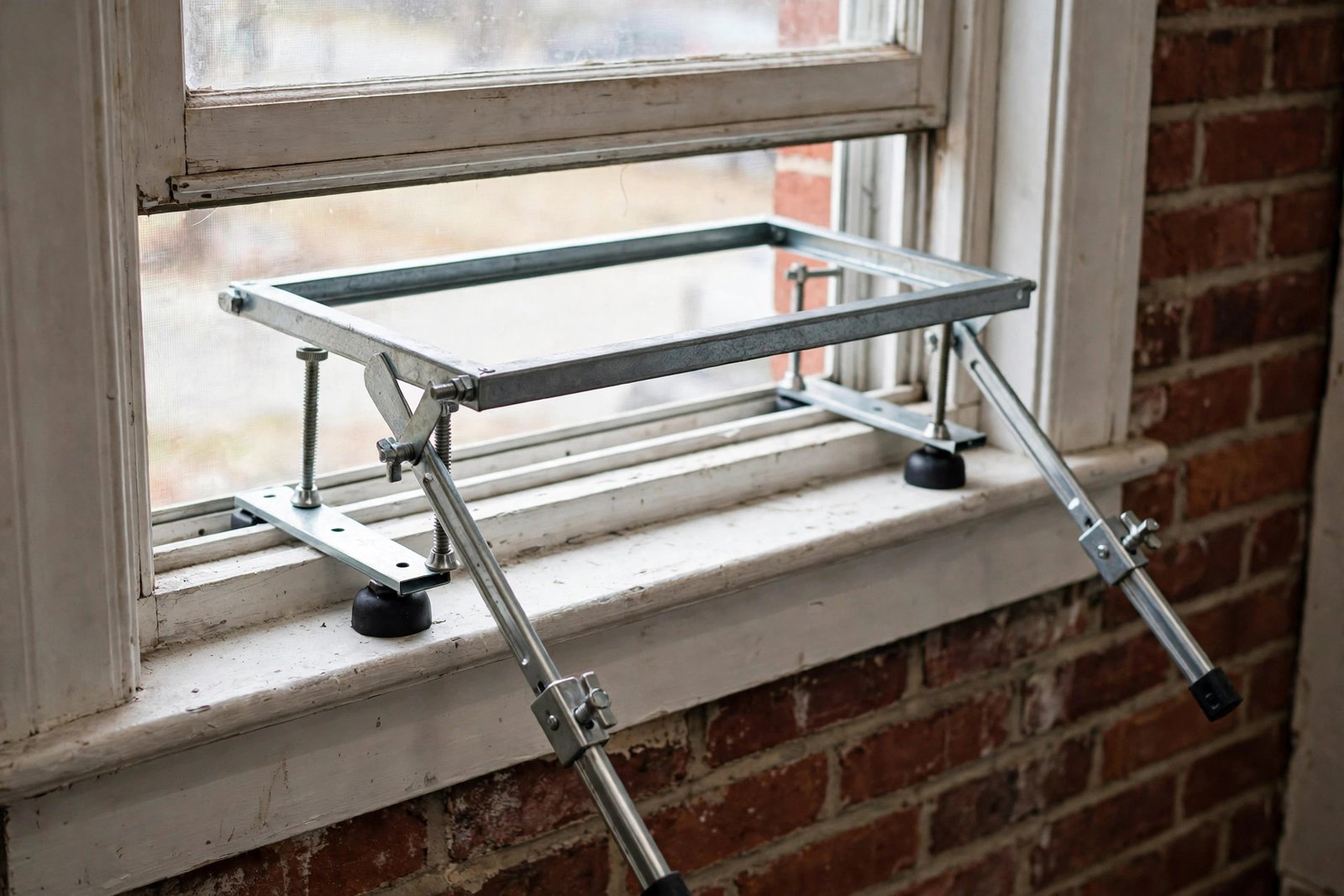
It helps to understand what is carrying the weight, because the design explains both the fit limits and the safety rules. A no-drill bracket is a steel frame that hooks into the window opening: an inner section sits against the inside of the lower window frame, a flat platform extends outward through the opening, and two legs angle down from the platform to brace against the exterior wall below the window. When the air conditioner sits on the platform, its weight presses the frame down and back, which wedges the legs harder against the wall and the inner section harder against the frame. The unit’s own weight is what locks the bracket in place — there are no screws to pull out, and nothing is fastened to the building.
That design is why the measurements below are not optional. The frame can only span the window widths it was built for. The legs can only reach the wall if the wall thickness falls inside the bracket’s adjustment range — too thin and the legs cannot get the right angle, too thick and they cannot reach at all. And the whole assembly is only as trustworthy as the sill and wall it presses against. A bracket does not make a weak window strong; it moves the load from the sill to the wall and frame, which is why the condition of both matters as much as the numbers.
Measure first: three numbers decide everything
1. Window width. Open the window and measure the inside width of the opening where the bracket will sit — the track-to-track distance, not the glass. No-drill brackets here span roughly 22 to 42 inches depending on the model, and they are built for single- or double-hung windows (the kind that slide up and down). None of them works on slider, crank-out, or casement windows. If your window slides sideways, stop here: you need a different solution entirely.
2. Wall thickness and sill depth. This is the measurement most people skip, and it is the one that decides fit. Bracket legs brace against the exterior wall below the window, so the bracket must adjust to your wall’s thickness — measured from the inside lower window frame to the exterior sill or ledge. The brackets below cover ranges from about 3 to 12 inches, but each model has its own band, and at least one needs a full 6 inches minimum. Sill depth matters too: one model below requires a sill at least 3 inches deep. You also need clearance below the window for the legs — 10 inches on the most common design — so check that nothing (a radiator, a fire escape rail, a neighbor’s window) sits in the way.
To measure wall thickness without guessing, open the window fully and run a tape from the inside face of the lower frame straight out to the outer edge of the exterior sill or ledge. If there is no exterior ledge, measure to the outside wall face. Write the number down — “about a hand’s width” is how brackets get returned. While the window is open, press on the sill and look at it: it should feel solid and show no cracks, rot, or flex. Some vinyl windows have hollow or foam-filled sills, and at least one bracket maker warns against them; if your sill feels hollow when you knock on it, treat that as a stop sign and ask your landlord or building management what the window is rated for before hanging anything on it.

3. Your AC’s weight. Find the unit’s weight on its label or in its manual, not from memory. The brackets below are rated from 200 to 300 pounds by their makers, which covers most residential window units — a typical 8,000 BTU unit weighs around 53 pounds, and even large 12,000 BTU units usually stay well under 100. The rating still matters: it is the maker’s stated limit, and a bracket loaded past it is a safety problem, not a bargain. Also confirm your lease and building rules actually allow a window AC at all — some buildings require brackets, some ban window units entirely, and a few cities have their own rules for units overhanging sidewalks.
One more weight detail that surprises people: the bracket itself adds 9 or 10 pounds to what you are handling during installation, and the AC’s weight is not evenly distributed — the compressor end is the heavy end. That is another reason these installs are two-person jobs even though the bracket does the holding afterward. If you are shopping for the AC and the bracket together, weigh the decision the other way around: pick the lightest unit that cools your room, and every bracket in this guide will carry it with room to spare.
The brackets, measured
1. Top Shelf TSB-2438 — the long-running original design
The Top Shelf TSB-2438 is the bracket most other no-drill designs are compared against. It is 18-gauge powder-coated steel, installs from inside with no tools, drilling, or fasteners, and fits single- or double-hung windows 24 to 38 inches wide. Its adjustment range is the detail to check: it requires a wall thickness of 6 to 12 inches and 10 inches of clearance below the window. On weight, sources conflict — the listing title says “holds up to 225 lbs,” while the product details and the maker’s own instructions put the maximum at 200 pounds. Plan around 200 pounds, the lower and better-documented figure. It does not work with slider, crank-out, or casement windows, some wood windows, or slide-out AC units. If your wall is at least 6 inches thick and you have the clearance below, this is the established choice.
Check latest price on Amazon
2. Ivation IVAACMOUNT — the widest wall-thickness range at the low end
Ivation’s bracket is heavy-duty steel with spring-button size adjustment, rubberized feet, and support legs that brace outside. It fits single- or double-hung windows 24 to 38 inches wide and adapts to exterior wall thicknesses from 4 to 11 inches — that 4-inch minimum makes it an option for thinner walls where the Top Shelf’s 6-inch minimum rules it out. The maker rates it for units up to 200 pounds, and it weighs 9.1 pounds itself. Installation is from inside with no tools or drilling, and it is not suitable for slider, crank-out, casement, or dormer windows. For a standard window on a thinner wall, this is the straightforward pick.
Check latest price on Amazon
3. Jeacent Universal — the narrowest window fit
The Jeacent universal bracket is epoxy-coated steel with a full-rubber mount that sits against the siding, and it adjusts for single- or double-hung windows from 22 to 38 inches wide — the 22-inch minimum is the narrowest fit in this guide, useful for small bedroom windows. It fits wall thicknesses from 4 to 11 inches, needs a window track about 1 inch wide, and is rated by the maker for up to 200 pounds. The unit weighs 8.8 pounds and offers an 18-inch resting surface for the AC. One caution: Jeacent also sells a lighter 85-pound bracket that does require screws into the sill — make sure you are looking at the no-drilling universal model, not the light-duty one. If your window is narrower than 24 inches, this is the bracket that still fits.
Check latest price on Amazon
4. GNILLKO — the widest span, with the strictest sill rules
The GNILLKO bracket covers the widest windows here: its frame expands from 31.5 to 41.7 inches, for window openings the maker puts at 21 to 39 inches, and it adjusts for wall thicknesses from 3 to 12 inches. It is rated for up to 220 pounds and for AC units from 5,000 to 24,000 BTU. The trade-off is a strict sill checklist: the sill must be at least 3 inches deep, no more than 12 inches thick, and the sliding-window lip or stool cannot exceed 1 7/8 inches. It cannot be used with casement windows. If your window is wide and your sill passes those three checks, this is the high-capacity option; if your sill is shallow, it is not.
Check latest price on Amazon
5. ADKLLA — the highest stated rating, verify the details
The ADKLLA bracket is epoxy-coated steel, marketed as holding up to 300 pounds — the highest figure in this guide — with an adjustment range reported at 31.5 to 41.7 inches for single- and double-hung windows. Treat that 300-pound number as a maker’s claim to verify on the listing rather than a tested fact: published specifications for this model are thinner than for the brackets above, and wall-thickness limits are not stated as clearly. It suits wide windows and heavy units on paper, but measure your wall thickness and confirm the fit requirements on the product page before ordering, because the public spec sheet leaves gaps the other makers fill in.
Check latest price on Amazon
6. Midea U-Shaped — the no-bracket alternative
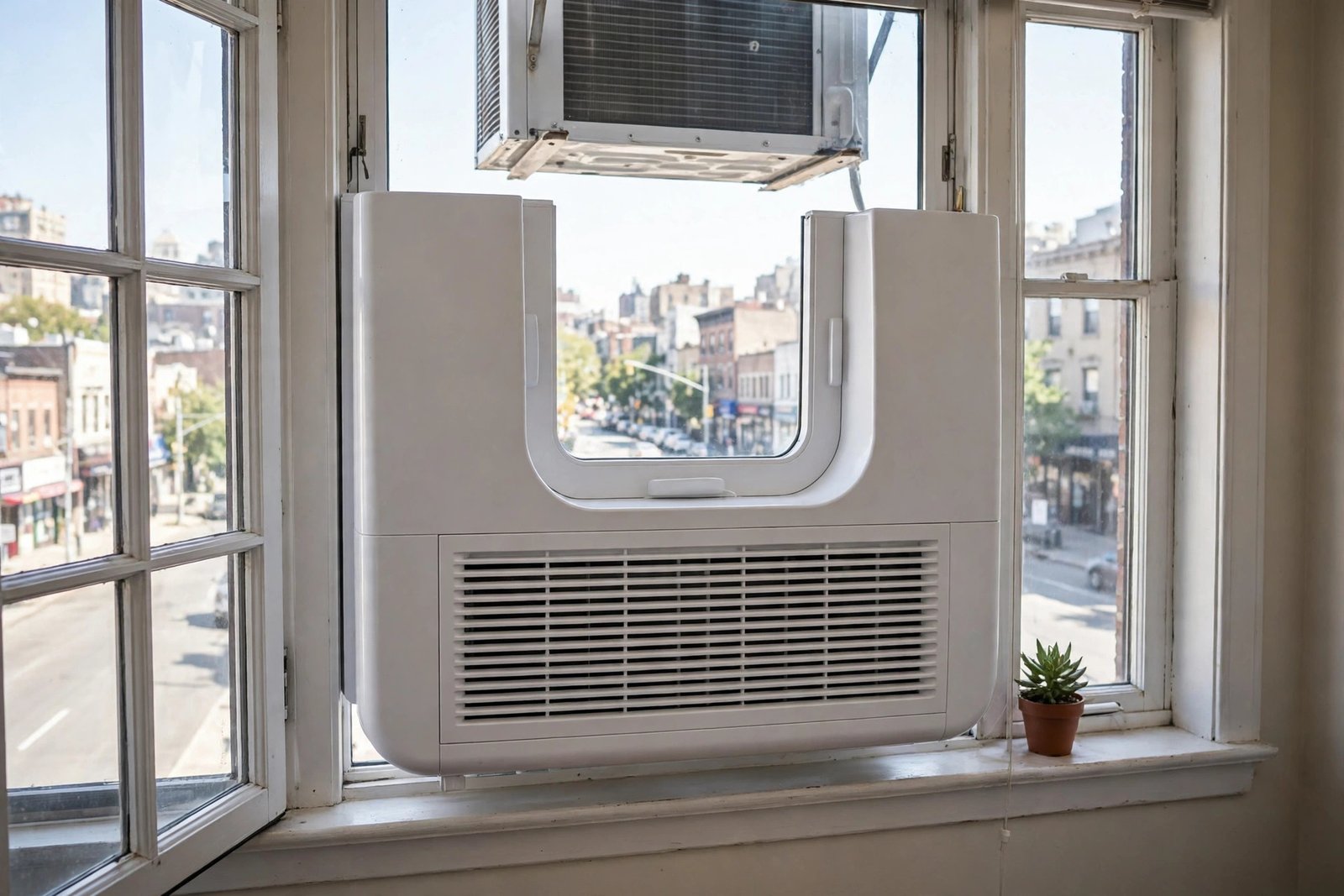
If you are buying the air conditioner itself, there is a way to skip the bracket question entirely. Midea’s U-shaped window AC straddles the sill in a saddle shape: the compressor half sits outside, the cooling half inside, and the window sash closes into the notch between them — so the window can still open and close with the unit installed, and the design does not require a separate support bracket. The 8,000 BTU model is rated for rooms up to 350 square feet, measures about 19.2 inches wide × 13.5 inches high × 22 inches deep, and weighs about 53 pounds. It needs a single- or double-hung window at least 13.75 inches high and 22 to 36 inches wide. Two honest notes: at 53 pounds it is still a two-person lift onto the sill, and Midea ran a recall and repair program in 2025 covering some early U-shaped units over a mold risk — if you buy used, verify the unit’s status first; new units from current listings should already reflect the fix, but check before you pay.
Check latest price on Amazon
Which one fits your window? A quick decision path
Start with your three measurements and work down this list. If your window is narrower than 24 inches, the Jeacent universal is the only bracket here that fits, down to 22 inches. If your wall is thinner than 6 inches, cross the Top Shelf off and choose between the Ivation (4-inch minimum) and the Jeacent (4-inch minimum) — or the GNILLKO at 3 inches, if its sill rules pass. If your window is wide, past 38 inches, the GNILLKO and ADKLLA are the options, and between those two the GNILLKO publishes the fuller specification, including its sill requirements, while the ADKLLA carries the higher stated rating but leaves its wall-thickness limits unclear. If you are buying the air conditioner at the same time and your window is 22 to 36 inches wide, the Midea U-shaped removes the bracket from the equation entirely and lets you keep opening the window.
Weight rarely decides between these brackets, because every rating here — 200 pounds and up — sits well above what a typical residential unit weighs. What decides is geometry: window width first, wall thickness second, sill depth and condition third. Get those three right and any bracket on this list will do its job; get one wrong and the strongest bracket made will not save the installation.
Side by side
Swipe sideways to see all columns →
| Product | Type | Window width (maker figures) | Wall thickness (maker figures) | Weight rating (maker figures) | Check latest price |
|---|---|---|---|---|---|
| Top Shelf TSB-2438 | No-drill bracket | 24–38 in, single/double hung | 6–12 in; 10 in clearance below | 200 lb (title says 225 — sources conflict) | Check latest price on Amazon |
| Ivation IVAACMOUNT | No-drill bracket | 24–38 in, single/double hung | 4–11 in | 200 lb | Check latest price on Amazon |
| Jeacent Universal | No-drill bracket | 22–38 in, single/double hung | 4–11 in; ~1 in track | 200 lb | Check latest price on Amazon |
| GNILLKO | No-drill bracket | Expands 31.5–41.7 in | 3–12 in; sill ≥3 in deep | 220 lb | Check latest price on Amazon |
| ADKLLA | No-drill bracket | 31.5–41.7 in (reported) | Not clearly published — verify | 300 lb (maker claim) | Check latest price on Amazon |
| Midea U-Shaped 8,000 BTU | Saddle AC, no bracket | 22–36 in; ≥13.75 in high | Straddles sill | Unit weighs ~53 lb | Check latest price on Amazon |
Installing: what the job actually looks like
Every bracket here installs from inside the room — no ladder, no leaning out, no exterior work. The general sequence is the same across brands: assemble the frame on the floor (most click or pin together), set it into the open window, adjust the width and leg angle to your measurements, then set the air conditioner onto the platform and slide it out to its final position. Makers typically call for a slight downward tilt toward the outside — about a quarter to a half inch — so condensation drains out instead of pooling. Once the unit is seated, close the sash down onto it and fill the side gaps with the foam or panels that came with the AC.
Two practical points renters learn the hard way. First, this is a two-person job even with a bracket: the bracket holds the unit once it is placed, but a person still has to lift 50-plus pounds of air conditioner up to sill height and set it down squarely. Second, keep the bracket’s instructions and any spare pins in a labeled bag taped inside a closet — you will take this apart every fall and reassemble it every spring, and the part you lose in October is the part you need in May. At move-out, the whole assembly lifts out and the window closes as if nothing was ever there, which is the entire point.
Safety and lease notes worth reading twice
A bracket reduces risk; it does not remove it. A window AC that falls is a serious hazard to anyone below, which is why some cities and buildings regulate them. Before you buy anything, check three documents: your lease (many require written permission for window units, and some require a bracket specifically), your building’s house rules (co-ops and condos often have their own approved-installation rules), and your city or state rules if your window hangs over a sidewalk or public space. If your building requires a specific bracket type or a professional installation, that requirement wins over anything in this guide.
Also be honest about the window itself. A bracket cannot compensate for a rotten frame, a cracked sill, or a sash that does not close properly. If the window is in poor shape, the fix is a maintenance request to your landlord, not a heavier bracket. And if the window is a fire-escape or egress window, think carefully before blocking it with an air conditioner at all — in many places that is restricted, and everywhere it is worth a second thought.
When to skip a no-drill bracket
Skip it if your window is a slider, crank-out, or casement — none of these brackets fits, and forcing one is unsafe. Skip it if your wall is thinner than the bracket’s minimum or your sill is hollow, damaged, or too shallow for the model you picked; a bracket is only as solid as what it braces against. Skip it if your lease or building bans window ACs or requires a specific approved installation — a bracket does not override house rules. And skip it if your unit weighs more than the bracket’s rating: at that point the honest options are a through-wall unit, a portable AC, or a different window.
Measurement checklist
- Window type: single- or double-hung? (Sliders and casements rule out every bracket here.)
- Window width: inside track-to-track measurement, in inches.
- Wall thickness: inside lower frame to exterior sill or ledge, in inches.
- Sill depth and condition: depth in inches; solid, not hollow or cracked?
- Clearance below the window: at least 10 inches of open wall for the legs?
- AC weight: from the unit’s label or manual, in pounds — under the bracket’s rating?
- Lease and building rules: window AC allowed? Bracket required or restricted?
- Lift plan: two people for the unit, installed from inside, no leaning out?
FAQs
Do no-drill brackets damage the window or wall? They are designed not to: they clamp into the opening and brace with rubberized feet rather than screws. That said, “no damage” assumes a sound sill and correct installation — a cracked or hollow sill can still be stressed by any heavy unit, bracket or not.
Can I use one on a sliding (sideways) window? No. Every bracket in this guide is made for single- or double-hung windows only. Sliding, crank-out, and casement windows need a different approach, such as a portable AC with a window vent kit.
How much weight can these brackets really hold? Only the makers’ ratings are published: 200 pounds for the Top Shelf, Ivation, and Jeacent; 220 for the GNILLKO; 300 claimed for the ADKLLA. Stay under the rating for your exact model — and where sources conflict, as with the Top Shelf’s 225-pound title versus its 200-pound instructions, plan around the lower number.
My wall is only about 4 inches thick. What fits? The Ivation and Jeacent brackets both adjust down to 4 inches, and the GNILLKO down to 3. The Top Shelf needs at least 6 inches, so it is out for thin walls. Measure before ordering — wall thickness is the most common reason these brackets get returned.
Is a U-shaped AC really bracket-free? The Midea U-shaped design straddles the sill and does not require a separate support bracket, and the window can still open. You still need the right window size (22 to 36 inches wide, at least 13.75 inches high for the 8,000 BTU model), a solid sill, and two people for the lift.
Can I leave the bracket in all year? You can, but most renters remove the AC for winter and store it indoors, which means the bracket comes out too. That is one of the advantages of a no-drill design: it lifts out in minutes with no holes to patch. If you do leave the unit in over winter, use a proper exterior cover and check the bracket’s feet and legs for rust each spring.
What if my window is wider than 42 inches? None of the brackets here spans beyond about 42 inches. For very wide windows, the usual options are a portable AC with a window vent kit, a through-wall unit if the building has a sleeve, or asking your landlord what installation the building approves — some buildings have standard solutions for exactly this case.
Does the bracket stop the AC from being pushed in from outside? A bracket supports the unit from below; it is not a security device. The closed sash resting on top of the unit is what resists pushing, and for ground-floor windows many people add a window security bar or track lock as well. Treat support and security as two separate jobs.
Keep Reading
- Organize a Small Kitchen Without Drilling — the same no-drill logic, applied to the kitchen.
- Will It Fit? The Cabinet Measurement Worksheet — the measure-first method used throughout this guide.
- Blind Corner Cabinet Storage Without Drilling — renter-safe storage that needs no landlord permission.
- Best Pantry Organizer for a Small Kitchen — sized to the shelf you actually have.
- Best Under-Sink Organizer for a Small Kitchen — measure the cabinet, then buy the organizer.