

Most spice-storage guides assume a drawer. Yours may not have one to spare — or the one shallow drawer near the stove is already full of utensils. So the jars end up on the counter, in a cabinet pile three deep, or in a box you have to unpack every time you cook.
Here is the short version. A small kitchen almost always has four surfaces a spice rack can use: a shallow drawer, the inside of a cabinet door, the side of the fridge, and a deep cabinet shelf. Each surface takes a different rack, and each rack fails on the wrong surface. A drawer insert in a drawer that is too shallow jams against the drawer above. A door rack that is too deep stops the cabinet door closing. Magnetic tins on a fridge side that faces a wall never get opened. The fix is not a better rack — it is matching the rack to the surface you actually have.
This guide is a decision path, not a beauty contest: measure your four surfaces first, then the racks, surface by surface.
As an Amazon Associate, HomeXWander earns from qualifying purchases made through links on this page — at no extra cost to you.
Step 1: Measure the four surfaces
Write these numbers down before you look at a single product — five minutes that decide storage versus return label.
- Drawer interior height — floor of the drawer to the underside of the drawer or counter above it, measured with the drawer closed. Angled inserts need at least 3 inches here, because the jars sit tilted and their lids are the highest point.
- Cabinet-door clearance — with the door closed, the gap between the inside face of the door and the front edge of the shelves. A door-mounted rack plus jars has to fit inside that gap or the door will not latch. Most standard spice jars need a rack about 2.5 to 3 inches deep; measure your recess before assuming.
- Fridge-side clearance — the flat metal area on the fridge side, and how far anything stuck to it can project before it blocks a walkway, a door swing, or the oven handle. Magnetic shelves typically project about 3.5 to 4 inches.
- Cabinet interior depth and height — back wall to the inside of the closed door, and shelf-to-shelf height. A pull-out rack needs its full depth plus room for the door to close over it.
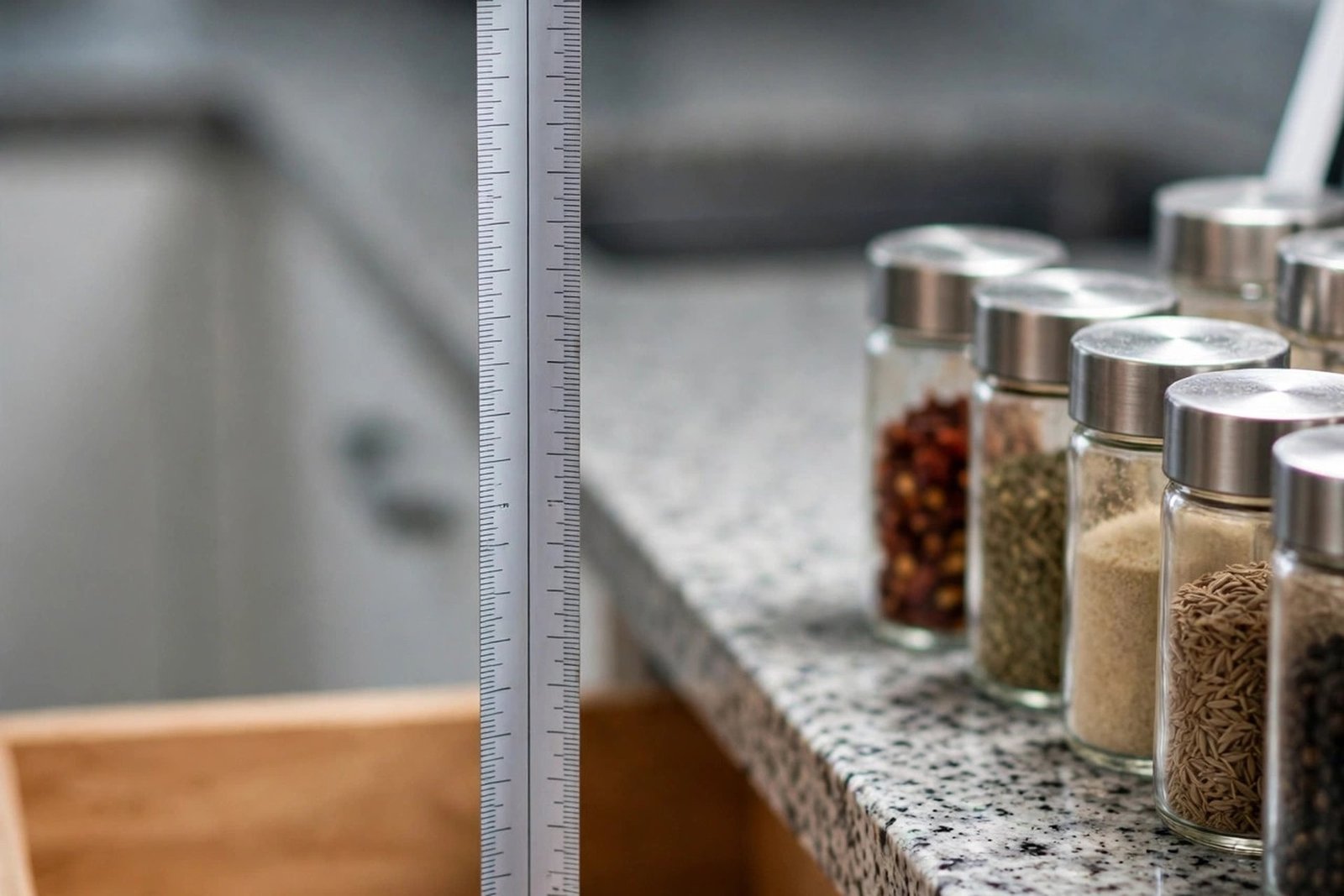
How the numbers map to surfaces: a drawer with 3 inches or more of interior height takes an angled insert. A cabinet door with a few inches of recess takes a slim door rack. A fridge side with a clear walkway takes magnetic tins. A deep cabinet with a shelf you cannot see the back of takes a pull-out or a tiered step. If none of the four surfaces clears its minimum, skip to “When to skip” — the honest answer there is fewer jars, not a bigger rack.
Step 2: Which surface do you actually have?
A shallow drawer near the stove. This is the best spice storage in any kitchen — jars lie tilted, labels up, protected from light and steam. The catch is height: the insert plus a standard jar needs roughly 3 inches of drawer interior, and many apartment drawers are shallower than they look. Measure first; this is the number that sends drawer inserts back.
A cabinet door with recess behind it. The inside of an upper cabinet door is dead space in most kitchens. A slim rack there holds a row or two of jars without touching shelf space — but only if the door still closes over it. Shelves that run flush to the cabinet face leave almost no recess; shelves set back an inch or two leave room. Your measurement from Step 1 decides.
A fridge side facing open room. A flat steel fridge flank is a vertical surface that holds magnetic tins with no screws, no adhesive, nothing to repair when you move out. It works when the side faces a walkway you use; it fails when the fridge sits in an alcove and the tins would face a wall six inches away.
A deep cabinet shelf. Deep shelves swallow jars — the back row disappears. Two fixes: a tiered step that lifts back rows into view, or a pull-out that brings the whole shelf to you. The step is cheaper and needs no installation; the pull-out needs cabinet depth and height to match its frame.
The racks, surface by surface
How we chose these: we do not buy and bench-test every product, and never claim we did. We shortlist on published dimensions and fit, cross-check specs against listing and review sources, and state drawbacks plainly. Where no verified price exists, we quote none — the link takes you to the live price.
SpaceAid Bamboo Spice Drawer Organizer, Expandable — best if your drawer clears 3 inches
If measurement one came back at 3 inches or more, this is the drawer answer: a solid bamboo insert with four angled tiers that expands from 12 to 23 inches wide, so it fits a narrow drawer or stretches across a wide one. The tiers tilt jars so cap labels read at a glance, and the listing rates capacity at up to 48 standard spice jars. It arrives assembled — no screws, no tools — and jars are not included, which matters if you were expecting a full set.
The drawbacks, stated plainly. The 3-inch minimum is real: the listing itself warns the drawer must be deeper than 3 inches once jars are loaded, and one spec summary puts the safe figure at 3.1 inches. A drawer that measures exactly 3 inches is a gamble — lids can scrape the drawer above. The insert is also 17 inches long front to back, so a short drawer (some apartment drawers are barely 16 inches deep inside) will not take it even if the height clears. Measure both numbers.
Simple Houseware Over Cabinet Door Organizer — best slim basket for a cabinet door
This is the cabinet-door surface done thin: a powder-coated steel mesh basket that hangs over a cabinet door on a slim hook, using the recess between door and shelf edge. Overall size is about 12.75 inches wide × 3.75 inches deep × 18.5 inches high, with a basket interior about 11.8 inches wide × 2.9 inches deep — one row of standard spice jars, or the packets and small bottles that usually get lost. The hook is thin with foam padding, so it hangs without drilling and without chewing the door finish, and the same basket can wall-mount or sit on a counter if you move.
The drawbacks: it is one basket, not a tiered rack, and it was designed for flat items — cutting boards, wraps, packets. A row of spice jars fits the 2.9-inch interior if your jars are standard diameter, but tall grinders and wide bottles will not. And the whole unit projects 3.75 inches from the door, so your Step 1 recess measurement has to beat that, with the jars inside, or the door stays open. Measure the recess, measure a jar, then decide.

Delamu 8-Tier Over the Door Pantry Organizer, 12″ — best for a pantry or room door
When the door you have is a full pantry or kitchen door — not a cabinet door — this is the heavy lifter: eight adjustable metal baskets on a frame about 12 inches wide × 5 inches deep × 74 inches high, hanging over the door on hooks (two hook sizes included, about 1.45 and 1.85 inches, for different door thicknesses). The baskets adjust in height, so tall bottles and short jars each get a tier that fits, and adhesive pads keep the frame from swinging when the door moves. The listing rates each basket at up to 10 pounds — treat that as a brand figure, not a promise, and keep glass jars on the lower tiers.
The drawbacks: it needs more than 5.6 inches of depth behind the door (the listing’s own figure) plus a door gap over 0.06 inches at the top, so a pantry whose shelves run close to the door will not take it. At 74 inches tall it also needs a full-height door, not a half door or a cabinet. This is the pick for a real pantry door with shelf setback — measure the setback first.
ULG Over The Door Organizer — best pocket panel for packets and small jars
The other door answer is fabric, not metal: a hanging panel about 15 inches wide × 6.5 inches deep × 55 inches high with six large pockets and twelve smaller side pockets, on two metal hooks the listing rates for doors under about 1.85 inches thick. For spices, the side pockets take seasoning packets, bouillon, and small tins you can see at a glance, and the large pockets take the overflow — backup jars, oils, the things that currently live on the counter. It hangs in seconds, folds flat when you move, and the listing rates total capacity at 50 pounds.
The drawbacks: fabric pockets hold packets and small items well but are the wrong shape for a row of glass jars — jars tip, lean, and hide behind each other. Think of this as the packet-and-overflow panel next to a real jar rack, not a replacement for one. And like every over-door unit, it adds its depth to the door: 6.5 inches of pocket has to clear whatever is behind the door when it closes.
Kamenstein Magnetic Spice Tins, Set of 3 — best for the fridge side
The fridge-side surface in its simplest form: three magnetic tins, each holding up to 3 ounces, with clear lids and sift-or-pour tops, that stick to any flat metal surface — fridge door or side, most appliance panels. No drilling, no adhesive, nothing to patch at move-out, and the spices you reach for daily sit at eye level instead of in a cabinet pile. Decant your three most-used spices and the rest of the collection can stay wherever it is.
The drawbacks: three tins is a starter, not a system — a real spice collection needs several sets, and the cost adds up per set. The lids are clip-on rather than screw-tight, so treat these as everyday-use tins, not long-term airtight storage. And availability has been spotty — the listing has shown as unavailable at times, so check the live listing before planning a whole wall of them. Also check your fridge: some stainless-steel-look doors are not magnetic on the front, though the side panels usually are. A fridge magnet you already own answers that in two seconds.

SpaceAid Bamboo Pull Out Spice Rack — best for a deep cabinet you cannot see into
For the deep-cabinet surface: a bamboo pull-out about 7.6 inches wide × 10.6 inches deep × 9.6 inches high, with three narrow drawers (about 2 inches wide each) across two tiers on ball-bearing, full-extension glides. Pull it out and the back row comes to you; the bottom panel is shaped to clear a cabinet lip. The listing recommends a cabinet about 12 inches tall and 10.6 inches deep, and the hardware — screwdriver included — is in the box.
The drawbacks: those 2-inch-wide drawers only take standard-diameter jars; wide bottles and grinders stay on the shelf. Assembly is required, unlike the drop-in options above. And a pull-out only earns its keep in a cabinet deep enough that jars actually get lost — in a shallow cabinet, the tiered step below does the same job with no moving parts. Measure your cabinet height against the 12-inch recommendation before ordering.
Copco 3-Tier Non-Skid Spice Rack, 15″ — best no-install fix for one deep shelf
The simplest deep-shelf answer: a one-piece molded step shelf, 15 inches wide × 9 inches deep × about 3.5 inches high, with three tiers about 2.75 inches deep each, lined with a non-skid surface so jars stay put when the door closes. Review roundups put capacity at 18 to 24 standard spice jars on a single shelf, every label visible because the back rows stand higher. Nothing to assemble, nothing to mount — set it down and fill it.
The drawbacks: it is a fixed 15 inches wide, so a shelf narrower than that rules it out, and the tiers do not adjust — jars taller than about 4 inches on the front tier will hide the row behind. The 2.75-inch tier depth fits standard jars but is tight for wide cans and bulk containers. And it only works where you already have a shelf; it creates visibility, not new space. If your problem is “no shelf at all,” go back to the door and fridge-side surfaces.
Spice storage fit table
One row per checked rack. “Key measurement” is the number from Step 1 that decides fit. Blanks and “check” entries are deliberate — a blank beats a made-up number, and where no verified price exists we quote none.
Swipe sideways to see all columns →
| Product | Surface it needs | Key measurement | Approx price (dated) |
|---|---|---|---|
| SpaceAid Bamboo Drawer Organizer, expandable 12–23″W, 4 tiers, up to 48 jars | Shallow drawer near the stove | Drawer interior height ≥3″ (3.1″ to be safe); drawer depth ~17″ | Check latest price |
| Simple Houseware Over Cabinet Door Organizer — 12.75″W × 3.75″D × 18.5″H, basket interior ~2.9″D | Inside of a cabinet door | Door-to-shelf recess >3.75″ with jars loaded | Check latest price |
| Delamu 8-Tier Over the Door Organizer, 12″ — 12.3″W × 5″D × 74.27″H, 8 baskets | Full pantry or room door | Depth behind door >5.6″; door gap >0.06″; door thickness ≤1.85″ | Check latest price |
| ULG Over The Door Organizer — 15″W × 6.5″D × 55″H, 6 large + 12 side pockets | Full room or pantry door | Door thickness <1.85″; 6.5″ clearance behind door | Check latest price |
| Kamenstein Magnetic Spice Tins, Set of 3 — 3 oz each | Fridge side or flat metal panel | Magnetic surface (test with a magnet); ~4″ walkway clearance | Check latest price |
| SpaceAid Bamboo Pull Out Spice Rack — 7.6″W × 10.6″D × 9.6″H, 3 drawers ~2″ wide | Deep cabinet shelf | Cabinet ~12″ tall × 10.6″ deep; jar diameter ≤2″ | Check latest price |
| Copco 3-Tier Non-Skid Spice Rack, 15″ — 15″W × 9″D × ~3.5″H, tiers ~2.75″ deep | One existing cabinet or pantry shelf | Shelf width ≥15″; jar height ≤~4″ on front tier | Check latest price |
Read the table against your four numbers. Drawer clears 3 inches: the SpaceAid insert, done. Drawer too shallow but a cabinet door has recess: the Simple Houseware basket for a row of jars, or the Delamu if the door is a full pantry door. No door recess but a fridge side faces the room: magnetic tins for the daily three. Deep shelf, jars getting lost: Copco step if the shelf is 15 inches wide, SpaceAid pull-out if you want the back row to come to you.
When to skip a spice rack
Skip the drawer insert if your drawer interior measures under 3 inches — no angled rack fixes physics, and forcing one in gives you a drawer that will not close. Skip door racks if the door-to-shelf recess is under about 3 inches, or if the cabinet has a center stile or pull-out shelves behind the door — the rack and the shelf will fight every time the door swings. Skip magnetic tins if your fridge side faces a wall or the door panels are non-magnetic stainless — test with a magnet first. Skip the pull-out if your cabinet is shallow; a step shelf does the same job. And skip any rack, on any surface, if the real problem is forty jars in a kitchen that cooks with eight — decant the eight you use, store the rest in a labeled box on a high shelf, and buy the rack that fits the eight.
Your five-minute measurement checklist
Before you order, write down four numbers: drawer interior height with the drawer closed; cabinet-door recess (closed door to shelf front edge); fridge-side flat area and walkway clearance; cabinet interior depth and shelf height. Add one test: a fridge magnet on every metal surface you are considering. With those on paper, the table above becomes a yes-or-no answer — and if it is “no rack fits,” you have saved the return postage.
Frequently asked questions
How deep does a drawer need to be for a spice drawer organizer? At least 3 inches of interior height for angled inserts like the SpaceAid — the listing itself warns the drawer must be deeper than 3 inches once jars are loaded, and 3.1 inches is the safer figure. Measure from the drawer floor to the underside of whatever is above it, with the drawer closed. Also check drawer depth front to back: the SpaceAid insert is about 17 inches long.
Will a cabinet door rack stop my cabinet door from closing? It will if the rack plus jars is deeper than the recess between the closed door and the shelf front edge. Measure that recess first. The Simple Houseware basket projects 3.75 inches from the door, so your recess needs to beat that with jars inside. If your shelves run flush to the cabinet face, there is almost no recess — skip the door rack and use another surface.
Do magnetic spice tins work on stainless steel fridges? Sometimes. Many stainless-look fridge doors are non-magnetic on the front, while the side panels are usually plain steel and hold magnets fine. Test with any fridge magnet before buying tins. The Kamenstein tins also stick to most flat appliance panels, so a dishwasher front or range side can work if the fridge does not.
How many spice jars does a tiered cabinet rack hold? The Copco 15-inch step shelf holds about 18 to 24 standard spice jars across its three tiers, per review roundups — roughly six to eight jars per tier. Taller jars on the back tier, short jars in front, keeps every label readable.
Are over-door organizers renter-safe? The ones here hang on hooks or magnets — nothing screws into the door or wall, so there is nothing to patch at move-out. Two cautions: check door thickness against the hook size (the ULG hooks fit doors under about 1.85 inches; the Delamu includes 1.45 and 1.85 inch hook sets), and make sure the door still closes with the organizer loaded. The Delamu can also wall-mount, but that version needs screws — renters should use the hooks.
Why do the dimensions differ between listings for the same product? Because listings are sloppy. The Simple Houseware basket reads 12.5 inches wide in its title and 12.75 inches in its spec table; the Copco’s depth and width labels swap between its details table and its bullet points. Our rule: plan on the larger figure and confirm the exact variant before ordering.
What if I have no drawer, no door recess, and a non-magnetic fridge? Then the deep-shelf surface is your answer: a tiered step or pull-out on the shelf you have. If you have no shelf either, the honest fix is fewer jars in play — keep the eight you cook with on the counter in one small tray, box the rest labeled on a high shelf, and skip the rack. A rack cannot create a surface that does not exist.
Keep reading
- Best Pantry Organizer for a Small Kitchen — the pantry version of the same measure-first logic.
- Will It Fit? The Cabinet Measurement Worksheet for Small-Kitchen Storage — the seven cabinet measurements behind every fit call on this site.
- Organize a Small Kitchen Without Drilling — the no-drill rules every rack in this guide follows.