

If your cutting boards live in a leaning stack inside a cabinet, you know the drill: pull one out and the rest slide, clatter, or land on your foot. In a small rental kitchen the obvious fixes — a wall rack, a pull-out insert — usually need screws your lease does not allow. Door-mounted, under-shelf, adhesive, and countertop holders can solve the stack without a single hole. The catch is that most of them fail for two boring reasons: your thickest board does not fit the slot, or your cabinet door will not close with the holder in place.
This guide is built around those two checks. Every option below is sorted by where it lives — on the door, under a shelf, inside the cabinet, or on the counter — with the board thickness it can take and the clearance it needs. Measure those two numbers first, and the right holder picks itself.
As an Amazon Associate, HomeXWander earns from qualifying purchases made through links on this page — at no extra cost to you.
Why upright storage matters (and why stacks fail)
Storing boards flat traps moisture between them: wood can warp or pick up odors, and plastic holds water in its knife grooves. Upright storage lets air reach both faces, lets water drain down, and lets you grab one board without moving three others.
It also claims the tall, narrow gap between your shelf edge and the cabinet door — usually 2 to 4 inches deep and unused. Door-mounted and under-shelf holders are designed to live in exactly that dead space.
Measure first: two numbers decide everything
1. Your thickest board. Measure every board at its thickest point, including feet, handles, and juice-groove rims. Thin plastic boards are often under 1/2 inch, everyday wood and bamboo boards run about 3/4 to 1 inch, and butcher blocks can reach 1.5 to 3 inches. A fixed-slot rack that accepts boards up to 1.2 inches will reject a 1.5-inch block no matter how good the reviews are. Mixed thin and thick boards point to an adjustable-divider rack; all-thin boards can use a slim door case or basket.
2. Your door clearance. This is the check most people skip, and it causes most returns. For any holder that mounts inside the door, measure the gap between the shelf edge and the inside of the closed door, the door thickness (for over-door hooks), and the clear height from the cabinet floor to the shelf above. Holder plus board must fit with the door fully closed and latched — test with the thickest board, not the thinnest. Check the hinge side too: a holder that is too wide will foul the hinges. For under-shelf holders, measure shelf thickness as well, because clip-on cases have a maximum they can grip.
For in-cabinet racks, measure interior width and depth, not the door opening — expandable racks need the full interior width. For countertop stands, measure counter depth and the height under your wall cabinets, leaving room to lift a tall board out.

The holders, measured
1. Simple Houseware Over Cabinet Door Organizer — the renter classic for the door gap
This steel basket hangs over a cabinet door on padded hooks — no screws, no adhesive, no tools — and lifts off cleanly when you move out. The brand lists about 3.75 inches deep × 12.75 inches wide × 18.5 inches high overall, a basket interior of about 2.9 × 11.8 inches, and a minimum cabinet space of 13 × 4 × 19 inches. It is rated for 4 to 5 regular boards, and also fits baking sheets and rolls of wrap.
The fit checks are height and door clearance: roughly 19 inches of clear height, and about 4 inches between the shelf edge and the closed door. The ultra-thin 1-inch padded hooks suit most standard doors, but thick or beveled doors can still fail — measure door thickness first. At 2.9 inches deep inside, the basket suits thin to medium boards; a thick block belongs in a cabinet rack.
2. Joseph Joseph DoorStore Chop — adhesive door case for thin boards
The DoorStore Chop is two color-coded boards in a slim case that sticks inside a cabinet door (or on a clean flat wall) with 3M VHB adhesive tape — no drilling, no hook, which helps on doors too thick for baskets. The brand lists the case including boards at about 13 5/8 × 9 3/4 × 7/8 inches; guides list the boards at about 13 3/8 × 9 1/2 and 10 7/8 × 7 7/8 inches, with non-slip feet and knife-friendly surfaces.
Be clear about what this is: a board set with its own case, not a universal holder. At 7/8 inch deep in total, it stores its two thin boards and little else — no thick wood board, no sheet pan. Choose it if your boards are worn out anyway; choose something else to store boards you own. Adhesive needs a clean, flat, dry surface and the full cure time in the instructions.
Check latest price on Amazon
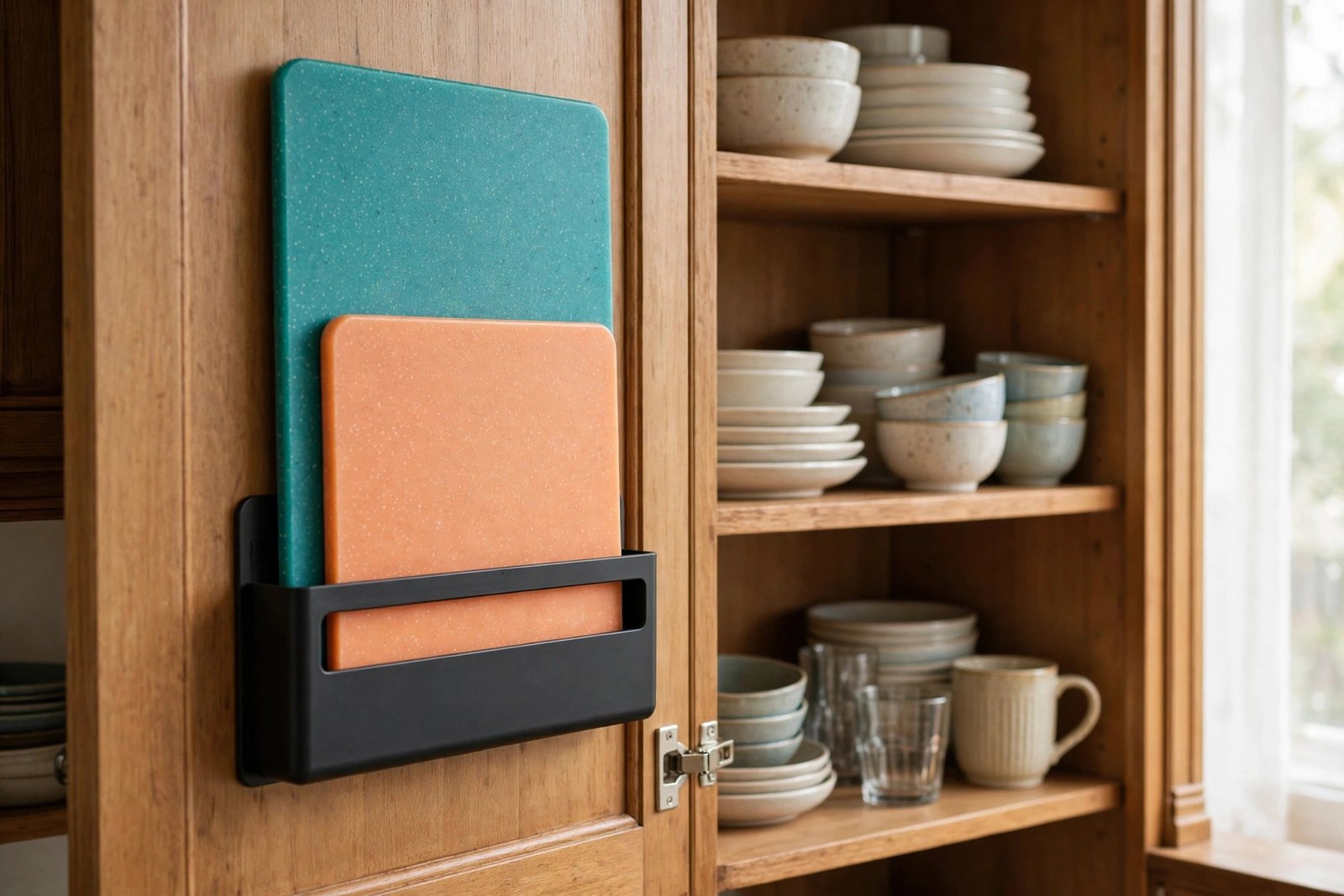
3. Joseph Joseph Folio Slim Under-Shelf Set — hooks on, but read the fine print
The Folio Slim set stores three color-coded boards in a tiered case that hooks onto a shelf, using the wasted space underneath it. The brand lists the case at about 2.8 × 12.4 × 8.9 inches, for units with a minimum internal size of 13 × 9.5 inches and a maximum shelf thickness of about 0.75 inch. Boards have stainless-steel selecting bars and non-slip feet, kept separated for airflow.
Here is the renter catch, stated plainly: the case hooks on but is secured at the back with two small screws, which are included. That makes it low-drill, not no-drill. If your lease bans screws, skip it. If two small screws are allowed, it is genuinely space-efficient — but measure first: a shelf over 0.75 inch will not fit the hook, and a cabinet under 13 inches inside will not fit the case.
Check latest price on Amazon
4. ORDORA Cutting Board Holder Stand — compact wire rack for counter or cabinet
This freestanding rack is made from 5 mm iron wire with non-slip silicone strips, holding boards, sheets, lids, and skillets upright in fixed slots. The brand states slot spacing of about 1.2 inches and warns buyers to measure thickness to ensure it is less than 1.2 inches — take that seriously, because fixed slots cannot be widened later. It needs no installation on a counter or in a cabinet.
Published dimensions conflict, so plan against the larger figure: one listing gives about 6.1 × 7.7 × 6.9 inches, while a comparison summary lists about 7.7 × 6.2 × 7.7 inches. Either way it suits two to four everyday boards, and at roughly 7 inches tall it supports boards low — very tall boards may lean. Choose it when all your boards are under 1.2 inches thick.
Check latest price on Amazon

5. ORDORA Expandable Cabinet Organizer — adjustable dividers for mixed thicknesses
Where the stand above uses fixed slots, this expandable rack uses movable dividers on a sliding base, so narrow slots for thin boards and wide slots for a thick board can share one cabinet. The listing describes 10 adjustable dividers on a base listed at about 8 × 23 × 6.2 inches at full extension, with anti-slip tubing and protective strips. Similar models adjust from roughly 12 inches up, so confirm widths for the exact variant you order.
The fit check is interior width and depth: at least as wide as your chosen setting, plus about 8 inches of depth and room to lift boards out. In a narrow 12-inch cabinet it holds only a few boards, and a compact fixed rack may serve you better. In a wide base cabinet with boards, pans, and lids together, adjustable dividers are the most flexible no-install option here.
Check latest price on Amazon
6. YIGII Adhesive Cabinet Door Set — small baskets plus board holders
This set combines adhesive door baskets with dedicated board holders, aimed at lids, thin boards, and small sheets. The brand lists three baskets — large about 8.6 × 3.6 × 4.7 inches, medium 8.2 × 2.7 × 4.7, small 7.8 × 2.3 × 4.7 — and a holder at about 7.7 × 2.8 × 1.6 inches. Installation is by adhesive pads, with screw holes as an alternative. The brand warns to allow about 8 cm (roughly 3.2 inches) between partitions and doors — that clearance note is the whole ballgame with adhesive door storage.
Two honest limits. The baskets are shallow (2.3 to 3.6 inches deep), so they suit lids, thin mats, and slim boards, not thick boards or large pans. And listings disagree on contents: specifications list 3 baskets and 1 holder, the description lists 3 organizers and 2 holders — confirm the count before ordering. Within those limits, the set claims door space in cabinets too tight for a full-size basket.
Check latest price on Amazon
Side by side
Swipe sideways to see all columns →
| Product | Where it lives | Install | Board thickness | Footprint (brand figures) | Clearance to check | Check latest price |
|---|---|---|---|---|---|---|
| Simple Houseware Over Cabinet Door Organizer | Inside door | Over-door hooks | Thin to medium (basket ~2.9 in deep) | 3.75 D × 12.75 W × 18.5 H in | ~19 in height, ~4 in door gap | Check latest price on Amazon |
| Joseph Joseph DoorStore Chop | Inside door / wall | 3M VHB adhesive | Its own 2 thin boards only | 13 5/8 × 9 3/4 × 7/8 in incl. boards | Flat clean surface; 7/8 in case | Check latest price on Amazon |
| Joseph Joseph Folio Slim Under-Shelf | Under shelf | Hooks on + 2 screws | Its own 3 boards only | 2.8 H × 12.4 W × 8.9 D in | Shelf ≤0.75 in; interior ≥13 × 9.5 in | Check latest price on Amazon |
| ORDORA Cutting Board Holder Stand | Counter / cabinet | None | Under 1.2 in (fixed slots) | ~6.1–7.7 D × 7.7 W × 6.9–7.7 H in (conflict) | Counter depth; tall boards lean | Check latest price on Amazon |
| ORDORA Expandable Cabinet Organizer | Inside cabinet | None | Adjustable dividers | ~8 D × up to 23 W × 6.2 H in | Interior width; ~8 in depth | Check latest price on Amazon |
| YIGII Adhesive Cabinet Door Set | Inside door | Adhesive pads | Thin boards / lids (2.3–3.6 in deep) | Baskets to 8.6 × 3.6 × 4.7 in; holder 7.7 × 2.8 × 1.6 in | ~3.2 in door gap; count conflicts | Check latest price on Amazon |
When to skip a holder entirely
Skip a door-mounted holder if your door will not latch with a test board taped inside it — no holder fixes a door that is already tight. Skip adhesive options if your doors are textured, damaged, or greasy, because pads need a smooth surface. Skip fixed-slot racks if your thickest board is over the slot width; forcing it bends dividers or scars the board. And skip any under-shelf case that needs screws if your lease bans them — two small holes still count at move-out inspection.
If nothing fits, no-buy options remain: a sturdy magazine file or office file sorter inside a cabinet works like a board rack, two short tension rods create instant dividers, and a single wood board can live upright against the backsplash as long as it stays dry.
Measurement checklist
- Thickest board (feet, handle, rim included) — under the slot width?
- Tallest board — stands inside with the door closed?
- Door gap — shelf edge to closed door, thickest board in place?
- Door thickness — fits over-door hooks?
- Clear height — about 19 inches for full-height door baskets?
- Shelf thickness — at or under the hook limit?
- Cabinet interior — width and depth at your chosen rack setting?
- Counter — depth plus lift-out height under wall cabinets?
- Surface — clean, flat, and dry for anything adhesive?
FAQs
Will an over-door basket stop my cabinet door from closing? It can, which is why the door-gap measurement matters. Basket plus boards must fit between the shelf edge and the inside of the closed door. Test with your thickest board before you commit — if the door will not latch, choose a slimmer holder or a freestanding rack.
Can I store a thick butcher block in these holders? Generally no. Door cases, adhesive baskets, and fixed-slot racks here top out around 1.2 inches or hold only their own thin boards. A block 1.5 inches or thicker needs an adjustable-divider rack with a wide slot, or its own spot on the counter.
Is adhesive storage safe for rental cabinets? Pads are removable in principle, but removal can lift paint or finish on delicate surfaces, and heat and steam weaken adhesive over time. If your deposit depends on pristine cabinets, prefer over-door hooks or freestanding racks, which leave nothing behind.
Under-shelf or door-mounted: which saves more space? They save different space. Under-shelf cases use the zone beneath a shelf but need the right shelf thickness and, for the Folio Slim, two screws. Door-mounted holders use the door gap but need clearance. Measure both zones; many small kitchens have one that works and one that does not.
How do I keep boards from smelling or warping in storage? Dry boards before storing them, keep them upright and separated so air reaches both faces, and wipe out the holder regularly — crumbs and water collect at the bottom of any rack. Never put a wood board back into a tight case while damp.
Keep Reading
- Will It Fit? The Cabinet Measurement Worksheet — the measure-first method used in this guide.
- Organize a Small Kitchen Without Drilling — renter-safe fixes, no landlord permission needed.
- Blind Corner Cabinet Storage Without Drilling — claiming the dead corner next to your board cabinet.
- Galley Kitchen Organization Zones — zoning a narrow room so every cabinet earns its keep.