

A countertop ice maker sounds like a small appliance. In a small kitchen, it rarely behaves like one. The box is roughly the size of a bread maker, it runs for hours, it hums, it drops ice into a plastic basket, and it needs open air around it to work properly. Put it in the wrong spot and you lose a full strip of counter or listen to it cycle all evening.
This guide is built around the four measurements that decide whether an ice maker fits your kitchen: depth, height, ventilation, and noise. It also starts with the mistake most roundups make: they sort machines by width and call the narrowest one “compact.” Narrow is not shallow. A machine can be under 10 inches wide and still need 14 inches of depth plus clearance — more counter than a galley kitchen can spare. Below, every product is listed with its full footprint, and every place where published figures conflict is flagged in the text.
As an Amazon Associate, HomeXWander earns from qualifying purchases made through links on this page — at no extra cost to you.
Narrow is not shallow: the footprint trap
Ice makers are usually advertised by width because width is the smallest, friendliest number. Depth is where small kitchens get caught. A standard counter is about 24 to 25 inches deep. A machine that is 14 inches deep leaves roughly 10 inches in front of it — before you add the clearance its manual asks for, the power cord, and room to pull the basket out.
Height is the second trap. The gap between a countertop and the bottom of upper cabinets is often around 18 inches, but it is not a standard you can assume — older kitchens, soffits, and under-cabinet lighting all eat into it. A machine that is 13 inches tall fits under an 18-inch gap on paper, but you still need to open its lid, lift the basket out, and pour water in from a pitcher. If you have to drag a 15- to 20-pound machine forward every time you refill it, it does not really fit.
So measure three things before you look at ice shapes: counter depth from backsplash to edge, counter-to-cabinet height at the exact spot, and the width of the free strip you can honestly give up. Then compare those numbers to the full footprint — width × depth × height — plus clearance.
Measure first: four numbers decide everything
1. Depth, with the cord and clearance included. Published depth is the body only. Behind the body sits a power cord that cannot be crushed flat, and most manuals ask for open space at the back and sides so the condenser fan can move air. EUHOMY’s manuals for this class ask for at least 4 to 5 inches of clearance around the unit. Add that to the body depth and a “compact” 11-inch-deep machine can want 15 inches or more of counter. Measure from the backsplash, and leave the front edge clear so the basket can slide out without tipping the machine.
2. Height, with the lid open. Measure counter-to-cabinet height at your spot, then subtract the machine’s height. What is left is your working room. Top-fill designs and removable top covers need several inches above the machine to open fully and pour without spilling. A machine that clears the cabinet by an inch but cannot open its lid in place will live pulled forward on the counter. If your gap is tight, a shorter bullet-ice machine beats a taller nugget machine every time.
3. Ventilation and heat. A countertop ice maker is a small refrigerator: a compressor and fan reject heat into your kitchen while the inside gets cold. Block the side or rear vents — pushing the unit flush against a backsplash or into a corner — and the machine works harder, makes ice more slowly, and runs its fan longer. Keep the vents clear and away from the stove and direct sun, and clean the vent area regularly.
4. Noise, honestly. Brand noise figures for this class are claims, not guarantees, and they usually describe steady running — not the loudest moment, which is ice dropping into an empty plastic basket. One listing here claims under 45 dB; treat that as a best-case brand figure. What you will actually hear is three sounds: a low compressor hum, a fan, and intermittent clatter as each batch drops. If the machine will sit near a bedroom door or an open-plan sofa, run it when you are out or awake, make ice ahead, and store it in the freezer.
Weight matters too. The machines below run from about 13 to 21 pounds by brand figures — light enough to move for cleaning, heavy enough that you will not move it twice a day. Pick a permanent spot that passes all four measurements.
The machines, measured
1. EUHOMY 26 lb bullet ice maker with handle — the shallowest, shortest option
This is the classic portable bullet-ice design: a handled box that makes 9 bullet cubes per cycle, rated by the brand at up to 26 pounds per day, with a 1.2-liter tank and a basket that holds about 1.3 pounds at a time. For a small kitchen its appeal is the footprint — but here is the caution: sources disagree on which number is the height. One listing gives the size as 11.57 × 11.42 × 8.74 inches with the 8.74-inch figure as height, while the manual’s specification table lists depth × width × height as 11.42 × 8.74 × 11.57 inches, which would make it 11.57 inches tall. Those are very different machines under a cabinet. Confirm the height on the exact listing before you order; if the shorter figure is right, this is the easiest under-cabinet fit in the guide. The brand claims under 45 dB in normal operation — a claim, not a measurement. At about 13 pounds with a carry handle, it is also the easiest to move or put away between uses.
Check latest price on Amazon
2. EUHOMY 34 lb nugget ice maker with handle — chewable ice, still counter-friendly
If you want soft, chewable nugget (sonic-style) ice without giving up the counter, this handled EUHOMY is the middle option. The brand rates it at up to 34 pounds per day with a 1.2-quart tank, a removable 1.8-pound basket, first ice in about 6 to 8 minutes, and a removable top cover with auto-cleaning. The footprint is about 9.5 inches wide × 11.6 inches deep × 13 inches high by listing figures — but the width and depth figures are swapped between two listings of the same model, so plan around the larger number in each direction: roughly 11.6 inches of depth and 13 inches of height, plus the 4 to 5 inches of ventilation clearance EUHOMY manuals ask for. Under an 18-inch cabinet gap, 13 inches of height leaves about 5 inches to open the top cover and refill — workable, but measure your gap. At about 19.6 pounds it is noticeably heavier than the bullet model above, so treat it as a semi-permanent resident. Published wattage figures conflict sharply between listings, so check the rating on the listing.
Check latest price on Amazon
3. EUHOMY 40 lb nugget ice maker — more ice, more depth
The larger EUHOMY nugget model raises the brand rating to up to 40 pounds per day, with first ice in about 7 minutes by listing figures. The cost is size: about 9.8 inches wide × 13.8 inches deep × 14.9 inches high. That depth is the decision. On a 24-inch counter, 13.8 inches of body plus rear clearance and a cord leaves a thin working strip in front — fine on a dedicated beverage station, cramped on a galley run where the same counter holds a cutting board. Height matters too: at 14.9 inches, an 18-inch cabinet gap leaves about 3 inches overhead, which is tight for lifting a top cover and pouring water. This is the pick when you regularly serve a household and can give the machine a permanent, ventilated spot — not the pick for a counter you also cook on. Keep the side and rear vents clear; nugget machines slow down when they cannot shed heat.
Check latest price on Amazon
4. Frigidaire 33 lb touchscreen nugget ice maker — check the height twice
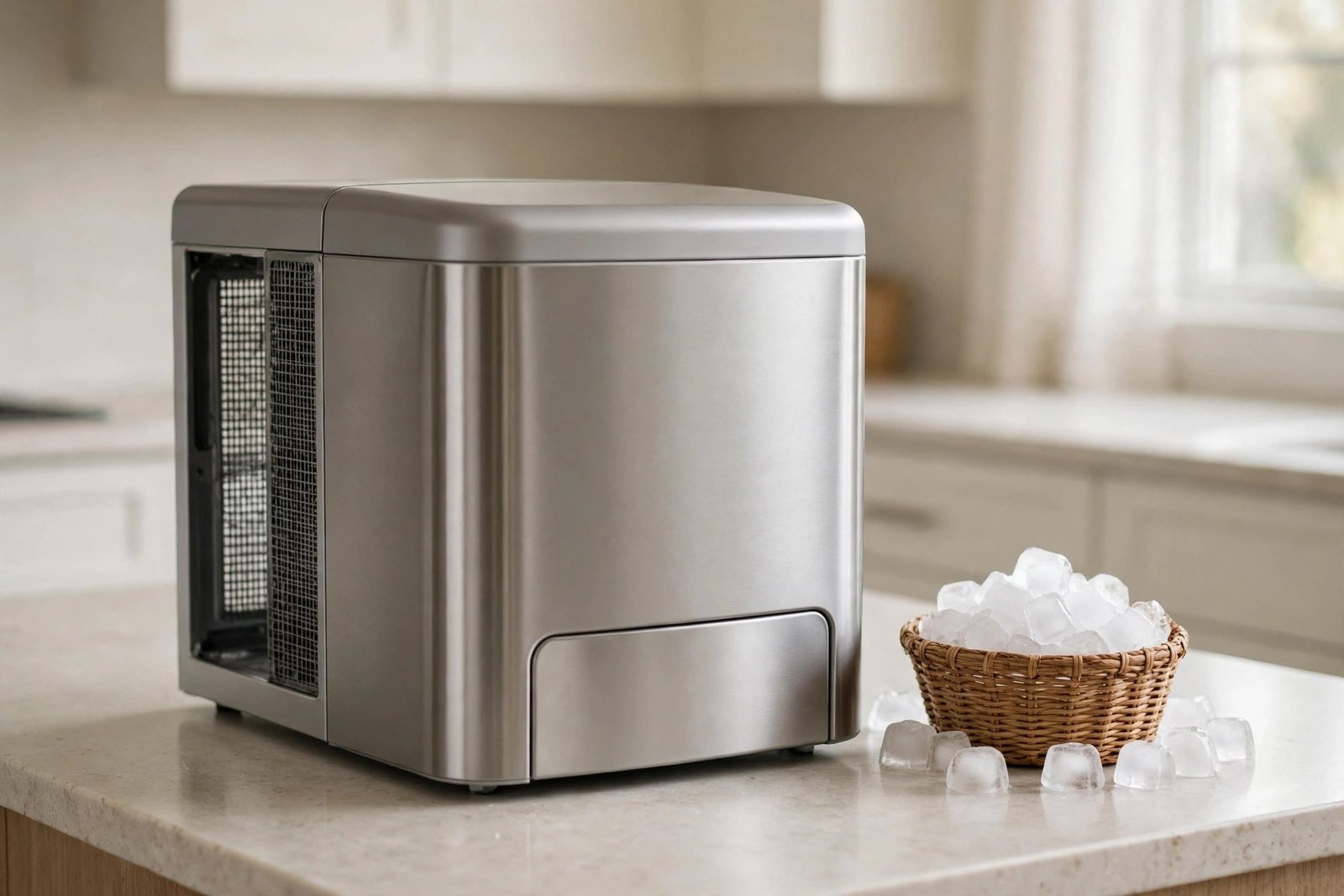
Frigidaire’s touchscreen nugget model is rated by the brand at 33 pounds per day with auto self-cleaning, and it is the cautionary tale of this guide. Listing figures put it at about 11.75 inches wide × 16.75 inches deep × 20.25 inches high, at about 21.5 pounds. Read that height again: 20.25 inches will not fit under a typical 18-inch upper-cabinet gap at all. This machine needs an open counter run with nothing above it, a kitchen island end, or a sturdy cart — and 16.75 inches of depth plus clearance is most of a standard counter. None of that makes it a bad machine; it makes it the wrong shape for the under-cabinet spot most small kitchens have. If you have an open stretch of counter and want nugget ice with a touchscreen, measure the full 20-plus inches of height first. If your only spot is under cabinets, cross this one off.
Check latest price on Amazon

Side by side
Swipe sideways to see all columns →
| Product | Ice type | Output (brand figures) | Footprint W × D × H (in) | Under-cabinet fit | Check latest price |
|---|---|---|---|---|---|
| EUHOMY 26 lb with handle | Bullet | Up to 26 lb/day; 9 cubes/cycle | ~8.7–11.4 × 11.4–11.6 × 8.7 or 11.6 (sources conflict on height) | Best chance — confirm height first | Check latest price on Amazon |
| EUHOMY 34 lb nugget with handle | Nugget | Up to 34 lb/day; 1.8 lb basket | ~9.5 × 11.6 × 13 (W/D swapped between listings) | Fits an 18-in gap with ~5 in to spare | Check latest price on Amazon |
| EUHOMY 40 lb nugget | Nugget | Up to 40 lb/day | ~9.8 × 13.8 × 14.9 | Tight — ~3 in overhead in an 18-in gap | Check latest price on Amazon |
| Frigidaire 33 lb touchscreen nugget | Nugget | 33 lb/day | ~11.75 × 16.75 × 20.25 | No — taller than an 18-in gap | Check latest price on Amazon |
All footprints are brand/listing figures; add 4–5 inches of clearance and room for the cord before comparing to your counter.
When to skip a countertop ice maker
Skip it if your only free counter is also your only prep space — an ice maker plus clearance can take a third of a galley run. Skip it if the only spot is under cabinets and the machine you want is taller than the gap with its lid open; no feature fixes geometry. Skip it if you need silence at night in a studio and have no freezer space to bank ice made during the day. And skip it if your household rarely uses ice: trays in the freezer are free, silent, and take no counter at all.
Measurement checklist
- Counter depth: backsplash to front edge, at the exact spot.
- Cabinet gap: counter to cabinet bottom, minus any under-cabinet lighting.
- Free width: the strip you can give up permanently, not just today.
- Footprint math: body depth + 4–5 inches clearance + cord bend, versus your counter depth.
- Lid room: machine height + room to open the cover and pour, versus your cabinet gap.
- Vent path: side and rear vents clear of walls and corners?
- Noise plan: distance to bed or sofa — and a freezer shelf for banking ice?
- Outlet: a grounded outlet within cord reach, clear of sink and stove.
FAQs
Will a countertop ice maker fit under standard kitchen cabinets? Sometimes. The gap is often around 18 inches, but measure yours. Here, the 26 lb bullet model (if its shorter height figure is confirmed) and the 34 lb nugget model fit with working room; the 40 lb nugget model is tight; the Frigidaire touchscreen model at about 20.25 inches tall does not fit at all. Height with the lid open is the number that counts.
How much ventilation space does an ice maker really need? EUHOMY manuals for this class ask for at least 4 to 5 inches around the unit. Treat that as the planning figure: add it to the body depth and width before you decide a spot works. A machine pushed flush to a backsplash makes ice more slowly and runs its fan longer.
Are nugget ice makers louder than bullet ice makers? Both use a compressor and fan, and both make noise when ice drops into the basket. Brand decibel claims describe steady running at best. Run the machine when the room is in use, bank ice in the freezer, and switch it off at night in a studio.
Bullet or nugget ice for a small kitchen? Bullet machines in this class tend to be shorter, lighter, and easier to move or store; nugget machines tend to be taller, deeper, and heavier but make the soft, chewable ice many people prefer. In a small kitchen, let the footprint decide first and the ice shape second.
Can I keep an ice maker on a rolling cart instead of the counter? Yes, if the cart is sturdy, level, and rated for the weight with water added — roughly 13 to 21 pounds for the machine plus water and ice. A cart also solves the under-cabinet height problem for taller models, as long as the vents stay clear and the cord reaches an outlet safely.
Keep Reading
- Will It Fit? The Cabinet Measurement Worksheet — the measure-first method used in this guide.
- Mini Air Fryer Footprint and Storage — the same depth-and-clearance math for another counter appliance.
- Best Countertop Dishwasher for an Apartment — when a counter appliance needs water and door swing, not just width.
- Organize a Small Kitchen Without Drilling — renter-safe ways to free the counter strip an ice maker needs.
- Galley Kitchen Organization Zones — zoning a narrow room so one appliance does not take the whole run.