

A juicer is the appliance most likely to be bought with good intentions and abandoned by week three. In a small kitchen, the reason is rarely the juice. It is the counter space the machine quietly eats once assembled, and the pile of sticky parts waiting in the sink afterward. The dimensions on the box describe the motor base — not the juicer with its jug under the spout, its pulp bin attached, and its food pusher raised.
This guide measures compact juicers the way a small kitchen experiences them: assembled footprint first, height second, cleanup third — how many parts come off and whether they can go in the dishwasher. Every figure below is a brand or listing figure, and where sources disagree, the disagreement is stated instead of smoothed over.
As an Amazon Associate, HomeXWander earns from qualifying purchases made through links on this page — at no extra cost to you.
Two kinds of compact juicer, two kinds of footprint
Centrifugal juicers spin produce against a fine strainer basket at high speed. They are fast, usually have wide chutes that take whole apples, and throw pulp into a bin. The cleanup catch is the strainer basket: the one part that typically needs a brush and a minute of attention, even when everything else is dishwasher-safe.
Masticating (cold press) juicers crush produce slowly with an auger. They tend to be quieter, often narrower, and their parts are simple shapes that rinse quickly. The catch is prep: narrow chutes mean produce gets cut into small pieces first, and juicing takes longer.
Neither type is automatically smaller. A centrifugal machine with pulp bin and jug attached can sprawl across more counter than a slim masticating model — or the reverse, if the masticating model parks two containers at two spouts. The footprint that matters is the assembled one.
Measure first: four numbers decide everything
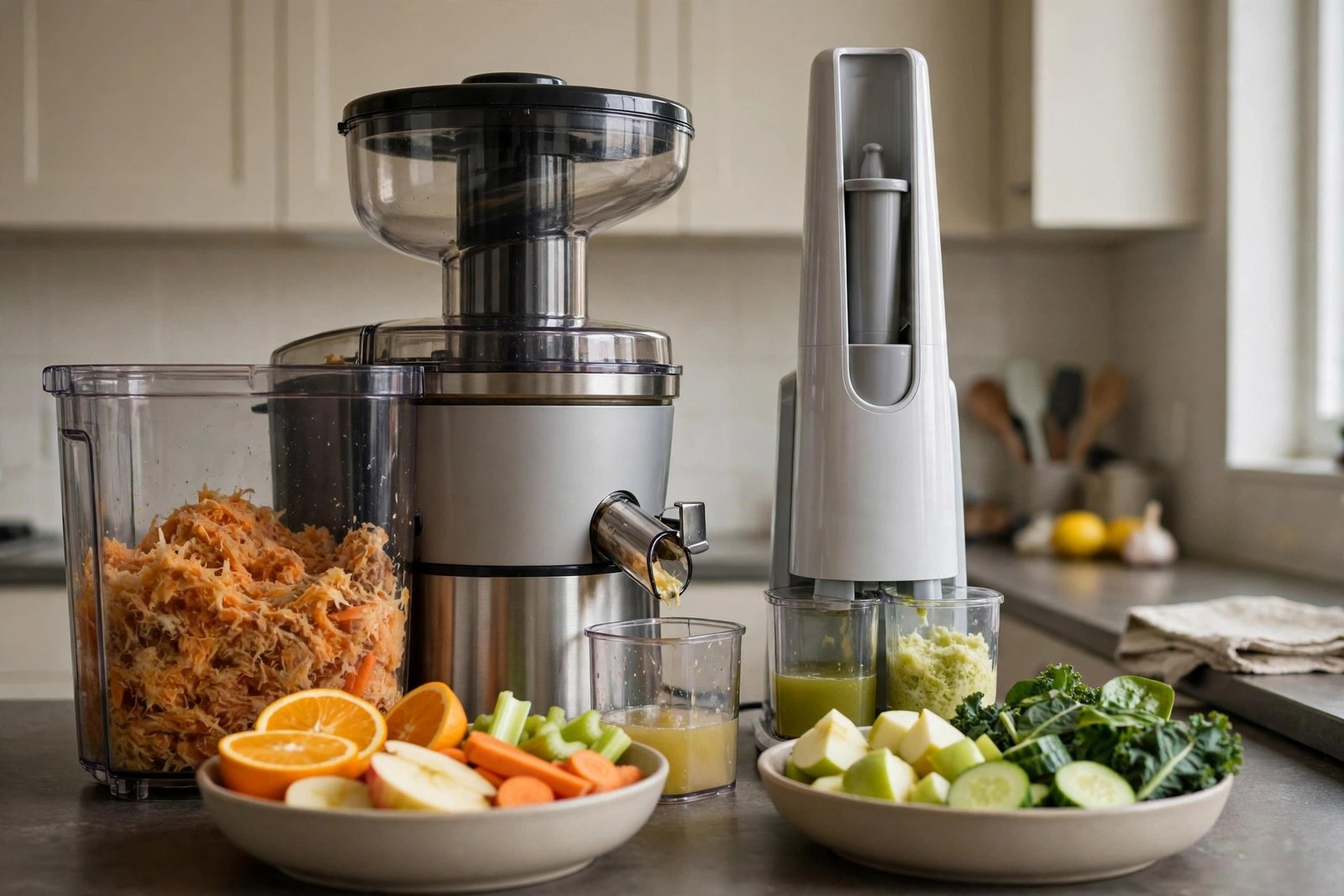
1. Assembled footprint. Measure the depth and width of the spot you can actually give up — then compare it against the machine with everything attached. Some designs collect pulp inside the body footprint; others put a pulp container beside the base and a jug under the spout. A juicer listed at 9 inches wide can occupy 14 inches of counter once its containers are in place. Check where the cord exits, too.
2. Height, with the pusher up. Under-cabinet clearance in many kitchens is around 18 inches, but measure yours — older cabinets and under-cabinet lights eat into it. These juicers stand about 11 to 16 inches tall by listing figures, but the working height is taller: the food pusher rises above the chute while you feed produce. If the machine will live under a cabinet, confirm you can load it without pulling it out every time.

3. Chute width versus prep time. A 3-inch chute swallows whole apples. A 2.4-inch chute takes most produce with light cutting. The smallest masticating models here have chutes under an inch wide, so everything gets cut small first. In a small kitchen, prep space is counter space too.
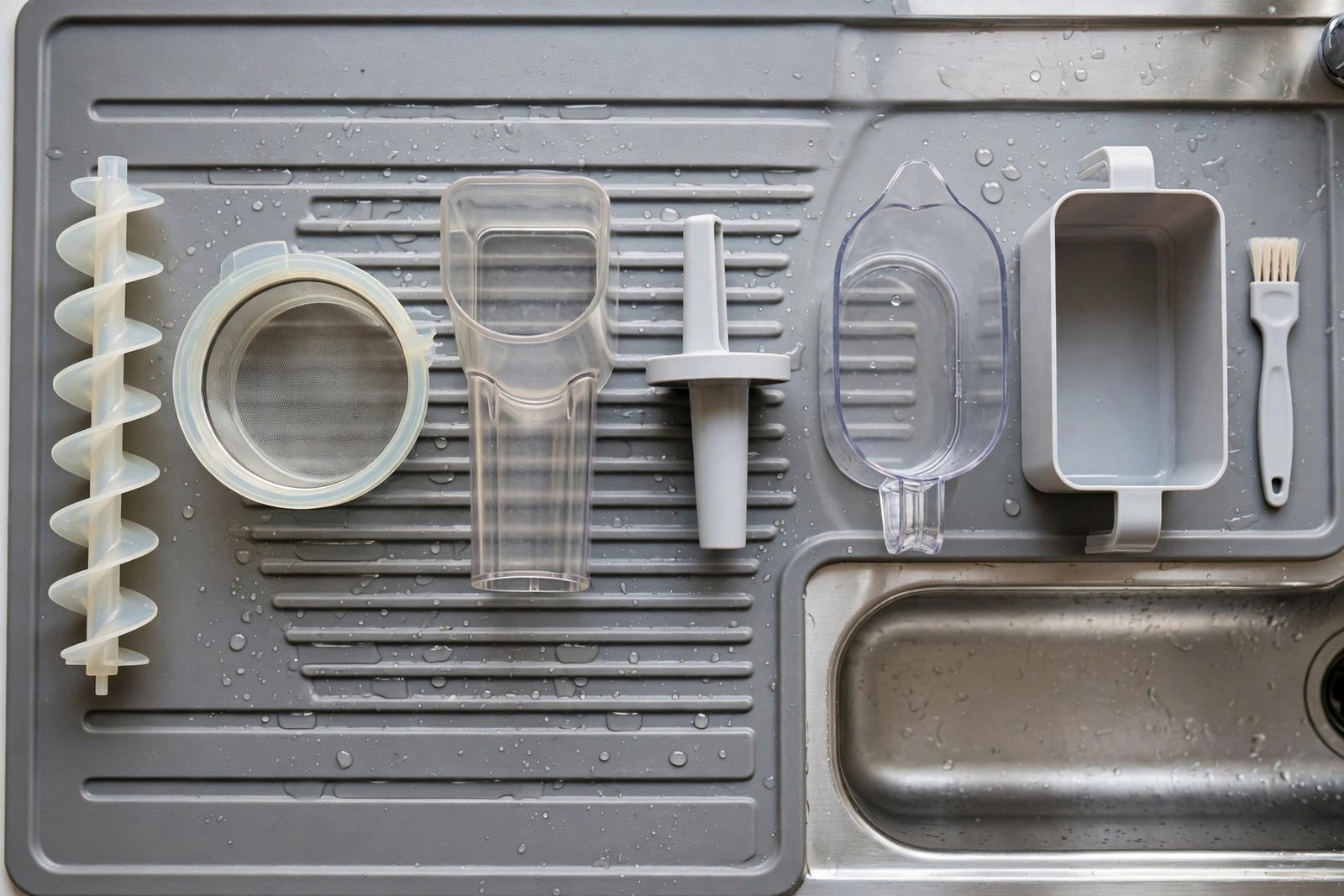
4. Parts to wash. Count what comes off: chute, pusher, auger or strainer basket, jug, pulp container, drip tray. The simplest machines here have three removable parts; centrifugal models have more, plus a strainer basket to scrub. Then check the fine print: “dishwasher-safe” sometimes covers only some parts, and one mini here is hand-wash only. The honest question is not “is it easy to clean?” but “will I wash these parts on a tired Tuesday?”
The juicers, measured
1. Breville Juice Fountain Compact BJE200XL — pulp stays inside the footprint
The Breville BJE200XL is a 700-watt centrifugal juicer with a 3-inch feed chute, a 25-fluid-ounce juice jug, and a 1.6-quart pulp container. Its small-kitchen advantage is where the pulp goes: the container collects pulp within the machine’s footprint instead of in a separate bin beside it, so the assembled depth stays closer to the listed depth. The listing gives dimensions of 9.84 inches deep × 9.06 inches wide × 15.75 inches high and a weight of 8.38 pounds; other sources list the same machine at roughly 16 × 9.5 × 8.75 inches and 9 to 11 pounds, so treat the exact numbers as approximate and confirm on the listing. Removable parts are dishwasher-safe per the listing, the cord stores in the base, and the warranty is one year. This is the pick for whole-fruit feeding and fast juicing without giving up a second container’s worth of counter.
Check latest price (checked Nov 24, 2026; listed as a Black Friday deal ending Dec 2)
2. Ninja NeverClog JC151 — cold press with two containers to plan around
The Ninja NeverClog JC151 is a 150-watt masticating juicer listed at 12.11 inches deep × 7.15 inches wide × 15.93 inches high and 7.93 pounds — the tallest machine here, so check under-cabinet clearance with the pusher raised. It juices into a 24-ounce jug with a separate 36-ounce pulp container; both sit at the spouts, so your real footprint is the body plus those two containers. One caution: some variant listings quote a 30-ounce jug instead of 24 ounces, so confirm the jug size on the exact listing you order. Parts are dishwasher-safe per the listing, an anti-drip lever keeps the counter clean between glasses, and two pulp filters let you choose less pulp or lots of pulp. The cord is about 31.5 inches; warranty is one year. Choose it for cold-press juice in family-size batches, if you can give the containers their space.
Check latest price (checked Nov 24, 2026; listed as a Black Friday deal ending Dec 6)
3. Hamilton Beach Big Mouth 67601A — the wide chute, the big pulp bin
The Hamilton Beach Big Mouth 67601A is an 800-watt centrifugal juicer with a 3-inch chute and an extra-large 80-ounce pulp bin — you can juice a lot before emptying anything. Published dimensions conflict: the most common listing figures are 11.5 inches deep × 7.8 inches wide × 14.4 inches high at about 9.6 pounds, but some sources list the same numbers in a different order, and another gives roughly 14.5 × 10.75 × 7.75 inches. Measure against the largest interpretation before ordering. Removable parts — pulp bin, juice bowl, lid and pusher — are dishwasher-safe per the listing, and a strainer cleaning brush is included. No juice jug is included; juice flows into your own glass or jug, which saves a part to wash but means a container of yours lives at the spout. The warranty is three years, the longest here. This is the value pick for bigger batches, if the depth fits.
Check latest price (checked Nov 24, 2026)
4. Hamilton Beach HealthSmart Compact 67502 — short, light, pours into your glass
The HealthSmart Compact 67502 is the smaller sibling: a 400-watt centrifugal juicer listed at 6.5 inches deep × 8.4 inches wide × 12.7 inches high and 4.96 pounds. At under 13 inches tall it slides under most cabinets, and at about 5 pounds it is light enough to store in a cabinet and lift out. The feed chute is 2.4 inches — most produce fits with light cutting, though not whole large apples. The pulp container holds 7 cups, removable parts are dishwasher-safe per the listing, and the spout pours straight into a glass, so there is no jug to store or wash. It has a single speed. Pick this one when the juicer will live in a cabinet between uses and come out for a glass or two at a time.
Check latest price on Amazon
5. SIFENE Mini Slow Masticating JS3304 — narrow body, three parts to wash
The SIFENE Mini (model JS3304) is a masticating juicer listed at 9.06 inches deep × 5.12 inches wide × 11.02 inches high and 4.3 pounds — one of the narrowest and shortest machines here. It uses a dual feed chute (the wider opening is about 2 inches) and a 280-milliliter juice cup (about 9.5 ounces) with a 360-milliliter pulp container, so it is a single-serving machine. Cleanup is its selling point: three major detachable parts, described as dishwasher-safe in the listing. Two spec conflicts to know about: listings rate the motor at 100 or 150 watts and the speed at 90 or 101 RPM, so treat power figures as approximate. A reverse function helps clear jams, and the brand claims under-60-decibel operation. Choose it for one-person daily juice in a small cold-press footprint.
Check latest price on Amazon
6. Elite Gourmet EJX600 — the smallest footprint, the most prep
The Elite Gourmet EJX600 is a mini masticating juicer listed at just 3.25 inches deep × 3.25 inches wide × 12 inches high and 2.66 pounds — by listing figures, the smallest footprint here by a wide margin. It runs at 100 watts and 70 RPM, juices into a 16-ounce cup, and comes apart into only three removable parts plus a cleaning brush, with a separate pulp container. The trade-offs are real: the feed chute is only about 3/4 inch wide, so all produce must be cut into small pieces, and at least one source lists the parts as hand-wash only. This is the pick for a studio, dorm or RV counter where a full-size juicer cannot live — as long as you accept the chopping.
Check latest price on Amazon
Side by side
Swipe sideways to see all columns →
| Product | Type | Footprint D × W × H (in, listing figures) | Juice container | Cleanup (listing figures) | Price (checked Nov 24, 2026) |
|---|---|---|---|---|---|
| Breville Juice Fountain Compact BJE200XL | Centrifugal, 700W | 9.84 × 9.06 × 15.75 (sources conflict) | 25 fl oz jug; 1.6 qt pulp container inside footprint | Dishwasher-safe removable parts | Check latest price (Black Friday deal ends Dec 2) |
| Ninja NeverClog JC151 | Masticating, 150W | 12.11 × 7.15 × 15.93 | 24 oz jug + 36 oz pulp container (some listings say 30 oz jug) | Dishwasher-safe parts; anti-drip lever | Check latest price (Black Friday deal ends Dec 6) |
| Hamilton Beach Big Mouth 67601A | Centrifugal, 800W | 11.5 × 7.8 × 14.4 (axis order conflicts) | 80 oz pulp bin; no jug included | Dishwasher-safe parts; strainer brush included | Check latest price |
| Hamilton Beach HealthSmart Compact 67502 | Centrifugal, 400W | 6.5 × 8.4 × 12.7 | 7-cup pulp container; pours into your glass | Dishwasher-safe removable parts | Check latest price on Amazon |
| SIFENE Mini JS3304 | Masticating, 100–150W (listings conflict) | 9.06 × 5.12 × 11.02 | 280 ml cup + 360 ml pulp container | 3 detachable parts; dishwasher-safe per listing | Check latest price on Amazon |
| Elite Gourmet EJX600 | Masticating, 100W | 3.25 × 3.25 × 12 | 16 oz cup; separate pulp container | 3 removable parts + brush; hand-wash per one source | Check latest price on Amazon |
When to skip a juicer
Skip it if the assembled footprint — body plus jug plus pulp bin — leaves no room to prep food. Skip it if the parts will sit in the sink: a juicer not washed the same day becomes a juicer not used. Skip the minis if you juice for a family every morning; a 9.5- or 16-ounce cup means multiple rounds. And skip juicing altogether if you want smoothies — a blender keeps the fiber, needs one jar washed, and takes less counter.
Measurement checklist
- Counter spot: depth and width where the juicer will actually run.
- Assembled size: body plus jug plus pulp container, in working positions.
- Height: counter to the underside of cabinets or lights, pusher raised.
- Storage: cabinet interior height, depth and door swing — and the machine’s weight.
- Outlet: reachable within the cord’s length, on a circuit that can carry the motor.
- Sink plan: where parts will be washed; do they fit the dishwasher’s top rack?
- Prep space: room to cut produce to your chute’s size, next to the machine.
FAQs
Centrifugal or masticating for a small kitchen? It depends on which cost you mind more. Centrifugal models juice fast with wide chutes and less prep, but the strainer basket needs scrubbing. Masticating models are quieter and often narrower, with simpler parts to rinse, but narrow chutes mean more chopping. Measure the assembled footprint either way — type alone does not tell you the size.
How much counter does a compact juicer really need? More than the box says. Add the jug under the spout and the pulp container wherever it sits. A machine listed at about 9 inches wide can occupy 12 to 14 inches in use. Designs that collect pulp inside the body footprint, like the Breville, stay closest to their listed size.
Will a compact juicer fit under my cabinets? These models stand about 11 to 16 inches tall by listing figures, so most fit under typical 18-inch clearances — but the food pusher rises above the chute while juicing. Measure your clearance, add a few inches for the pusher, and if it is tight, choose a shorter model or a spot with open air above.
Are the parts dishwasher-safe? Mostly, with exceptions. The Breville, Ninja and both Hamilton Beach models list dishwasher-safe removable parts; the SIFENE Mini’s listing says the same. The Elite Gourmet mini is listed as hand-wash only by at least one source. Even so, expect to brush a centrifugal strainer basket by hand.
What size juicer do I need for one person? A single-serving cup of about 9.5 to 16 ounces — the SIFENE Mini and Elite Gourmet here — covers one glass in the smallest footprint. For two or more, step up to a 24- to 25-ounce jug model like the Ninja or Breville.
Keep Reading
- Mini Air Fryer Footprint and Storage — the same measure-the-assembled-size method, applied to air fryers.
- Best Mini Air Fryer for a Small Kitchen — start with the smallest appliances when counter space is the battle.
- Small Kitchen Setup Under Check latest price — a working small kitchen on a tight budget and a tighter counter.
- Organize a Small Kitchen Without Drilling — renter-safe ways to win back counter space.
- Best Countertop Dishwasher for an Apartment — if washing parts by hand is the deal-breaker, the other half of the fix.