

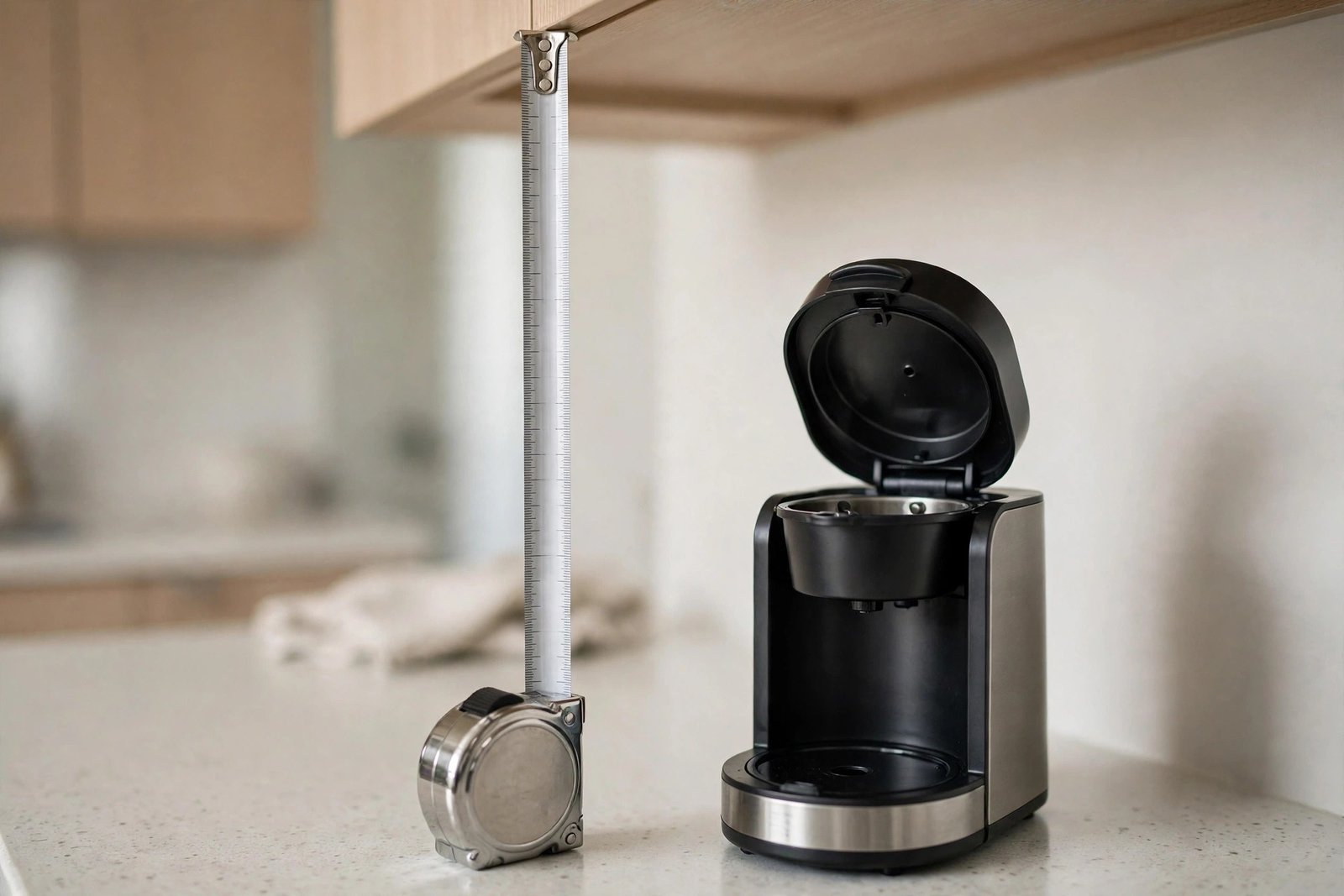
A compact coffee maker looks like an easy win for a small kitchen: same morning coffee, half the counter space. Then it arrives, and three problems show up. The carafe needs more depth to slide out than the box promised. The lid hits the underside of the cabinet when you open it to add grounds. And filling the water tank means dragging the whole machine forward every single day. None of those numbers are on the front of the box.
This guide is built around those three measurements — true counter depth including the carafe pull, lid-open height under your cabinets, and how the water tank actually fills. Every machine below is a 4- or 5-cup drip brewer: about 20 to 25 ounces, or two full 12-ounce mugs. Sizes are brand and listing figures, conflicts are stated where sources disagree, and where a brand does not publish a lid-open height, this guide says so instead of guessing.
As an Amazon Associate, HomeXWander earns from qualifying purchases made through links on this page — at no extra cost to you.
Measure first: three numbers decide everything
1. Counter depth, with the carafe pull. A coffee maker’s listed depth is the body only. To use it, the carafe slides forward out from under the brew head, and your hand needs room around the handle. So the working depth is body depth plus several inches of pull space in front. On a typical counter of about 24 to 25 inches deep, even the deepest machine here (about 12.3 inches) fits — the real question is what else shares that counter, and whether the machine can sit far enough back to leave you prep room in front of it. Measure from the backsplash to the counter edge, then subtract the machine’s depth and the carafe’s slide-out room.
2. Lid-open height. Closed height is the number brands publish; it is not the number that matters under a cabinet. A top lid swings up and back, so the machine needs more clearance open than closed — and the brands below do not publish an open-lid height. For scale, one review of a full-size 12-cup Mr. Coffee (about 13 inches tall closed) measured a little over 20 inches of clearance needed with its lid fully open. The compacts here stand about 10 to 11 inches closed, which leaves more headroom under a typical cabinet run, but measure your own counter-to-cabinet gap and plan on the lid needing several extra inches. If your gap is tight, a front-fill tank and a swing-out brew basket (see the Hamilton Beach below) matter more than any other feature.
3. Water-tank access. Most compact brewers fill from the top, under the same lid as the filter basket — fine on an open counter, annoying under a cabinet. Front-fill designs put the reservoir opening at the front, so you pour water in without moving the machine or opening the top. Also check the cord: several of these machines have cords around 24 inches, which decides how far from the outlet the machine can live.
One more honest note before the list: two of the starting points for this guide turned out not to be compact at all. A well-known Mr. Coffee 12-cup programmable and a Hamilton Beach 2-way 12-cup brewer both brew a full 60-ounce pot. They are fine machines, but at 12 cups they solve a different problem, so they appear below only as size contrasts, not as picks.
The machines, measured
1. Hamilton Beach 5-Cup FrontFill (46111) — narrowest body, easiest fill
If counter width is your tightest squeeze, this is the machine to beat: the brand lists it at 5.8 inches wide × 8.1 inches deep × 10.3 inches high, the narrowest footprint in this guide. Its real advantage is access. The FrontFill water reservoir fills from the front and the brew basket swings out, so under a cabinet you can add water and grounds without sliding the machine forward or fighting a top lid. It brews up to 5 cups (about 25 ounces, two large mugs) into a glass carafe, with a programmable clock, auto pause and pour, and a 700-watt heater by brand figures. A sibling model (46112) swaps the clock for smart-plug compatibility at the same listed size. Measure your cabinet gap anyway — the basket still swings — but of everything here, this one asks the least of your counter.
Check latest price on Amazon

2. Mr. Coffee 5-Cup Programmable Mini Brew — brew-now-or-later, with a size conflict to know
This is the programmable version of Mr. Coffee’s mini brewer: 25 ounces into a glass carafe with ounce markings, Brew Now or Later scheduling, Grab-A-Cup auto pause, water filtration, and a reusable nylon filter. Size is where you need care, because sources disagree. The brand’s own spec page lists 9.7 inches long × 6.4 inches wide × 10 inches high (about 3.2 to 3.4 pounds depending on variant), while the Amazon listing gives 7.1 inches deep × 9.65 inches wide × 10.63 inches high — figures that look like the width and depth axes have been swapped. Plan around the brand’s 9.7-inch depth, confirm on the live listing before you order, and keep the carafe pull in front of that number. Priced at Check latest price when checked on 24 Nov 2026 (a Black Friday deal ending Dec 1 — re-check before publishing).
Check latest price — Check latest price on Amazon
3. Mr. Coffee 5-Cup Mini Brew Switch — the simple one, cheapest to run
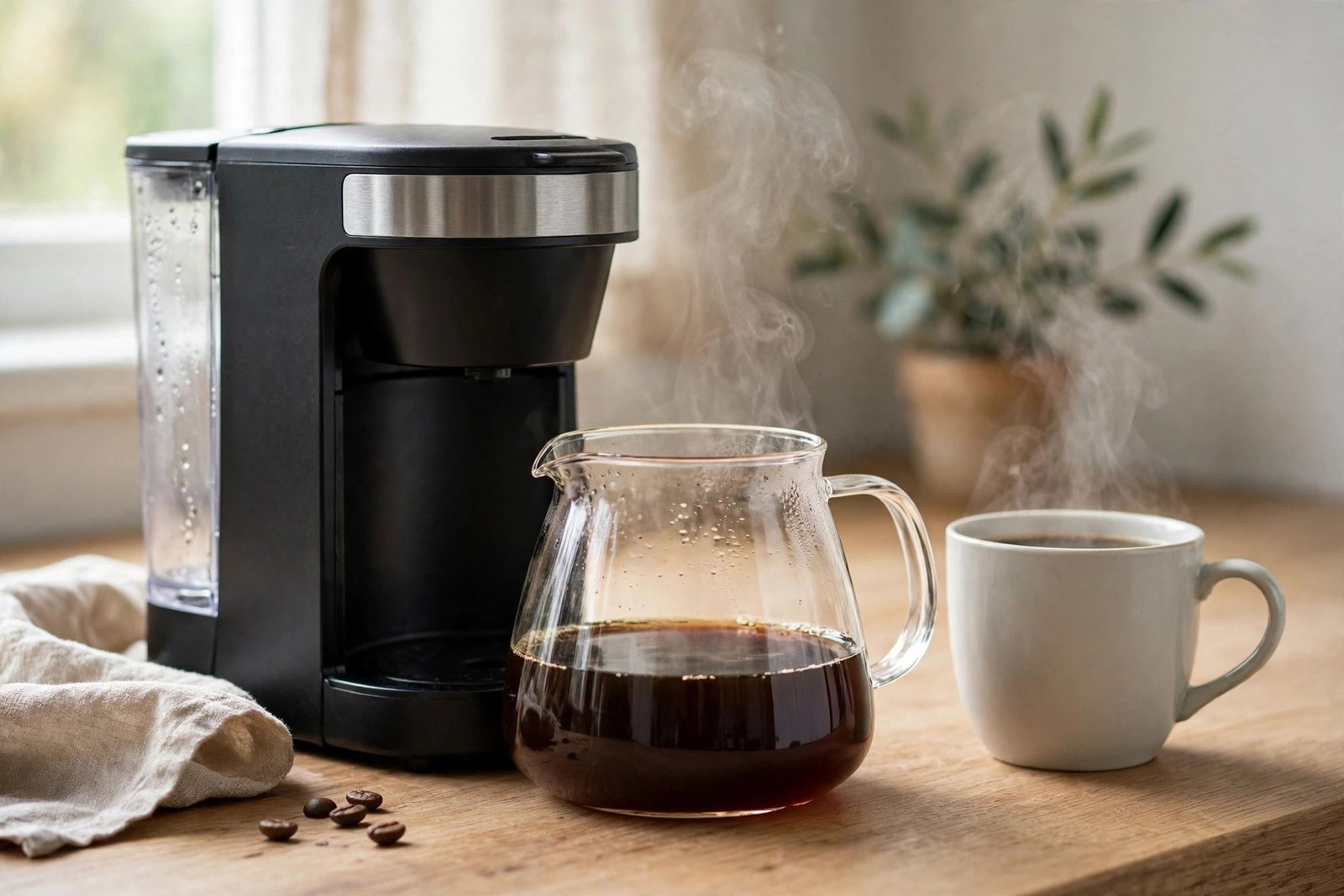
The Switch is the no-frills sibling: one switch, no clock, no programming. You get the same 25-ounce glass carafe, an easy-view water window, Grab-A-Cup auto pause, and a 2-hour auto shutoff. It is the pick if you brew on demand and want the fewest things to set or clean. Its listed dimensions need the same caution as its sibling: the Amazon listing gives 10.7 inches deep × 9.8 inches wide × 7.2 inches high, but a 7.2-inch height is not credible for a carafe brewer, so treat the listing’s axis order as unreliable and confirm the true height and depth on the live listing before relying on either number. Priced at Check latest price when checked on 24 Nov 2026 (a Black Friday deal ending Dec 1 — re-check before publishing).
Check latest price — Check latest price on Amazon
4. Cuisinart 4-Cup with Stainless-Steel Carafe (DCC-450BK) — metal carafe, smallest brew
The Cuisinart brews the least coffee here — 4 cups, about 20 ounces — and is the only pick with a stainless-steel carafe instead of glass, with a dripless pour spout and a knuckle guard on the handle. It has a brew-pause feature and shuts off automatically after 30 minutes. On size, every guide lists it at about 5.25 inches wide × 8 inches deep × 10 inches high (3.25 pounds); the Amazon listing prints the same three numbers with the axes rotated (8 deep × 10 wide × 5.25 high), so go by the guide orientation and confirm on the listing. One availability caution: at the time of writing, the Amazon listing showed this model as currently unavailable, so check stock before planning around it — the metal carafe is the reason to choose it, and it is also the reason it cannot be swapped for a glass-carafe lookalike without changing the pick.
Check latest price on Amazon
5. BLACK+DECKER 5-Cup Compact (CM0700B) — shallow body, glass carafe
The BLACK+DECKER is the shallowest body here. The brand lists 7.3 inches long × 8.2 inches wide × 10.8 inches high at 3.7 pounds, and the manual’s figures (about 7.25 × 8.2 × 10.75 inches) agree — a rare case of sources matching. It brews 5 cups (about 25 ounces) into a Duralife glass carafe, with a Sneak-A-Cup pause feature, an easy-view water window, a permanent filter option, and cord storage, running at 650 watts by the manual. That shallow depth is the point: on a counter where the machine must sit in front of a backsplash outlet or beside a toaster, 7.3 inches of body leaves the most working room in front for the carafe pull. The trade-off is width — at 8.2 inches it is wider than the Hamilton Beach — so measure the gap it will actually live in, not the counter in general.
Check latest price on Amazon
6. Bonavita 5-Cup Thermal (BV1500TS) — the step-up, and the deepest
The Bonavita is the enthusiast pick: a one-touch brewer with a double-wall stainless thermal carafe (no warming plate), #4 cone filters, and a 1,100-watt heater. It is also the deepest machine in this guide, which is exactly the counter-depth lesson. Most sources list 12.3 inches long × 6.2 inches wide × 10.6 inches high, while Consumer Reports lists 12 inches wide × 7 inches deep × 11 inches high — the axes disagree between sources, so plan on roughly a foot of depth in one direction and confirm the orientation on the live listing. Capacity figures also vary by source (about 25 ounces brewed into a roughly 1-liter carafe; some sources cite a 30-ounce tank). Choose it if coffee quality matters more than the last inches of counter, and give it a spot where a foot-deep machine plus carafe pull still leaves you room to work.
Check latest price on Amazon
Side by side
Swipe sideways to see all columns →
| Product | Capacity (brand figures) | Footprint W × D × H (in) | Carafe | Tank access | Price |
|---|---|---|---|---|---|
| Hamilton Beach FrontFill 46111 | 5 cups / ~25 oz | 5.8 × 8.1 × 10.3 | Glass | Front-fill reservoir, swing-out basket | Check latest price on Amazon |
| Mr. Coffee 5-Cup Programmable Mini Brew | 5 cups / 25 oz | ~6.4 × 9.7 × 10 (sources conflict) | Glass | Top-fill | Check latest price |
| Mr. Coffee 5-Cup Mini Brew Switch | 5 cups / 25 oz | Listing axes unreliable — confirm | Glass | Top-fill | Check latest price |
| Cuisinart DCC-450BK | 4 cups / ~20 oz | ~5.25 × 8 × 10 (listing axes rotated) | Stainless steel | Top-fill | Check latest price on Amazon |
| BLACK+DECKER CM0700B | 5 cups / ~25 oz | 8.2 × 7.3 × 10.8 | Glass (Duralife) | Top-fill | Check latest price on Amazon |
| Bonavita BV1500TS | 5 cups / ~25 oz | ~6.2 × 12.3 × 10.6 (sources conflict) | Stainless thermal | Top-fill | Check latest price on Amazon |
The 12-cup contrast: what “compact” is not
Two popular machines often land on compact lists by mistake. The Mr. Coffee 12-cup programmable brews a full 60-ounce pot and stands about 13 inches tall closed, with one review measuring a little over 20 inches needed with the lid open. The Hamilton Beach 2-way brewer adds single-serve brewing to a 12-cup glass carafe. Both are reasonable buys for a household that drinks a full pot; neither belongs in a small-kitchen footprint comparison, because the carafe alone needs the depth and height this guide is trying to save.
When to skip a compact drip brewer
Skip it if your household drinks more than about 25 ounces at a sitting — you will brew twice and resent the machine. Skip it if you only ever drink one mug and prefer pods; a single-serve machine has no carafe to pull and no pot to wash, though it trades counter space for pod storage. And skip any specific model whose listing dimensions you cannot confirm: as the conflicts above show, a rotated width-depth figure can put a machine in a gap it does not fit.
Measurement checklist
- Counter depth: backsplash to edge, minus machine depth, minus carafe slide-out room.
- Cabinet gap: counter to cabinet underside, with several extra inches for the lid swing.
- Width: the actual gap the machine will live in (beside the toaster counts).
- Tank access: can you pour water in where the machine sits, or must it slide?
- Outlet: cord length (about 24 inches on several models here) versus distance to the outlet.
- Carafe clearance: room in front to pull the carafe out and set it down full.
- Brew size: your real morning volume in ounces — 20, 25, or a full 60?
FAQs
What does “5 cups” actually mean? Coffee-maker cups are about 5 ounces, not 8. A 5-cup brewer makes about 25 ounces — two full 12-ounce mugs. A 4-cup model makes about 20 ounces. Size by ounces, not by the cup count on the box.
Will a compact brewer fit under my cabinets? Closed heights here run about 10 to 11 inches, which fits under most cabinet runs — but the lid still needs swing room, and brands do not publish an open-lid height for these models. Measure your counter-to-cabinet gap, and if it is tight, prefer the front-fill Hamilton Beach or plan to slide the machine out to fill it.
How much counter depth do I really need? The body depth plus room to slide the carafe forward and lift it clear. Bodies here run from about 7.3 inches (BLACK+DECKER) to about 12.3 inches (Bonavita). On a typical 24- to 25-inch counter, all of them fit; the difference is how much working room is left in front.
Glass or stainless carafe? Glass lets you see how much coffee is left and usually sits on a warming plate. Stainless (Cuisinart) and thermal (Bonavita) carafes hide the level but do not break, and the Bonavita’s thermal carafe keeps coffee hot without a plate. Choose by how you serve, not by looks.
I drink one mug a day. Is a carafe brewer still right? It can be — brew half a pot — but a single-serve machine removes the carafe entirely. The trade is pod cost and storage. If you brew for two most mornings, the 5-cup carafe machines above are the better fit.
Keep Reading
- Will It Fit? The Cabinet Measurement Worksheet — the measure-first method used throughout this guide.
- Best Mini Air Fryer for a Small Kitchen — the same footprint logic applied to air fryers.
- Galley Kitchen Organization Zones — zoning a narrow counter so appliances earn their depth.
- Organize a Small Kitchen Without Drilling — renter-safe fixes that need no landlord permission.