

Most closet-storage guides assume a hinged door. Yours folds. That one difference kills the most popular closet product on the internet — the over-door organizer — and most guides never mention it. So the organizer arrives, the hooks have nowhere to sit, and the whole thing goes back in the box.
The short version: a bifold door gives you three surfaces that are not the door — the closet rod, the inside frame and side walls, and the floor. Storage that hangs from the rod, wedges between the frame walls, or stands on the floor never touches the door, and that is exactly why it works. The door keeps folding, the pivot carries no extra weight, and nothing gets crushed between the panels.
This guide is a decision path: measure the fold and the closet first, then the storage, surface by surface.
As an Amazon Associate, HomeXWander earns from qualifying purchases made through links on this page — at no extra cost to you.
Step 1: Measure the fold and the closet
Write these down before you look at a single product — five minutes that decide storage versus return label.
- Fold clearance — open the doors fully and watch where the panels travel. They fold face to face, so anything on a panel’s inside face gets pressed against its twin. Measure the gap between the closed door’s inside face and the front of your hanging clothes: that is your total depth budget inside the closet.
- Closet depth — back wall to the inside of the closed door. A standard reach-in is about 24 inches deep, and clothes on hangers use roughly 22 to 23 of them — which is why floor storage has to be slim.
- Rod height and drop — floor to the underside of the rod, plus the length of your longest hanging item. A second rod or hanging shelf only works if the drop still clears the clothes above it.
- Clear floor strip — open floor between the back wall and where the panels sweep when they fold. Measure with the doors open and closed; the smaller number counts.
How the numbers map to surfaces: tall drop below the rod takes a rod doubler or hanging shelves. Side walls with a clear span take a tension shelf. A floor strip of 5 inches or more takes a slim cart; 9 inches or more takes a low shoe rack. If the fold clearance is under an inch and the floor strip is zero, skip to “When to skip” — the honest answer there is the room’s hinged entry door, not the closet.

Step 2: Why the door itself is out
There is no top edge to hang from. A bifold is built short so the track can mount in the header — common molded bifold panels list at 24 by 78 inches in an 80-inch opening. The top rail carries the pivot pin and roller guide, exactly where an over-door hook needs to sit. Decorumi’s laundry-closet guide puts numbers on it: hooks need roughly half an inch to an inch of gap above the door, while a bifold track eats about 1.5 to 2 inches of the opening and leaves no clearance at the top.
The panels fold face to face. Anything stuck to the inside face of one panel gets sandwiched against the other every time the door opens. HoneyEra’s bifold guide says it plainly: panels fold face to face, crushing whatever is on the inside face. Flat, soft items can survive; anything rigid or loaded cannot.
The weight lands on the pivot. Bifold hardware is rated by maximum panel weight — the bare door, not the door plus a loaded organizer. The pivot pin and roller guide are the failure point, which is why overloaded bifolds jump the track. A door that will not stay on its track is a worse problem than a messy closet.
So the door is out — as a surface, a hook, and a weight-bearer. What remains is everything inside the closet that never touches it.
The storage, surface by surface
How we chose these: we do not buy and bench-test every product, and never claim we did. We shortlist on published dimensions and fit, cross-check specs against listing and review sources, and state drawbacks plainly. Where no verified price exists, we quote none.
Simple Houseware Adjustable Closet Hanging Rod — best second rod under your existing rod
The rod surface in its simplest form: a chrome steel bar that hooks over your existing closet rod and hangs a second, lower rod beneath it. The width expands from about 18.75 to 30.5 inches in seven spring-locked steps, and the drop adjusts in 1-inch increments, so you set the lower rod to clear the shirts above it. No tools — hooks on, adjust, hang.
The drawbacks: the listing publishes no weight rating, so load it with everyday clothes, not heavy coats — and every pound on the lower rod is also a pound on the top rod and its brackets. It only doubles the section it covers, so a wide closet may need two. And it needs the drop to spare: shirts over shirts take roughly twice a shirt length of vertical room.

Simple Houseware 6-Shelf Hanging Closet Organizer — best shelves where there is no shelf
If the closet came with a rod and nothing else, this turns 12 inches of rod into six fabric shelves: about 12 inches wide by 12 inches deep by 54 inches tall, each shelf roughly 12 by 12 by 8.75 inches, with six mesh side pockets. It hangs from the rod on two hooks and folds flat when you move. The 12-inch depth is the number that matters — it sits within the depth hanging clothes already use, so the bifold panels never meet it.
The drawbacks: fabric shelves are for folded clothes and accessories — load them heavy and they sag, and there is no published weight rating. The 54-inch drop needs a rod high enough that the bottom shelf clears the floor or the shoe rack below it. And confirm the exact listing before ordering: this model appears under more than one ASIN in search results, so match the model number (BO-012-2) and dimensions, not just the name.
Check latest price on Amazon
Home in Bold Tension Rod Shelving — best shelf between the frame walls
For the side-wall surface: a full-metal shelf that pressure-fits between two walls or frame sides on two tension rods — no screws, nothing touching the door. The medium adjusts from 17 to 27 inches wide at 10 inches deep; a large covers 29 to 41 inches. The brand rates the system at up to 50 pounds — treat that as a brand figure, not a promise. It creates a shelf where the closet never had one: above the rod, or low over the floor strip.
The drawbacks: tension needs two solid, parallel surfaces — it will not hold on a single wall or a flimsy divider. The rods carry a yellow warning line: extend past it and the grip weakens, so buy the size that fits inside the range, not at its limit. And at 10 inches deep, hanging clothes must still clear it when the doors fold — measure the Step 1 depth budget first.
SPACEKEEPER Slim Rolling Storage Cart, 3-Tier — best floor unit for a 5-inch strip
The floor surface, at its slimmest: a three-tier plastic cart about 4.9 inches deep by 15.3 inches wide by 26.1 inches high, on four wheels, two lockable. Five inches of depth is the whole point — it stands between the back wall and the fold line and rolls out when you need the back tier. The listing rates it at up to 20 pounds per shelf; the manual’s maximum recommendation is 40 pounds total. Keep heavier items low.
The drawbacks: at under 5 inches deep, the shelves hold folded items, shoes and small boxes — not bulky bins. One color variant’s listing prints a smaller footprint (about 5 by 14.2 by 23.4 inches), so plan on the larger figures and confirm the variant before ordering. And the floor strip must be flat with the fold sweep clear — roll it in, close the doors, and check before loading it.
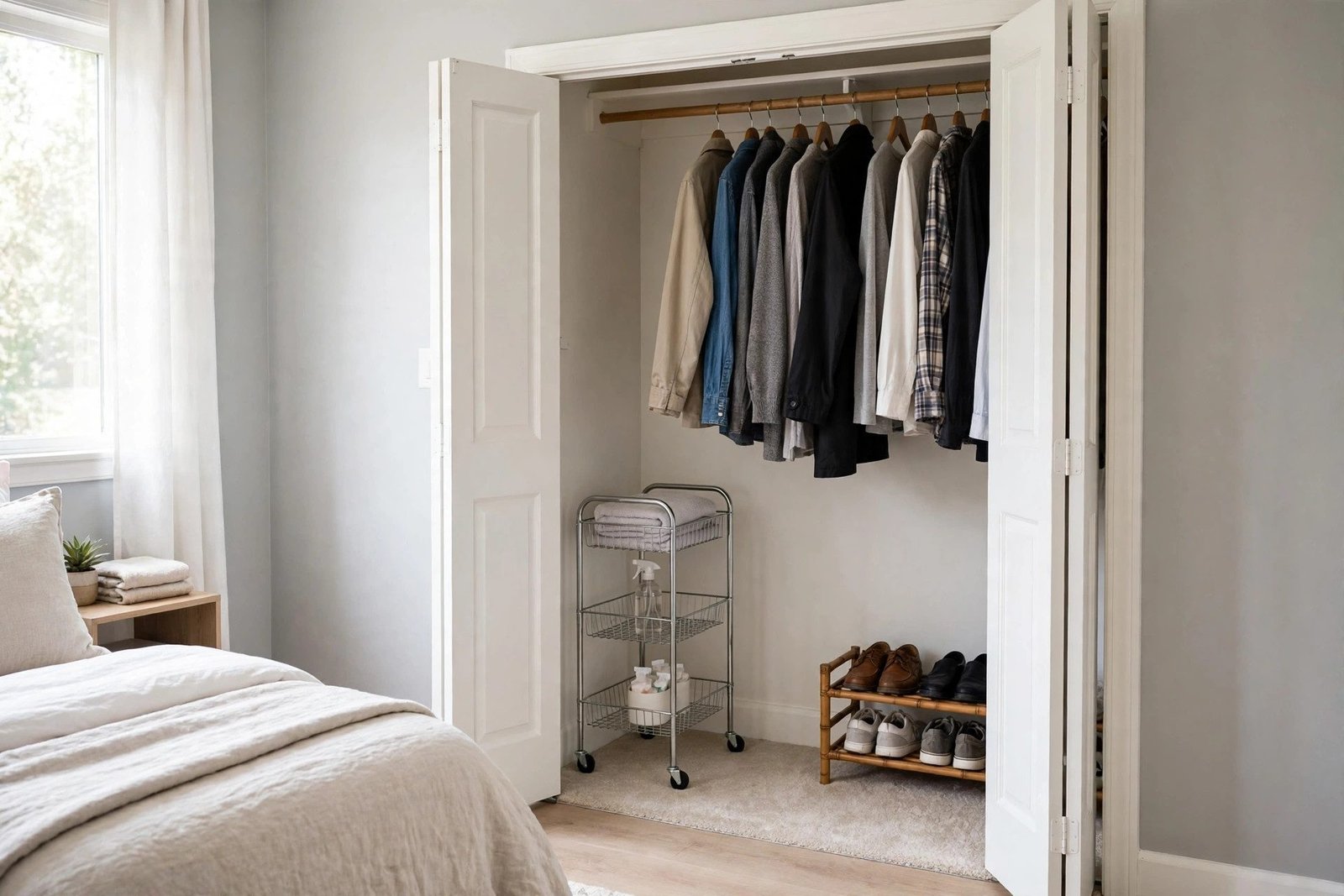
STORAGE MANIAC Expandable Shoe Rack, 2-Tier — best low rack under hanging clothes
For the floor strip under short hanging clothes: a two-tier metal shoe rack that expands from 17.7 to 32.3 inches wide, about 8.78 inches deep and 13.98 inches high, listed for up to 8 pairs. The expandable width is the fit feature — set it to the exact width between the closet walls instead of hoping a fixed size matches. At under 9 inches deep it stays inside the depth hanging clothes already occupy, so the fold never reaches it. Units stack for four tiers later.
The drawbacks: two tiers is a small collection’s worth — count your pairs first, and large shoes may overhang the depth. The height needs about 14 inches of clear space under your shortest hanging clothes. And the wider extended version is a different listing — confirm the 17.7-inch-base model before ordering.
Bifold-closet fit table
One row per checked product. “Clearance needed” is the Step 1 number that decides fit. “Check latest price” entries are deliberate — where no verified price exists, we quote none.
Swipe sideways to see all columns →
| Product | Surface it uses | Clearance needed | Approx price (dated) |
|---|---|---|---|
| Simple Houseware Adjustable Closet Hanging Rod — 18.75–30.5″W, drop in 1″ steps | Existing closet rod | Rod drop for two rows; no published weight rating | Check latest price |
| Simple Houseware 6-Shelf Hanging Organizer — 12″W × 12″D × 54″H | Existing closet rod | 12″ of rod width; 54″ drop; depth within clothes depth | Check latest price |
| Home in Bold Tension Rod Shelving — medium 17–27″W × 10″D | Between two frame/side walls | Span inside size range; two solid parallel surfaces | Check latest price |
| SPACEKEEPER Slim Rolling Cart, 3-Tier — 4.9″D × 15.3″W × 26.1″H | Closet floor strip | Floor strip ≥5″ deep, clear of fold sweep | Check latest price |
| STORAGE MANIAC Expandable Shoe Rack, 2-Tier — 17.7–32.3″W × 8.78″D × 13.98″H | Closet floor, under hanging clothes | Floor depth ≥9″; ≥14″ clear height | Check latest price |
Read the table against your four numbers. Tall rod drop and no shelves: the hanging organizer, or the rod doubler if everything hangs. Two solid side walls and a span under 27 inches: the tension shelf. A 5-inch floor strip: the slim cart. Nine inches of floor depth under short clothes: the shoe rack. Most bifold closets can take two at once — one on the rod, one on the floor — without the door ever knowing.
When to skip closet storage entirely
Skip door-mounted anything if the panels fold face to face with under an inch of clearance — most bifolds — because the fold will crush or scrape it, and the pivot was never rated for the weight. Skip the rod doubler if the top rod sags or its brackets are loose; doubling the load on a weak rod turns a storage problem into a repair. Skip the tension shelf without two solid parallel surfaces, or if the span sits at the very end of the size range. Skip floor units if the fold sweep crosses the whole floor strip — doors that cannot close are worse than a bare floor. And skip everything here if the real problem is volume: a closet holding twice what fits defeats any organizer. Declutter first, then measure, then buy once.
Your five-minute measurement checklist
Before you order, write down four numbers: fold clearance (closed door’s inside face to the front of your hanging clothes); closet depth (back wall to inside of closed door); rod height and drop; clear floor strip with the doors open and closed. Add one test: close the doors slowly and watch where the panels travel — anything you buy must stay out of that path. With those on paper, the table becomes a yes-or-no answer — and if it is “nothing fits,” you have saved the return postage.
Frequently asked questions
Can you put an over-door organizer on a bifold closet door? No — not reliably. A bifold has no free top edge for the hooks (the track and pivot hardware sit in the header), the panels fold face to face and crush anything on the inside face, and the extra weight lands on the pivot pin, rated for the bare panel. Use the rod, the frame walls, or the floor instead — or hang the organizer on the room’s hinged entry door.
How much clearance do bifold doors need to fold? Anything inside the closet must stay clear of the fold path and the closed door’s inside face. Measure the gap between the closed door and the front of your hanging clothes — that is your depth budget. Standard reach-in closets are about 24 inches deep and clothes on hangers use roughly 22 to 23 of them, which is why slim floor units (under 9 inches deep) are the safe buy.
Will a rod doubler damage my closet rod? It hangs from the rod, so its load adds to the rod’s load. The Simple Houseware doubler publishes no weight rating, so keep it to everyday clothes and check that the rod and brackets are solid first. If the rod already sags, fix that before doubling anything.
Do tension shelves work in a closet with no side walls? No. A tension shelf needs two solid, parallel surfaces to push against — side walls, frame sides, or a sturdy divider. In an open alcove with one wall, use a rod-hung organizer or a floor unit instead.
What is the slimmest storage that fits inside a bifold closet? The SPACEKEEPER cart at about 4.9 inches deep is the slimmest floor unit here; the hanging shelf organizer at 12 inches deep matches the depth hanging clothes already use. Both stay clear of the fold if your Step 1 measurements say so — the fold clearance decides, not the product.
Why do the dimensions differ between listings for the same product? Because listings are sloppy. The SPACEKEEPER cart’s gray variant prints a smaller footprint than the white one, and the Simple Houseware hanging organizer appears under more than one ASIN. Our rule: plan on the larger figure, match the model number and dimensions, and confirm the exact variant before ordering.
What if my closet has no rod at all? Then the floor and the frame walls are your surfaces: a tension shelf between the walls, a slim cart or shoe rack on the floor. If there are no two solid walls either, a freestanding garment rack outside the closet — or the room’s hinged door — is the honest answer.
Keep reading
- Closet Rod Doubler: Double Your Hanging Space — the full rod-doubler guide, with sag and weight limits.
- Closet Organizer Kit Under Check latest price — the budget closet build behind this article’s rod products.
- Will It Fit? The Cabinet Measurement Worksheet for Small-Kitchen Storage — the measure-first method behind every fit call here.