

A portable washing machine is one of the few appliances that can fail before you ever press start. The drum is rarely the problem. The problems are a faucet the adapter cannot thread onto, a drain hose that will not stay in the sink, a storage corner two inches too narrow, or a lease clause that bans the machine outright. Every one of those is checkable in about ten minutes with a tape measure and your lease — and every one of them is cheaper to discover now than after a 50-pound box arrives.
This guide is built in that order: permission first, faucet second, space third, capacity last. The machines at the end are sized against those measurements — a 0.9 cubic foot automatic for one person, mid-size automatics around 10 to 11 pounds for two, and a twin tub for the apartment where no faucet will adapt at all. Capacities and dimensions below are the brands’ published figures as found on 23 Nov 2026; where sources disagree, we say so. We do not buy and bench-test every machine, and never claim we did — this is a fit guide, not a wash-quality contest.
As an Amazon Associate, HomeXWander earns from qualifying purchases made through links on this page — at no extra cost to you.
Step 1: The lease check — before the faucet check
Read your lease for words like “washing machine,” “laundry,” “appliances,” and “water-using devices” before you shop. Landlords can generally prohibit tenant-owned portable laundry machines in a lease, for practical reasons: a failed hose connection can flood your unit and the one below, older plumbing may not handle the discharge volume, and some landlord insurance policies exclude damage from unauthorized appliances. A lease that bans “in-unit laundry” typically covers portable sink-hookup units too — needing no permanent plumbing does not automatically exempt it.
If the lease is silent or unclear, ask the landlord or property manager in writing and keep the reply. If the answer is no, the honest options are the building laundry room, a laundromat, or asking about a reasonable accommodation if a medical condition makes communal laundry genuinely difficult — get any approval in writing before a machine enters the apartment. A portable washer is a great renter appliance; it is a bad lease dispute.
Step 2: The faucet check — the measurement that decides the machine
Nearly every automatic portable washer fills through a quick-connect adapter that threads onto the faucet where the aerator screws out. That single fact sorts apartments into two groups:
- Your aerator unscrews (by hand or with cloth-wrapped pliers) and the spout has a standard thread: an automatic sink-hookup machine will work. The most common North American aerator threads are 55/64-inch-27 female and 15/16-inch-27 male; most included adapters are built around these, and adapter kits exist for others. Note whether your threads are inside or outside the spout, and compare against the manual’s compatibility list.
- Pull-out or pull-down spray head, sealed aerator, wall-mounted tub spout, or a designer faucet with unusual threads: most quick-connect adapters will not seat properly. Your options are a different tap (a bathroom basin with a threaded spout is the usual fallback), a rubber clamp-style universal adapter (less secure — test carefully), or a twin tub you can fill by bucket or showerhead, which needs no faucet connection at all.
Two more faucet-adjacent numbers. Hose reach: the machine sits on the floor and the faucet is up on the counter, so measure the path, not the straight line. BLACK+DECKER states the faucet must be within 4 feet of the back of its 0.9 washer to match the included inlet hose; Panda lists a 39-inch inlet hose and a 55-inch drain hose on its 1.34 model. If your only storage spot is across the room from the sink, the hose decides against you. Water temperature: single-inlet machines take whatever temperature the faucet delivers — you set warm or cold at the tap. BLACK+DECKER’s 0.9 is cold-water-only by brand specification, which matters for heavily soiled loads.

Step 3: Space, drain, and power — the other three measurements
Footprint plus lid. Portable washers are top-loaders, so the number that matters is height with the lid open, not just cabinet height. BLACK+DECKER lists 31.1 inches closed and 41.5 inches open; COMFEE’s 1.6 is about 36.6 inches closed and 47.9 open per its manual figures. Measure the storage spot, the path to the sink, and the headroom where the machine will run. Wheels help — most automatics roll or tilt-and-drag — but a 70-plus-pound machine still wants a planned route.

Drain. Two kinds. A built-in drain pump (the automatics in this guide) pushes water up and out through a hose you hang into the sink or tub — flexible, but the hose must be secured so it cannot slip out mid-cycle and soak the floor. A gravity drain (typical twin tubs) only flows downhill: the hose end must sit lower than the tub outlet, which is why twin-tub manuals suggest running the machine in or beside a bathtub. Either way, a shallow drip pan or a battery water alarm under the machine is cheap insurance in a rental.
Power. These are 120-volt machines; BLACK+DECKER lists 300 watts for its 0.9. That is modest, but older apartments with shared circuits can still trip a breaker if the washer runs alongside a space heater or microwave. Know which outlet you will use and what else shares it.
Step 4: Capacity in pounds, translated into laundry
Cubic feet do not tell you what fits; pounds of dry laundry come closer. The brand figures in this guide run from about 6 pounds (0.9 cubic foot automatics) to 11 pounds (1.6 cubic foot), with twin tubs quoting separate wash and spin capacities. As a planning translation, guides that convert these figures put a 0.9 cubic foot drum at roughly two or three outfits, or about four bath towels — not a sheet set. BLACK+DECKER’s own load guidance for its 6.6-pound machine lists, per load: 5 to 7 shirts, or 2 pairs of jeans, or twin bed sheets, or one queen flat or fitted sheet at a time. Treat all of these as brand figures for ideal loads, and weigh a typical laundry basket once — most people are surprised how fast jeans and towels add up.
One person doing small frequent loads: a 0.9 is enough. Two people, or anyone who wants to wash a sheet without origami: look at the 1.34 to 1.6 cubic foot automatics. Comforters are beyond every machine here.
The machines, sized to the checks above
How we chose these: published dimensions, capacity, hookup and drain details cross-checked against listings and manuals on 23 Nov 2026, drawbacks stated plainly. Where no verified price exists, we quote none — the link takes you to the live price. Load figures are the brands’ own.
COMFEE’ 0.9 Cu. Ft. Portable Washer — best narrow footprint for one person
The narrowest automatic in this guide: about 18.1 inches wide × 17.7 inches deep × 31.5 inches tall, 44.1 pounds, on built-in rollers with handles. The 0.9 cubic foot stainless tub takes roughly 6 pounds per load (brand figure), with five programs (Heavy, Soft, Normal, Rapid, Soak), three water levels, an LED display, a lint filter, and a drain pump. Setup is the standard sink routine: remove the aerator, fit the included quick adapter, connect the inlet hose, hang the drain hose in the sink. For a single person in a studio whose storage spot is a closet corner or the gap beside a fridge, this is the machine shaped for the space.
The drawbacks, stated plainly. Six pounds is two or three outfits — this is a wash-often machine, not a weekly-laundry machine, and sheet sets are out. Reviewers of this model family have reported the included quick-connect adapter as occasionally unreliable, fixable with a standard replacement adapter — budget the small hassle of checking your thread before the first wash. And because it is a single-inlet machine, water temperature is whatever your faucet delivers. If your aerator unscrews and your loads are small, this is the first machine to measure against.
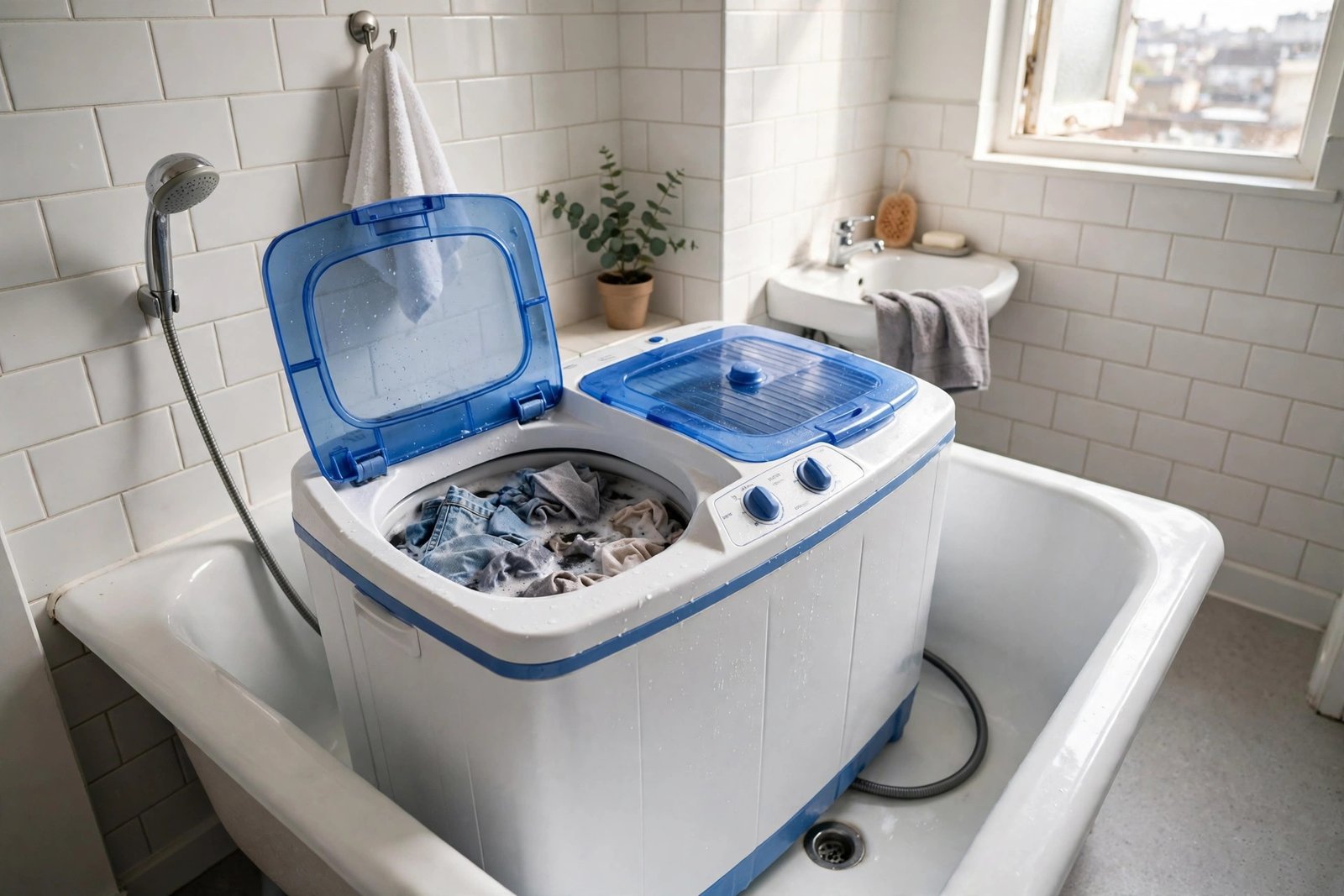
BLACK+DECKER 0.9 Cu. Ft. Portable Washer (BPWM09W) — best stated load guidance
The same drum class as the COMFEE’, with the most explicit paperwork in this guide. Dimensions per the manual and major retailers: about 17.7 inches deep × 17.3 inches wide × 31.1 inches tall — 41.5 inches with the lid open, the number to check against your counters and shelves. Maximum load 6.6 pounds (brand figure), five cycles (Heavy, Gentle, Normal, Rapid, Soak), three cold-water levels, stainless tub, quick-connect sink adapter and drain hose included. The brand states the faucet must be within 4 feet of the back of the washer, and gives per-load examples (5–7 shirts, 2 pairs of jeans, one queen sheet at a time) that make the capacity honest before you buy.
The drawbacks: it is cold-water-only by specification, so heavily soiled loads get no warm-water help. At 48.4 pounds it is the heaviest of the 0.9-class machines here. One review summary notes the drain hose has no shutoff — secure it in the sink before every cycle. And a caution on dimensions: some secondary spec sites list this model at 24.8 × 14 × 28.5 inches, which appears to be a copy error from a twin-tub listing; the manual, Amazon, and Target figures agree on roughly 17.7 × 17.3 × 31.1 inches, so measure against those and confirm on the live listing. Choose this one if the lid-open height fits and you want the clearest capacity guidance in the class.
Panda 1.34 Cu. Ft. Portable Washer (PAN356HB) — best mid-size automatic
The step-up automatic for two people or bigger loads: 1.34 cubic feet, up to 10 pounds per load (brand figure), ten wash programs, five water levels, a built-in drain pump, child lock, and delay start. The published hose lengths are genuinely useful for planning — a 39-inch inlet hose and a 55-inch drain hose — and the single inlet means temperature is set at the faucet. Two rear wheels let you tilt and roll it between storage and sink. Footprint is roughly 19–20 inches square by 34 inches tall, which is the catch: sources disagree on the exact cabinet. The Amazon specification table lists 19 × 19 × 33.5 inches; the manual and other listings say 19 deep × 20 wide × 34 tall, with weight listed from 50 to 60 pounds.
The drawbacks follow from those conflicts: plan your space around the larger figures (20 × 20 × 34 inches, up to about 60 pounds) and confirm the exact variant on the live listing before ordering — Panda sells several 1.34-class models under similar names. The 780 RPM spin speed (brand spec) is on the gentle side, so clothes come out damper than a faster-spinning machine and need more air-dry time. If the larger footprint fits your storage spot, this is the most automatic washing per inch in the guide.
COMFEE’ 1.6 Cu. Ft. Portable Washer — best for two people and bigger loads
The largest automatic here: 1.6 cubic feet, 11 pounds per load (brand figure), six programs (Normal, Quick, Heavy, Bulky, Delicate, Spin Only), a drain pump, a clear lid, and wheels. Cabinet size is about 20.7 inches wide × 20.3 inches deep × 36.6 inches tall, and manual figures put the open-lid height at about 47.9 inches — measure that against under-cabinet clearance and any shelf above the running spot. This is the machine for a couple, for someone who washes bedding piece by piece, or for anyone who would rather run fewer, fuller loads.
The drawbacks are size and weight. At roughly 21 inches wide it will not fit the closet corners the 0.9 machines disappear into, and published weights conflict by color variant — about 70.5 pounds for the ivory white and 79.4 pounds for the magnetic gray in listing tables — so plan the route to the sink as if it were the heavier figure and confirm your variant. It is also the tallest machine here with the lid open. If your storage spot clears roughly 21 × 21 inches and 48 inches of headroom where it runs, this is the capacity pick; if not, the Panda above is the compromise.
Giantex Portable Mini Compact Twin Tub (EP21684) — best when no faucet will adapt
The machine for the apartment that fails the faucet check. A twin tub has two compartments — a wash tub rated at 12 pounds and a spin tub rated at 8 pounds (brand figures) — in a cabinet about 24.8 inches wide × 15 inches deep × 28.5 inches tall, weighing 28 pounds. You fill the wash tub through the included inlet hose from any faucet, or manually with a bucket or showerhead; no threaded adapter is required. Timers are manual: up to 15 minutes of washing, up to 5 minutes of spinning, both tubs at once if you like. Drainage is by hose with no pump mentioned in the manual, which recommends placing the machine in a bathtub or near a drain.
The drawbacks are the hands-on routine. You move wet clothes from wash tub to spin tub yourself, the spin tub holds about half to two-thirds of a full wash load so big loads spin in two batches, and spun clothes come out damp — they still need air drying. The cabinet is wide (24.8 inches) even though it is light, so measure the bathtub or floor spot before assuming it fits. Choose the twin tub when your faucet cannot take an adapter, when you want the lowest-commitment way to wash at home, or when manual fill from a showerhead is simply easier than fighting a designer faucet.
Portable washer fit table
Swipe sideways to see all columns →
| Machine | Capacity (brand figure) | Footprint W × D × H (in) | Hookup | Drain | Price |
|---|---|---|---|---|---|
| COMFEE’ 0.9 cu. ft. | ~6 lb | 18.1 × 17.7 × 31.5 | Quick adapter on aerator thread | Drain pump to sink | Check latest price |
| BLACK+DECKER 0.9 (BPWM09W) | 6.6 lb max | 17.3 × 17.7 × 31.1 (41.5 lid open) | Quick-connect sink adapter; faucet within 4 ft | Drain hose to sink | Check latest price |
| Panda 1.34 (PAN356HB) | 10 lb | ~20 × 19–20 × 34 (sources vary) | Quick adapter; 39 in inlet hose | Drain pump; 55 in drain hose | Check latest price |
| COMFEE’ 1.6 cu. ft. | 11 lb | 20.7 × 20.3 × 36.6 (~47.9 lid open) | Quick adapter on aerator thread | Drain pump to sink | Check latest price |
| Giantex Twin Tub (EP21684) | 12 lb wash / 8 lb spin | 24.8 × 15 × 28.5 | Inlet hose or manual fill (bucket/showerhead) | Drain hose, gravity — run near tub/drain | Check latest price |
Capacities, dimensions, and hose lengths are manufacturer/listing figures as found 23 Nov 2026. Panda dimensions and COMFEE’ 1.6 weights vary by source and variant — the table shows the planning figures; confirm the exact variant and live price before you buy.
When to skip a portable washer
Skip the purchase entirely if your lease bans in-unit laundry and the landlord will not put permission in writing — no machine is worth a lease violation or a flooded downstairs neighbor. Skip automatics if your only faucet is a pull-out spray head with a sealed aerator and no second tap exists; a twin tub or the laundromat is the honest answer there. Skip the 0.9 class if your normal load is a week of laundry for two — you will run it daily and resent it. And skip any machine whose lid-open height you have not measured: a washer that fits the closet but cannot open under the counter is furniture, not an appliance.
Your ten-minute measurement checklist
- Read the lease for laundry/appliance clauses; if unclear, get written permission.
- Unscrew the aerator. Note thread location (inside/outside) and whether it is a standard size; flag pull-out spray heads as adapter-hostile.
- Measure the hose path from the machine’s running spot to the faucet (compare with the included hose length; BLACK+DECKER wants the faucet within 4 ft).
- Measure the storage footprint and the lid-open height where the machine will run.
- Weigh one typical laundry basket; match it to the brand’s pound capacity, not the cubic feet.
- Plan the drain: pump to a secured sink hose, or gravity to a tub/floor drain. Add a drip pan or water alarm.
- Check the outlet and circuit you will use, and what else shares it.
- Confirm the exact variant, dimensions, included hoses/adapter, and live price on the listing before you buy.
Frequently asked questions
Will a portable washer work with a pull-out kitchen faucet? Usually not with the included adapter. Pull-out and pull-down spray heads typically have no usable aerator thread for a quick-connect fitting. Use a different tap with a threaded spout (a bathroom basin is common), try a rubber clamp-style universal adapter with careful leak testing, or choose a twin tub you can fill by bucket or showerhead.
Can my landlord ban a portable washing machine? Generally yes, if the lease says so. Landlords commonly prohibit tenant-owned laundry machines over water-damage, plumbing, and insurance concerns, and a ban on “in-unit laundry” typically includes portable sink-hookup units. Read the lease, and if it is unclear, get written permission before buying.
How much laundry does a 0.9 cubic foot washer actually hold? About 6 to 6.6 pounds by brand figures. In practical terms, guides that convert the number put it at roughly two or three outfits or about four bath towels per load — BLACK+DECKER’s own examples include 5–7 shirts or one queen sheet at a time. A full sheet set or a comforter is beyond this class.
Is a twin tub better than an automatic portable washer? It depends on your faucet and your patience. Automatics fill, wash, rinse, and spin on their own once connected, but they need a faucet an adapter can thread onto. A twin tub needs no threaded connection — you can fill it with a bucket — but you move loads between tubs by hand, spin in smaller batches, and air-dry afterward. Faucet works: automatic. Faucet fails: twin tub.
Where does the drain water go, and is it safe? Into the sink or tub through the drain hose. Machines with a drain pump push water up into the basin; gravity-drain twin tubs need the hose running downhill, which is why their manuals suggest the bathtub. The main risk is a hose slipping out mid-cycle — secure it, run a short test fill first, and consider a drip pan or water alarm underneath.
How loud are portable washers? It varies by model and load balance. BLACK+DECKER lists a 72 dB sound level for its 0.9 in its specifications; treat that as a brand figure, not a guarantee for your floor. A level surface and a balanced load matter more than the number — an unbalanced spin is loud in any machine.
Can I wash bedding in a portable washer? Piece by piece, in the larger machines. A 10–11 pound automatic can handle a sheet or a light blanket on its own; bulky comforters exceed every drum in this guide. The 0.9 class is for everyday clothes and towels, not bedding sets.
Keep reading
- Will It Fit? Cabinet Measurement Worksheet — the full measure-first worksheet, useful for the storage-spot check.
- Organize a Small Kitchen Without Drilling — renter-safe fixes around the sink you’ll be hooking up to.
- Best Under-Sink Organizer for a Small Kitchen — keep the cabinet under that faucet usable between wash days.
- Best Mini Air Fryer for a Small Kitchen — the same footprint-first thinking, applied to the counter.