

A mini freezer promises the one thing a small apartment fridge cannot give you: real frozen storage. But the number on the box — 1.2, 2.1, 3.5 cubic feet — is only the start. In a tight kitchen, three other numbers decide whether the freezer actually works: how far the door or lid swings, how much air the compressor needs around the cabinet, and how much of that rated volume is truly usable once shelves, baskets and the compressor step take their share. This guide works through those measurements first, then walks six freezers from a 1.2 cubic foot cube to 3.5 cubic foot chests. Every figure is a brand or listing figure, and where sources disagree, the disagreement is stated.
As an Amazon Associate, HomeXWander earns from qualifying purchases made through links on this page — at no extra cost to you.
First, the honest part: upright door swing vs chest lid clearance
Mini freezers come in two shapes, and each one eats space differently.
Upright freezers open like a fridge, with a front door on hinges. The footprint is small, but the door needs a clear arc in front of it — roughly the door’s own width — before you can reach the back shelf. In a galley kitchen or closet nook, that arc is the real measurement. Two uprights below (Whynter, Kismile) have reversible doors, so the swing can open from either side. Inside, shelves divide the space neatly, but the door seal, shelf rails and compressor step all subtract from the rated volume.
Chest freezers open from the top. No front swing, so they slide easily against a wall — but the lid needs clear space above it (Arctic King’s manual asks for 8 inches on top) and room to lean over and reach the bottom. A chest also gives back more usable space per rated cubic foot — one open box, minus a removable basket. The trade-off is digging: whatever goes in first comes out last.
So the first decision is not size, it is shape: a clear door arc in front of the spot, or clear air above it? Measure that first.

Measure first: four numbers decide everything
1. Door swing or lid clearance. For an upright, measure the spot, then add the door’s swing: open an imaginary door the full width of the cabinet and check nothing — a counter edge, a trash can, a closet door — blocks it. In a closet, the closet door must still close with the freezer door shut and the cord routed. For a chest, measure to anything overhead and leave the manual’s top clearance (Arctic King: 8 inches above the lid).
2. Ventilation clearance. A freezer moves heat from inside the box to the room and needs air around the cabinet to do it. Manuals are specific: Whynter asks for 4 inches at the rear and 1 inch at the sides; Arctic King for at least 4 inches on the back and sides and 8 inches on top; Midea for over 100 mm — about 4 inches — from each adjacent wall. Add those inches to the cabinet size before deciding a spot fits. A freezer squeezed flush into a nook will run hot and age early.
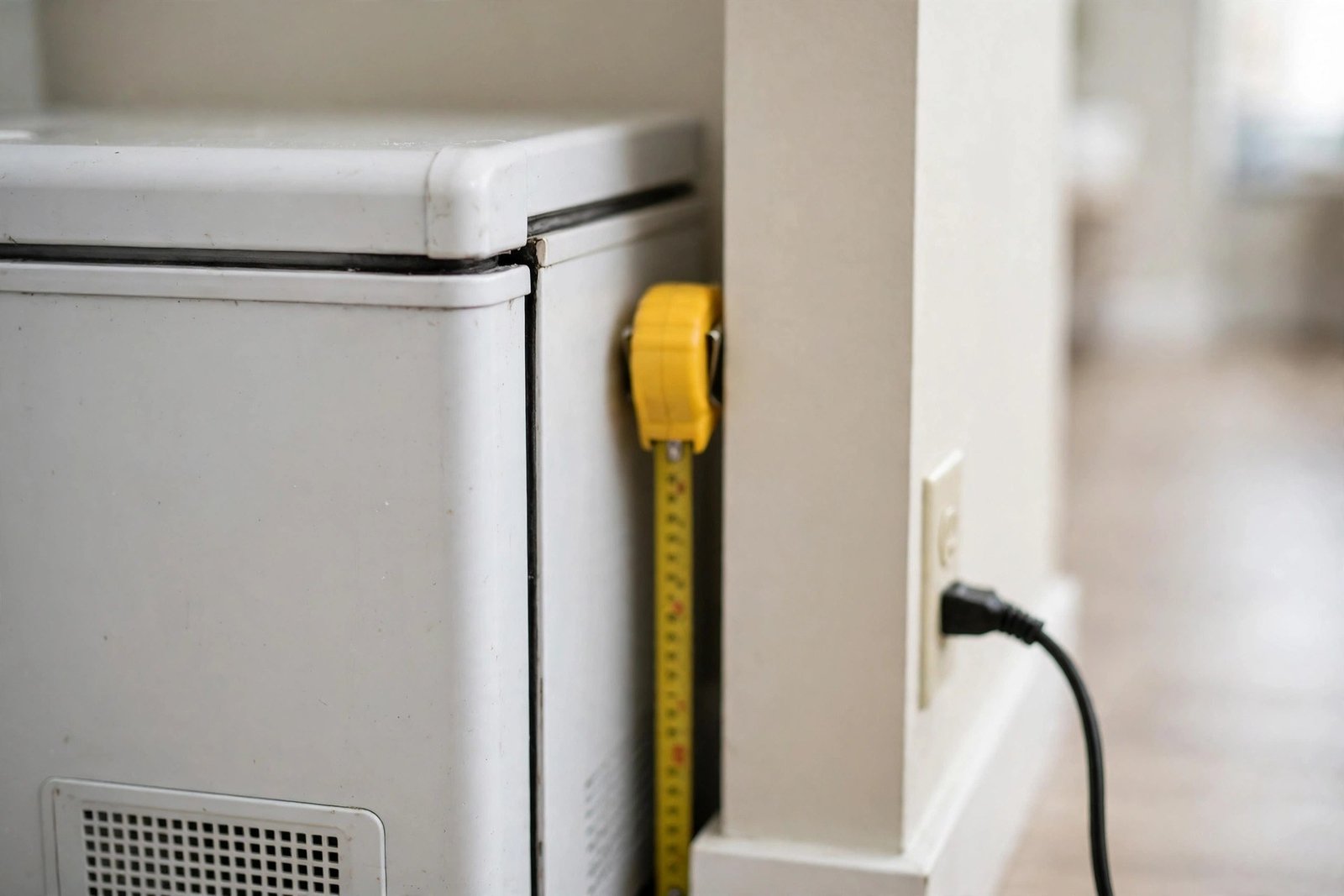
3. True capacity, in liters and in food. One cubic foot is about 28.3 liters, so the range here runs from roughly 34 liters (1.2 cu ft) to about 99 liters (3.5 cu ft — Midea and Natural Resources Canada both state 99 L for their 3.5 cu ft models). But rated volume is the empty box, not the usable box. Uprights lose space to the compressor step: Whynter publishes internal dimensions of 12 inches wide × 21⅜ inches high × 14⅞ inches deep, with a step of 11⅝ × 7⅝ × 5¾ inches eating the bottom rear — inside the “2.1 cu ft.” Chests lose a little to the basket and wall taper but keep one open cavity. Brands also quote food weight: BLACK+DECKER rates the 1.2 cu ft upright at about 42 pounds and its 2.0 cu ft chest at up to 70 pounds. Size by what you actually freeze — a week of meal prep for one fits the small end; batch cooking for two pushes you to 3.0 cu ft and up.
4. Power, floor and delivery path. Everything here runs on a standard 115–120V outlet and draws little — Whynter at 1.2 amps, Kismile at 90 watts — but the outlet should be grounded and the cord should reach without an extension cord. Weights run about 37 to 50 pounds empty, so one person can usually move these; still check the delivery path, because a 33.5-inch-tall chest has to turn corners. Let any freezer stand upright for several hours after delivery before plugging it in, so the compressor oil settles.
The freezers, measured
1. BLACK+DECKER BUFK12W — the 1.2 cu ft cube for the tightest spots
The smallest upright here: 1.2 cubic feet (about 34 liters), rated by the brand at roughly 42 pounds of frozen food. A near-cube — the brand lists about 19.7 inches wide × 19.3 inches deep × 19.7 inches high, fridge.com rounds it to 20 × 19 × 20 inches; plan on a 20-inch cube plus ventilation inches. Inside: one full-width wire shelf, mechanical thermostat, manual defrost. Weight figures conflict — about 40.8 pounds in a listing-based guide versus an implausible 12.1 pounds on the brand’s page — so plan on roughly 41 pounds and confirm on the listing. Energy Star certified, about 219 kWh per year by fridge.com’s figures. The pick for a dorm, office or bedroom corner where the freezer is overflow, not the main event.
Check latest price on Amazon
2. Whynter CUF-210SS — 2.1 cu ft upright with a lock
The mid-size upright: 2.1 cubic feet (about 59 liters) behind a stainless door with a cylinder lock and two keys — a real advantage in shared housing. The manual lists 17.3 inches wide × 20 inches deep × 27 inches high (retailers round to 17.5 × 20 × 27.5) and publishes the internal dimensions and compressor step quoted above, so you can check your tallest container before buying. Mechanical dial rated -10°F to 2°F, manual defrost, reversible door. Weight: 40 pounds in the manual, 44 by retailers — either way a one-person carry. Electrical: 115V at 1.2 amps (75 watts), about 228 kWh per year. With 4 inches at the rear and 1 inch at the sides, plan on roughly 24 inches of true depth. Choose it when the spot is narrow, the door arc works, and a lock matters.
Check latest price on Amazon
3. Kismile D5888S-SILVER — the 3.0 cu ft upright, with a capacity caveat
The largest front-door option here, with an honesty note: the listing title says 3.0 cubic feet while the specification table says 3.2. Plan on the lower figure — about 85 liters — and treat the rest as a bonus. The cabinet measures 20.3 inches deep × 20.5 inches wide × 31.7 inches high at 46.3 pounds, with two removable shelves, a reversible door, adjustable feet and a front-mounted seven-setting thermostat rated -7.6°F to 6.8°F. Power: 115V at 90 watts by listing figures. At nearly 32 inches tall it can slide under many counters — but a 20.5-inch-wide door needs roughly that much clear space in front. For a one- or two-person household that wants shelf-level access, this is the upright to measure first.
Check latest price on Amazon
4. BLACK+DECKER BCFK206 — the small chest, 2.0 cu ft
If your spot has no door arc but has air above it, this chest is the compact answer: 2.0 cubic feet (about 57 liters), rated by the brand at up to 70 pounds of frozen food. The listing gives 17.3 inches deep × 20.9 inches wide × 27.6 inches high at 37 pounds — the lightest freezer here — with a removable basket and manual defrost. Nearly all of that volume is one open cavity, which suits bulky items like a whole chicken or flat meal-prep containers better than a shelved upright of the same rating. Leave room above the lid to open it fully and lean in. The pick when the footprint is small but the food is bulky.
Check latest price on Amazon
5. Midea MERC04C4BAWW — 3.5 cu ft convertible chest, garage-ready on specs
The flexibility play: 3.5 cubic feet (99 liters by the manufacturer’s figure) that converts between freezer and refrigerator modes by thermostat setting — a drinks fridge in summer, a freezer at holidays. Listing dimensions: 17.6 inches deep × 21.5 inches wide × 33.5 inches high at 47.8 pounds, with an interior LED light, a removable basket and about 193 kWh per year. Midea rates it garage-ready for rooms from 0°F to 110°F in freezer mode (38°F to 110°F as a fridge) and claims food stays frozen up to 48 hours after a power loss — both brand claims, stated as such. One caution: the older MRC04M3AWW lists a deeper 19.5-inch depth, so confirm you are looking at the MERC04C4BAWW before measuring against the 17.6-inch figure. The manual asks for over 100 mm (about 4 inches) from each adjacent wall. Choose it for a garage, basement or unheated room — or when convertibility matters.
Check latest price on Amazon

6. Arctic King ACFM035BDW — 3.5 cu ft chest, measure the listing twice
A straightforward freezer-only chest: 3.5 cubic feet (99 liters by Natural Resources Canada’s listing), with a removable basket, a defrost drain, a balanced hinge and a lid that stays open between 45 and 75 degrees. The catch is dimensions — sources disagree. The ACFM035BDW manual figures give 22.2 inches deep × 20.6 inches wide × 33.5 inches high; the near-identical ACFM035ADW manual gives 21.75 × 22.25 × 33.5 inches at 50 pounds; the brand site lists 22.6 × 20.2 × 33.5 inches. All three agree on height, none on the footprint — so measure your spot, then confirm exact dimensions on the live listing for the exact model suffix. The manual’s clearances are the most generous here: at least 4 inches on the back and sides, 8 inches on top. For a laundry room or pantry corner with room to spare, a simple, honest chest; for a tight nook, the one to verify most carefully.
Check latest price on Amazon
Side by side
Swipe sideways to see all columns →
| Product | Type | Capacity (brand figures) | Footprint W × D × H (in) | Door/lid needs | Power (brand figures) | Check latest price |
|---|---|---|---|---|---|---|
| BLACK+DECKER BUFK12W | Upright | 1.2 cu ft (~34 L, ~42 lb food) | ~19.7 × 19.3 × 19.7 | Front door arc | Energy Star, ~219 kWh/yr | Check latest price on Amazon |
| Whynter CUF-210SS | Upright, lock | 2.1 cu ft (~59 L) | 17.3 × 20 × 27 (manual) | Reversible door; 4″ rear / 1″ sides | 115V, 1.2A, 228 kWh/yr | Check latest price on Amazon |
| Kismile D5888S-SILVER | Upright | 3.0 title / 3.2 spec cu ft (~85 L+) | 20.5 × 20.3 × 31.7 | Reversible door | 115V, 90W | Check latest price on Amazon |
| BLACK+DECKER BCFK206 | Chest | 2.0 cu ft (~57 L, up to 70 lb food) | 20.9 × 17.3 × 27.6 | Clear space above lid | 115V | Check latest price on Amazon |
| Midea MERC04C4BAWW | Chest, convertible | 3.5 cu ft (99 L) | 21.5 × 17.6 × 33.5 | ~4″ each wall (manual) | 193 kWh/yr | Check latest price on Amazon |
| Arctic King ACFM035BDW | Chest | 3.5 cu ft (99 L) | ~20.6–22.25 × ~21.75–22.2 × 33.5 (sources conflict) | 4″ back/sides, 8″ top (manual) | — | Check latest price on Amazon |
When to skip a mini freezer
Skip it if your lease bans extra appliances or the circuit already trips with a microwave — these draw little, but they run all day. Skip it if the only spot has neither a door arc nor lid clearance; a freezer you cannot open fully is a box, not storage. Skip it if you cannot give the cabinet its ventilation inches. And skip it if all you freeze is a few ice trays and a pint of ice cream — your fridge’s freezer compartment already does that job for free.
Measurement checklist
- Spot: width, depth, height — plus the manual’s ventilation inches on every side.
- Upright: door arc clear in front, swing direction workable (or reversible)?
- Chest: clear space above the lid, room to lean in and reach the bottom?
- Capacity: your typical frozen load in liters or pounds, against the brand’s food-weight figure — not just cubic feet.
- Tallest container: will it fit the internal height, compressor step included?
- Outlet: grounded 115–120V within cord reach, no extension cord?
- Delivery path: every doorway and turn from the front door to the spot?
- Room temperature: garage or basement spot — is the model rated for it (Midea states 0–110°F in freezer mode)?
- Defrost plan: all six here are manual defrost — a drain, or a towel-and-cooler plan twice a year?
FAQs
How much ventilation space does a mini freezer really need? Follow your model’s manual. Gathered here: Whynter asks for 4 inches at the rear and 1 inch at the sides; Arctic King for at least 4 inches on the back and sides and 8 inches on top; Midea for over 100 mm (about 4 inches) from each adjacent wall. Treat those inches as part of the footprint.
Is 1.2 cubic feet enough for one person? For overflow — a few meal-prep containers, frozen vegetables, ice cream — yes; the brand rates it at about 42 pounds of food. For batch cooking or bulk meat, step up to the 2.1 cu ft Whynter or a 3.5 cu ft chest. Size by your actual load, not by hope.
Upright or chest for a small apartment? Choose by the space you have. An upright needs a clear door arc and gives shelf-level access; a chest needs clear air above the lid and gives one open cavity that suits bulky items. Per rated cubic foot, a chest generally returns more usable space — but you will dig for the bottom layer.
Can a mini freezer go in a garage or basement? Only if the model is rated for it. Midea states its convertible chest is garage-ready from 0°F to 110°F in freezer mode; the others here publish no equivalent rating in the sources gathered. For an unheated space, measure the Midea first — and confirm the rating on the live listing.
Why do the dimension figures conflict between sources? Brands, manuals and listings round, transpose and copy each other. Here: the Kismile is 3.0 cu ft in its title and 3.2 in its specs; the Arctic King’s footprint differs across three sources; the BLACK+DECKER cube’s weight is about 41 pounds in one guide and an implausible 12.1 pounds on the brand page. Plan around the manual’s figures and confirm on the live listing before ordering.
Keep Reading
- Will It Fit? The Cabinet Measurement Worksheet — the measure-first method used throughout this guide.
- Fridge Bins for a Narrow 24-Inch Fridge: Sized to the Shelf You Have — once the freezer is sorted, make the fridge shelves work too.
- Slim Rolling Cart for the Fridge Gap — the narrow gap beside the fridge is storage, if you measure it.
- Organize a Small Kitchen Without Drilling — renter-safe fixes that need no landlord permission.
- Galley Kitchen Organization Zones — zoning a narrow room so appliances earn their footprint.