

Blind corner cabinets are where kitchen storage goes to die — deep, dark, and reachable only by kneeling and unloading half the shelf. Owned-home advice reaches for screw-in pull-outs and swing-out hardware. Renters cannot install any of it. The zero-screw answer is freestanding storage sized to the door opening, not the cabinet: rotating trays, sliding trays, and stackable bins that sit on the shelf and leave no mark. If you remember one thing: nothing helps you if it cannot get through the door — measure the opening first.
As an Amazon Associate, HomeXWander earns from qualifying purchases made through links on this page — at no extra cost to you.
Can a blind corner really work with zero screws?
Yes — because the problem was never storage volume, it is access. The corner already holds plenty; you just cannot reach the back of it. A tray that spins or slides brings the back row to the door, and a bin you can lift out does the same job in pieces. None of that needs a screw into the cabinet. The honest trade-off: freestanding trays waste some shelf corners and carry less than bolted hardware — stated per product below.
Measure first: the three numbers that decide everything
Write down three numbers before you buy anything. One: door opening width — the clear width between the frame edges with the door fully open, minus anything the hinge intrudes. This is the gate: a round tray wider than the opening does not go in, full stop. Two: cabinet depth — a tray needs shelf depth at least equal to its diameter to spin, and a sliding tray needs its full length. Three: shelf height — the clear height above the shelf, because stacked bins and two-tier sliders spend it.
One more allowance: published diameters and measured diameters are not always the same number. Where sources disagree below, we say so — measure with a small margin, not to the last eighth of an inch.

The five freestanding fixes, matched to your opening
LAMU Turntable 3-Pack — best when you are not sure which tray size your door takes
Three clear turntables — 9.25, 10.6, and 12 inches across per the listing — in one box let you match tray to opening instead of guessing once. The small tray goes in the blind corner, the larger ones earn their keep on deep shelves elsewhere. Each spins 360 degrees on a reinforced base with raised edges; the largest measures about 11.8 inches across and 2.56 inches high per Amazon product data summarized in reviews.
The drawbacks are geometry and missing numbers. A round tray wastes the shelf corners around it, the 12-inch tray needs a shelf at least 12 inches deep and an opening that wide to enter, and the listing publishes no weight limit, so keep heavy jars modest.
Copco 18-Inch Lazy Susan (2555-0186) — best for a wide opening and a deep corner
If your door opening is genuinely wide, one big tray beats three small ones: 18 inches of non-skid surface with a raised rim, sized for the deepest corner shelves. Copco lists the exterior at 18 inches in diameter and 1.5 inches high, with the interior space roughly 1 to 1.5 inches smaller — the usable surface is about 16.5 to 17 inches across. The non-skid surface is molded into the platform rather than stuck on, and the rim is 3/8 inch.
The drawback is the door, again: Amazon’s item data puts this tray at 18.31 inches across and 1.57 inches high, slightly more than Copco’s own figures, so allow for the larger number when you measure — an 18-inch tray will not fit every cabinet door, and the shelf must be at least that deep for it to spin. No weight limit is published; keep the heaviest items toward the center.
YouCopia MagicTrack Rectangle Turntable — best when a round tray wastes your shelf corners
A rectangle that still spins: 10.2 inches deep by 12.5 inches wide, so the four corners a round tray throws away stay usable. YouCopia states it holds 50% more than a standard round turntable — checked against its own published dimensions, the rectangle is about 127.5 square inches against roughly 81.7 for a round tray of the same 10.2-inch width, so the claim is conservative. It rotates on stainless steel ball bearings with soft non-slip feet, and the listing states no tools, suction cups, or installation are needed. For a blind corner, the narrow 10.2-inch side goes through the door first.
Two honest caveats. The listing publishes no weight capacity, and because the tray moves forward as it turns, no full-motion clearance figure is published either — leave margin around the resting footprint instead of assuming an exact-width fit will rotate freely.
madesmart Premium 2-Tier Organizer — best sliding access through a narrow door
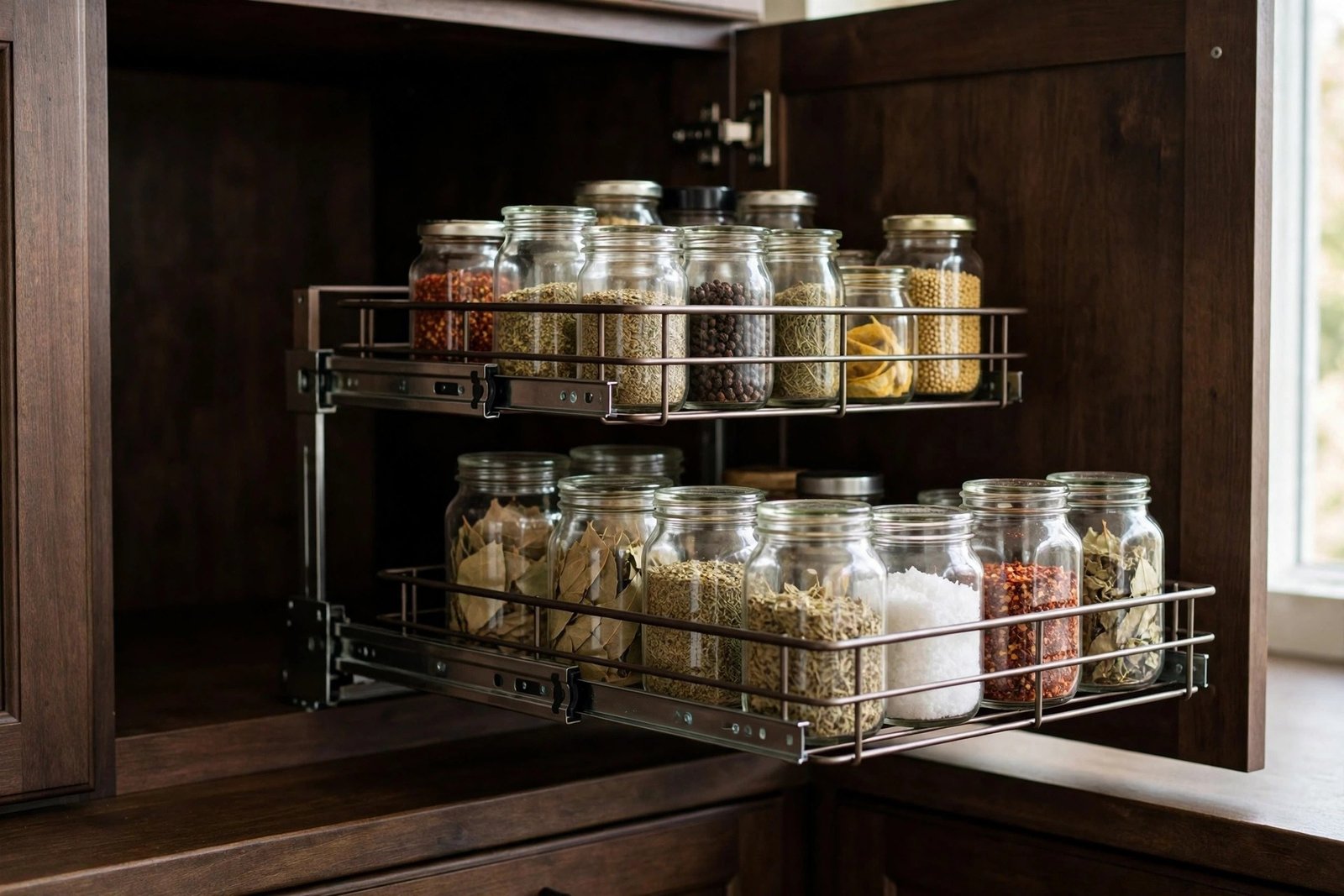
When the door is too narrow for any useful tray, slide instead of spin: two pull-out baskets on a freestanding frame, 9 inches wide overall. At 14.3 inches deep, 9 inches wide, and 10.6 inches high, it passes openings a 12-inch tray cannot, and the baskets slide out so the back row comes to you. Both baskets have adjustable dividers; the listing gives a 15-pound capacity.
The drawbacks: it needs shelf depth of at least 14.3 inches and clear height of at least 10.6 inches, it assembles from parts (snap-together, nothing screwed into the cabinet), and it is marketed for under-sink use — in a blind corner it works as a deep-shelf slider, not a corner-shaped fit.
Vtopmart Clear Stackable Storage Bins with Lids, 6-Pack — best for packets and small items in any corner
The lowest-tech fix is often the right one: clear bins you stack in the corner and lift out one at a time, each with a lid and a handle. Three sizes are listed — Medium about 10 × 6 × 5 inches, Large about 11.2 × 7.5 × 6 inches, XL about 13 × 7.4 × 7 inches — and at 6 to 7.5 inches wide, every size passes almost any cabinet door. Clear walls mean you can see what is in the back bin without emptying the shelf.
The drawbacks: bins do not bring things to you the way a tray does — you lift the front bin to reach the back one — and lids are lift-off, not airtight seals, so they suit packets, snacks, and dry goods rather than loose flour.
How we chose these: we do not buy and bench-test every product, and never claim we did. We shortlist on published dimensions and fit, state drawbacks, and re-check prices before publishing.
Door-opening fit table: what passes, what spins
Read your measured door opening down the left column. “Passes” means the product fits through the opening; the shelf must still meet the depth and height notes to work once inside.
Swipe sideways to see all columns →
| Your door opening | What passes | Shelf also needs |
|---|---|---|
| Under 9.5 in | Vtopmart bins (6–7.5 in wide) | Depth ≥ bin length (10–13 in by size) |
| 9.5–10.5 in | Vtopmart bins; madesmart 2-tier (9 in wide); LAMU 9.25 in tray | madesmart: depth ≥ 14.3 in, height ≥ 10.6 in |
| 10.5–12.5 in | Above, plus LAMU 10.6 in tray; MagicTrack rectangle (10.2 in side first) | MagicTrack: footprint 12.5 × 10.2 in plus rotation margin (unpublished — leave room) |
| 12.5–18 in | Above, plus LAMU 12 in tray | Tray shelf depth ≥ tray diameter to spin |
| Over ~18.5 in | Above, plus Copco 18 in tray (allow 18.31 in per Amazon data) | Shelf depth ≥ ~18.3 in to spin |
Two rules sit under the whole table. A round tray needs shelf depth and width at least equal to its diameter or it cannot turn. And if your opening lands within half an inch of a tray’s diameter, choose the smaller tray — hinge intrusion and frame lips eat the margin.
What to skip: screw-in corner hardware
The owned-home catalog for blind corners is built on hardware you cannot install as a renter: screw-in pull-outs (the Rev-A-Shelf type), swing-out and LeMans-style systems, pie-cut lazy Susans that mount to the cabinet, and bolted half-moon shelves. All of them need screws into the cabinet box, several need the cabinet modified, and none of them comes out cleanly at move-out. Competitor guides still rank this hardware first — it is simply not available to you. Also skip adhesive-mounted rails inside a corner cabinet: the loads in a corner (oils, jars, cans) are exactly the heavy kind adhesive fails on.
If a product listing says “installation required” with screws or brackets, it is not a renter product, whatever the photos show.

Your five-minute measurement checklist
Write down three numbers. One: door opening width — clear width with the door fully open, hinge intrusion subtracted. Two: cabinet depth — shelf front to back wall. Three: shelf height — clear height above the shelf. Then read the fit table: your opening picks the products, your depth and height confirm them. If a tray diameter lands within half an inch of your opening, go one size down.
Frequently asked questions
What is the best no-drill fix for a blind corner cabinet?
A freestanding tray sized to the door opening — a turntable if the opening takes it, a sliding tray if it does not. Screw-in pull-outs are the owned-home answer; renters get the same access from a tray that spins or slides on the shelf.
How wide does my cabinet door opening need to be for a lazy Susan?
At least the tray’s diameter, plus a small margin for hinge and frame intrusion. A 12-inch tray needs roughly a 12.5-inch clear opening and a shelf at least 12 inches deep to spin. Measure the clear width with the door fully open, not the door itself.
Will an 18-inch turntable fit a standard corner cabinet?
Only if the clear door opening is over about 18.5 inches and the shelf is at least that deep — Amazon’s item data puts the Copco 18-inch tray at 18.31 inches across, slightly more than the maker’s 18-inch figure. Many corner doors are narrower; measure before ordering.
Round tray or rectangular tray for a corner cabinet?
A rectangle keeps the shelf corners a round tray wastes — the MagicTrack’s 10.2 × 12.5-inch footprint is about 127.5 square inches against roughly 81.7 for a round tray of the same width. A round tray is simpler and spins in less depth. Either way, the door opening decides what you can use.
Can I use a sliding under-sink organizer in a blind corner instead?
Yes, if the shelf is deep enough — a 9-inch-wide two-tier slider passes doors a big tray cannot and pulls the back row out. Check the depth (14.3 inches for the madesmart) and clear height (10.6 inches) against your shelf first.
What corner storage should renters avoid?
Anything screwed or bolted into the cabinet — pull-outs, swing-out systems, mounted pie-cut trays — plus adhesive rails for heavy corner loads like oils and cans. If it needs a drill or leaves holes at move-out, skip it.
[…] Blind Corner Cabinet Storage Without Drilling — renter-safe storage that needs no landlord permission. […]