

Most under-sink guides solve one problem at a time: a rack that fits around a disposal, or one that fits around a filter. Your cabinet may have both — plus the P-trap bending between them. That is a different cabinet, and it needs a different answer.
Here is the short version. With all three under one sink, the cabinet floor is not one rectangle — it is two narrow strips, one on each side of the pipes, under a low ceiling of plumbing. A wide two-tier rack needs a wide rectangle, so it hits something at every position, which is why so many come back as returns. What works is a shape that matches the strips: an L-shaped rack whose top shelf steps aside, a tall C-frame unit on the clear side, or two narrow pull-out units, one per strip.
This guide is a decision path, not a beauty contest: where your pipes sit, how many obstructions you have, the five measurements that turn the table at the end into a yes or a no — then the organizers, shape by shape.
As an Amazon Associate, HomeXWander earns from qualifying purchases made through links on this page — at no extra cost to you.
Step 1: Where do your pipes sit — center or offset?
Open the cabinet and look at where the drain drops.
If the drain is centered, the P-trap hangs in the middle, the disposal usually hangs on that same center line, and a filter canister or tank takes one side wall or the back corner. What remains is a narrow strip of clear floor on the left and another on the right. Plan on two narrow solutions, or one L-shaped rack that uses a strip plus the low space under the trap.
If the drain is offset — the trap sits toward one wall — the other side is often genuinely open, and can take a full two-tier unit, including the taller adjustable-height frames below, while the pipe side gets a slim caddy or nothing.
Center or offset: that one observation eliminates half the products on the market before you measure anything.
Step 2: Count your obstructions
One obstruction (P-trap only). Almost any organizer fits — a standard two-tier rack, an expandable shelf, a sliding basket. This is the cabinet most guides are written for.
Two obstructions (trap + disposal, or trap + filter). The disposal is a fat cylinder eating one side of the floor and the space above it; the filter eats floor or back-wall space. Either way, one strip is gone. An L-shaped rack — wide bottom tier, narrow top shelf that installs left or right — routes around the blockage. Two narrow units also work if the remaining strip is at least about 8½ inches wide.
Three obstructions (trap + disposal + filter). This is the cabinet this article is for. The disposal takes one side, the filter the other or the back, and the trap hangs between them where a top shelf wants to be. Wide racks fail here, and expandable racks stretched wall to wall fail too — the rails meet an obstruction at every width. What survives: an L-shaped rack with its top shelf on the open side, two narrow pull-out units flanking the pipes, or one tall adjustable unit on the wider strip.
Step 3: The five measurements that decide fit
Write these down before you look at a single product — five minutes that decide storage versus return label.
- Clear floor width, left of the pipes — wall to nearest obstruction.
- Clear floor width, right of the pipes — same again.
- Clear depth — back wall to the inside of the closed door, minus whatever the filter steals at the back.
- Clear height under the lowest pipe — the ceiling for anything stored beneath it, and the number that decides whether a tall frame’s top tier clears the trap.
- Door opening width — framed cabinets have a narrower doorway than the interior; a unit that fits inside but cannot pass the frame is a return waiting to happen.
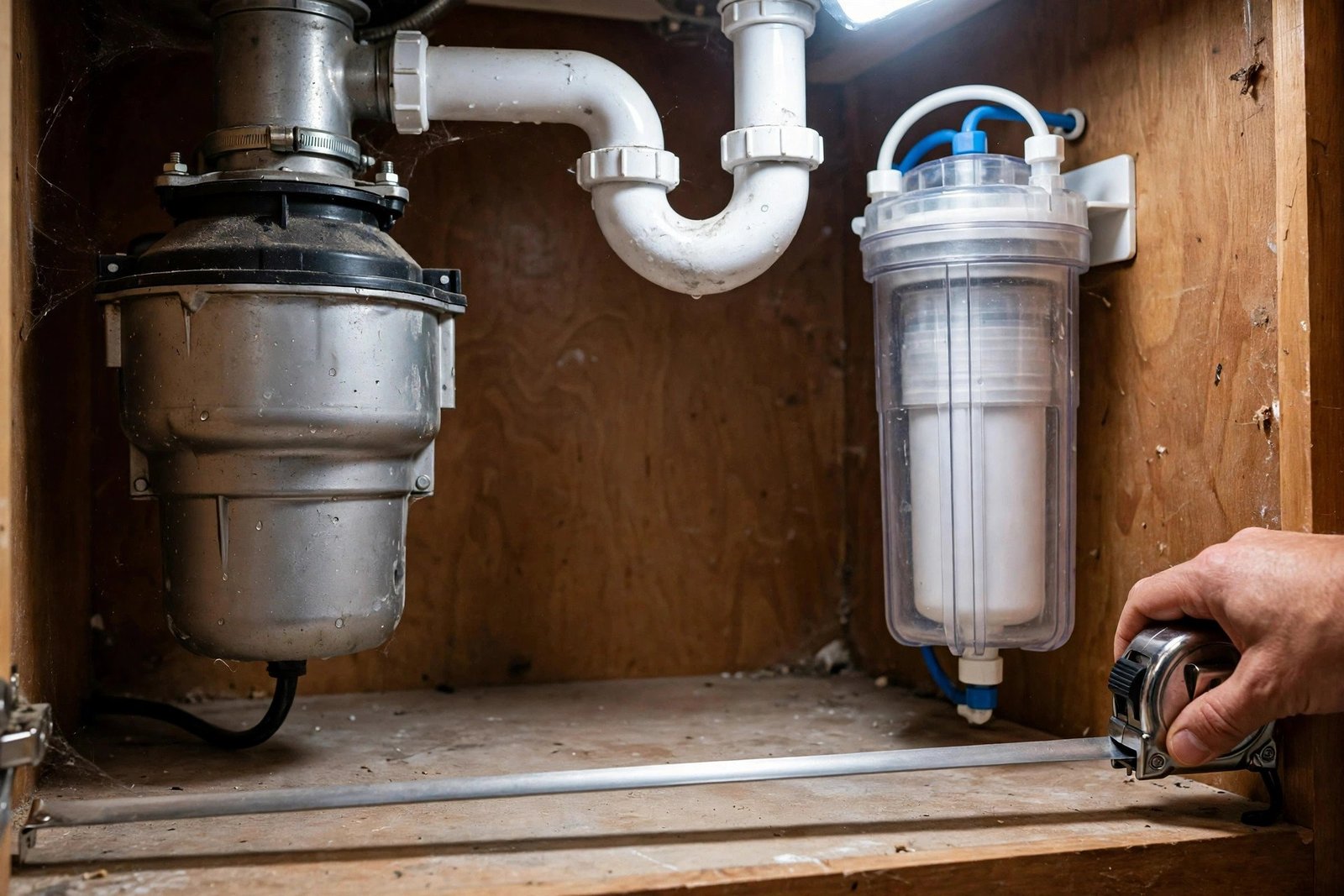
How the numbers map to shapes: a clear strip of 8–11 inches takes a narrow pull-out unit or rolling caddy; about 11–12 inches takes an L-shaped rack or C-frame unit; two strips of 8–9 inches take two small units. If no strip reaches about 8 inches, skip to “When to skip” — nothing here will fit.
The organizers, shape by shape
How we chose these: we do not buy and bench-test every product, and never claim we did. We shortlist on published dimensions and fit, cross-check specs against listing and review sources, and state drawbacks plainly. Where no verified price exists, we quote none — the link takes you to the live price.
REALINN L-Shaped 2-Tier Under-Sink Organizer (RL0025) — best for the true triple-obstruction cabinet
Our pick for the three-obstruction cabinet: a metal L-shaped rack whose narrow top shelf installs left or right, stepping aside for the disposal or trap instead of colliding with it.
The listing gives the assembled size as about 14.2 inches wide × 10.6 inches deep × 11 inches high, asking for a cabinet of at least 11 × 15 × 16 inches — extra depth for drawer travel, extra height so lower-tier bottles clear the plumbing. The top basket is narrow (about 14.2 × 4.8 inches), the bottom wider (about 14.2 × 8.9 inches), holding bottles up to about 8 inches tall per the listing. It mounts with suction cups and tape — no drilling — rated up to 50 lb by the listing.
The drawbacks, stated plainly. Its rating sits at 4.4 stars — below the 4.5-star bar some guides use — so we recommend the shape and the fit, not flawless execution. Buyer reports point to two consistent complaints: the drawer runs on basic glides rather than ball-bearing tracks, so it can catch under heavy bottles; and the adhesive only bonds if the cabinet floor is thoroughly cleaned and dried first. The listing’s width and depth labels also conflict — feature bullet and details table swap them — so measure against both readings.

Kitstorack Under Sink Organizer, 2-Pack XL — best L-shape when both tiers must slide
The Kitstorack takes the same L-shaped idea and makes both tiers sliding mesh drawers, so bottles at the back come forward instead of hiding behind the trap, with the upper tier to one side where a disposal or low drain usually sits.
Published dimensions are 16 inches deep × 11 inches wide × 16.5 inches high, with five height settings — the adjustment that matters here, because you can lower the top drawer until it clears the trap or raise it for tall spray bottles. The listing also mentions raising pads for framed cabinets, which lift the unit over the front lip so the bottom drawer does not catch as it slides. It is a two-pack; the second unit can go under a bathroom vanity.
The drawbacks: at 16 inches deep and 16.5 inches high, this is a big unit — it needs a deep, tall cabinet, and the height that makes it adjustable makes it wrong for shallow vanities. Weight capacity is not stated in the specs we read, so we do not quote one. Measure your clear height under the trap against the lowest setting before ordering.
PXRACK Under Sink Organizer, Adjustable Height, 2 Tier Pull Out (Large 2-Pack) — best tall unit for the clear side
The PXRACK is the tall answer: a two-tier pull-out on a C-shaped frame whose height adjusts across five levels, from about 13.6 to 16.9 inches — set it so the top basket passes under the trap, or raise it when the plumbing sits high. Both baskets slide out, and the base is held with four suction cups plus two adhesive strips, so the unit does not creep forward when you pull a loaded drawer. The brand rates maximum capacity at 100 pounds, the highest figure among these picks.
Published dimensions for the large version are about 15.9 inches deep × 11.8 inches wide × 16.9 inches high per unit, sold as a two-pack. At roughly 11.8 inches wide, each unit needs a clear strip of about 12 inches — in a triple-obstruction cabinet, that usually means one unit on the wider side and the second under another sink.
The drawbacks: 16.9 inches is tall, and many cabinets lack that clear height under the trap — measurement four decides this one. The suction-and-adhesive base needs a clean, smooth, dry floor. And it is a rectangle: it stands beside the plumbing, never around it.
Delamu 2-Tier Under-Sink Organizer Set (2-pack) — best when both strips are narrow
When the disposal takes one side and the filter the other, and neither strip is wide, the honest build is two small units instead of one big one: the Delamu set — two narrow two-tier drawer units with movable dividers, one on each side of the pipes, so the cabinet works like two small cabinets.
Listing dimensions read about 13.19 inches deep × 8.27 inches wide × 10.63 inches high per unit — but a related Delamu listing (the with-hook variant) prints a shorter depth, about 12.28 inches, so plan on the larger figure. At roughly 8¼ inches wide, each unit needs a clear strip a little wider than that; side by side the pair would need about 17 inches of combined clear width, which is exactly why splitting them across the pipes is the point.
The drawbacks: the shape is rectangular, so it does not wrap around a disposal or a trap — each unit needs its own clear floor. And two small drawers hold less than one L-shaped rack’s wide bottom tier. Choose this when both strips are 8–9 inches.
Only a slim strip left? If the filter and disposal leave one strip of about 8½ inches, a single narrow rolling caddy — the YouCopia RollOut Caddy, 8-inch — gives cleaning bottles one reachable home instead of a crowd behind the trap. Note the width: a 5-inch version exists under a different listing, so check for the 8-inch one.

Triple-obstruction fit table
One row per checked organizer. “Clear width needed” means clear floor width on one side of the pipes. Blanks and “check” entries are deliberate — a blank beats a made-up number, and where no verified price exists we quote none.
Swipe sideways to see all columns →
| Product | Shape | Fits disposal? | Fits filter? | Clear width needed | Approx price (dated) |
|---|---|---|---|---|---|
| REALINN L-Shaped (RL0025) — 14.2″W × 10.6″D × 11″H (labels conflict, see text) | L-shape, top shelf left or right | Yes — shelf steps aside | Yes — shelf steps aside | ~11″ where the frame sits | Check latest price |
| Kitstorack 2-Pack XL — 16″D × 11″W × 16.5″H, 5 height settings | L-shape, both tiers slide | Yes — upper tier to one side | Yes — upper tier to one side | ~11–12″ (unit is 11″ wide) | Check latest price |
| PXRACK Large 2-Pack — 15.9″D × 11.8″W × 13.6–16.9″H adjustable | C-frame two-tier pull-out | Beside it — needs clear strip | Beside it — needs clear strip | ~12″ (unit is 11.8″ wide) | Check latest price |
| Delamu 2-Tier Set (2-pack) — 13.19″D × 8.27″W × 10.63″H per unit (depth conflict, see text) | Two narrow drawer units | Beside it — one unit per strip | Beside it — one unit per strip | ~8.5″ per unit | Check latest price |
| YouCopia RollOut Caddy 8″ — 8″ wide (other dims not quoted) | Narrow rolling caddy | Beside it — slim strip only | Beside it — slim strip only | ~8.5″ | Check latest price |
Read the table against your five numbers. Centered pipes, two 8–9 inch strips: Delamu pair, or a Delamu plus the caddy. One strip of 11–12 inches: REALINN if the cabinet is shallow, Kitstorack if deep and tall, PXRACK if the trap hangs high enough to use the height. Offset pipes with one wide-open side: any of them — the biggest unit your clear height allows.
When to skip an under-sink organizer
Skip it if no strip of clear floor beside your pipes reaches about 8 inches — every organizer here needs at least that, and forcing one in gives storage you cannot open; an adhesive door-mounted caddy is the better spend there. Skip it if the cabinet floor is damaged or constantly wet: suction and adhesive mounts will not bond, and a rack hides the leak — fix the leak first. Skip screw-mounted full-width pull-outs if you rent. And skip wide expandable racks stretched wall to wall with all three obstructions present — with one obstruction they are fine, with three they meet plumbing at every width.
Your five-minute measurement checklist
Before you order, write down five numbers: clear floor width left of the pipes; clear floor width right of the pipes; clear depth to the inside of the closed door; clear height under the P-trap’s lowest point; door opening width. With those on paper, the table above becomes a yes-or-no answer — and if it is “no organizer fits,” you have saved the return postage.
Frequently asked questions
Will a two-tier organizer fit if I have a garbage disposal? Sometimes — it depends on the shape. A wide rectangular rack usually collides with the disposal, which eats one side of the floor and the space above it. An L-shaped rack, whose narrow top shelf steps aside for the plumbing, is built for this: our REALINN pick asks for about 11 inches of clear width where the frame sits and about 15 inches of depth for its drawer. Measure the clear strip beside your disposal first.
What if I have a disposal, a water filter, and the P-trap all together? Treat the cabinet as two narrow cabinets, not one wide one. The three obstructions leave two strips of clear floor, one each side of the pipes. An L-shaped rack uses one strip plus the low space under the trap; two narrow pull-out units use both. A single wide rack hits something at every width — the most common reason these organizers get returned.
Does the filter’s position matter, or just the disposal’s? It matters as much. A filter canister on the floor eats a strip exactly like the disposal does, and a tank against the back wall steals depth from every unit in front of it — which is why measurement three (clear depth, minus whatever the filter steals at the back) is on the list. A unit that fits the width but not the remaining depth will stop the door closing.
How much clear width does an under-sink organizer need? The narrow units here need roughly 8 to 8½ inches of clear floor on one side of the pipes; the L-shaped and C-frame units need about 11–12 inches where the frame sits. Measure wall to nearest obstruction, not the cabinet’s full width.
Do these organizers need drilling or screws? No. Everything here is freestanding, rolling, or held with suction cups and adhesive (the floor must be clean and dry to bond). Nothing modifies the cabinet — that is what makes them renter-safe.
Why do the dimensions differ between listings for the same product? Because listings are sloppy. The Delamu set’s depth reads about 13.19 inches on one listing and about 12.28 on a related variant, and the REALINN’s width and depth labels swap between its feature bullet and details table. Our rule: plan on the larger figure and confirm the exact variant before ordering.
Is a 4.4-star organizer worth buying? It can be, if the shape is right — ratings measure execution, not fit. Our REALINN pick sits at 4.4 stars, below the 4.5-star cutoff some guides use, with specific complaints: a drawer that can catch under heavy bottles, and adhesive mounts that fail on a dirty or damp floor. With all three obstructions, the L-shape may be the only shape that fits — buy it for the fit, drawbacks in mind.
Keep reading
- Best Under-Sink Organizer for a Small Kitchen (With a Disposal, Filter, and P-Trap) — the full under-sink guide this article builds on.
- Best Bathroom Under-Sink Organizer — the same fit logic for a vanity cabinet.
- Will It Fit? The Cabinet Measurement Worksheet for Small-Kitchen Storage — the seven cabinet measurements behind every fit call on this site.