

A compact food processor sounds like the easiest small-kitchen buy there is: one bowl, one blade, salsa handled. Then it arrives, and three problems show up that the product photos never mention. The “3-cup” bowl leaks if you fill it past halfway with anything liquid. The discs and blades have nowhere to live, so they colonize a drawer. And the machine is taller than you expected, so it cannot sit under your cabinets — which means it lives in a cupboard, which means you stop using it.
This guide is built around those three measurements: true working capacity, cabinet height, and the full storage footprint once every blade and disc is counted. Six processors follow, from a 2-cup mini to an 8-cup step-up — so you can match a machine to your batches, your cabinets, and your storage, in that order.
As an Amazon Associate, HomeXWander earns from qualifying purchases made through links on this page — at no extra cost to you.
First, the honest part: the cups on the box are not working cups
Every food processor in this guide is sold by a cup number, and that number is the bowl’s brim capacity — the most the bowl can physically hold, not the most you can process in one batch. The manufacturers say so themselves, in the manuals. Cuisinart’s own instruction booklet for its 8-cup Elemental processor prints a “recommended maximum work bowl capacity” chart: sliced or shredded food, 8 cups; thin liquid like dressings and soups, 4 cups; chopped fruit, vegetables or cheese, 2 cups; puréed food, 3 cups cooked yielding about 1½ cups puréed; chopped or puréed meat, ¾ pound; bread dough, 2½ cups of flour.
Read that again. The “8-cup” machine’s honest chopping batch is 2 cups — a quarter of the number on the box — and its liquid limit is half the rated size. That is not a Cuisinart quirk; it is how a blade in an open bowl works: food has to tumble to chop evenly, and liquid escapes through the center spindle if you pass the fill line molded into the bowl. That line — not the box — is the real capacity.
So plan your batches with the manual’s ratios. For chopping, plan on roughly a quarter to a half of the rated cups per batch. For liquids, plan on about half. A 3-cup mini, by that math, is a 1- to 1½-cup working machine: one onion, a small batch of pesto, a cup of hummus. A 7- or 8-cup bowl is a 2- to 4-cup working machine: coleslaw for four, a full batch of salsa, dough from 2½ cups of flour. Keep those conversions in hand and the product list below reads very differently from the boxes.
Measure first: three numbers decide everything
1. Cabinet gap versus machine height. This decides whether the processor lives on your counter or in a cupboard. The minis here stand 8.5 to 10.13 inches tall; the step-up models stand 14.6 and 15.19 inches. Measure from countertop to the underside of your upper cabinets at the exact spot — a standard gap is around 18 inches, but older kitchens run tighter. Remember working height too: a feed-tube machine needs room for the pusher to travel, and a motor-on-top chopper needs room for your hand on the pod. If the gap is tight, choose a short mini or accept the cupboard routine — and be honest about which one you will actually do on a weeknight.
2. Footprint, plus the accessories’ footprint. The base is only part of the storage bill. A mini chopper has one blade, which stores inside its own bowl — the whole machine is one object. A 7- or 8-cup processor adds slicing and shredding discs, a pusher, and sometimes a drive adapter. Cuisinart’s manual for the Elemental 8-Cup says the blades and discs can be stored within the work bowl; KitchenAid’s spec sheet for its 7-Cup lists no storage case (only its 13-cup sibling gets one), so those discs need a drawer slot or a spot inside the bowl that you arrange yourself. Measure the base footprint, then measure where every loose part will live. A machine that fits the counter but sheds discs across two drawers has not really fit.
3. Real working capacity. Work backward from your batches, not box numbers. Cooking for one or two, with the processor handling garlic, herbs, onions and the occasional sauce, means the 2- to 3.5-cup class — about 1 to 1½ working cups per batch. Shredding cheese for a family, slicing cucumbers for a crowd, or kneading a small dough means the 7- to 8-cup class and its 2- to 4-cup working batches. The electrical side is easy: these machines draw 200 to 350 watts by brand figures, so any standard 120V outlet handles them — an advantage in dorms and older wiring.

The processors, measured
1. Hamilton Beach Stack & Press Mini 3-Cup (72860) — the shortest body here
If cabinet clearance is measured in inches, this is the floor. The 72860 stands about 5.2 inches deep × 5.9 inches wide × 8.5 inches high — the shortest machine here — with a 3-cup glass bowl and a 350-watt motor by listing figures. The controls are the simplest in this guide: Hamilton Beach’s stack-and-press design has no buttons; you press the lid to chop and release to stop. The glass bowl is a genuine plus at this size, and the single blade stores inside it. Two cautions. Weight figures conflict — about 2.1 pounds in listing-based specs, 3.4 in one review roundup — so plan on the heavier number for any shelf. And treat the 3-cup bowl as a 1- to 1½-cup batch machine: herbs, garlic, a small salsa, not a family-size slaw.
Check latest price on Amazon
2. KitchenAid 3.5-Cup Food Chopper (KFC3516) — the drizzle-basin mini
KitchenAid’s smallest processor adds the one feature the other minis skip: a drizzle basin in the lid, so oil trickles in while the blade runs — the difference between a broken vinaigrette and an emulsified one. The brand rates the work bowl at 3.5 cups, with a handle, a pour spout and a locking blade, driven by a 240-watt motor with two speeds plus pulse. Published dimensions put it at about 5.95 inches deep × 7 inches wide × 8.74 inches high and 2.7 pounds, so it clears most cabinet gaps and lifts with one hand. Storage is one object: one blade, in the bowl. The limits are the class limits — no slicing or shredding discs, and a working batch of roughly 1½ cups: a sauces-and-small-prep machine, not a batch machine.
Check latest price on Amazon
3. Cuisinart Mini-Prep Plus 3-Cup (DLC-2ABC) — chop and grind in one blade
The Mini-Prep Plus is the classic 3-cup mini, and its party trick is the reversible SmartPower blade: one edge is sharp for chopping, the other blunt for grinding, chosen by the Chop and Grind buttons on the front. Cuisinart rates it at a 24-ounce (3-cup) work bowl with handle, a 250-watt motor, and dishwasher-safe bowl and lid, and includes a spatula and recipe book. The listing dimensions are 5 inches deep × 7 inches wide × 9.25 inches high. Weight figures conflict — the listing says 3 pounds, some spec pages say 2.2 — so plan on the heavier figure for any shelf. One honest limit from the brand’s own guidance: the grind setting is not recommended for very hard foods, and the bowl is thin plastic, so treat it gently. As with every 3-cup bowl here, plan on about 1 to 1½ working cups per batch, and keep liquids at or below the fill line — roughly half the bowl.
Check latest price (checked 24 Nov 2026) — Check latest price on Amazon
4. Ninja Express Chop (NJ110GR) — the smallest bowl, the tallest mini
The Express Chop inverts the usual trade-off: the smallest bowl here, in one of the tallest bodies. The bowl holds 16 ounces (2 cups), worked by a 200-watt power pod that sits on top and runs on a single pulse button, driving Ninja’s stacked 4-blade set. Listing dimensions are 5.75 inches deep × 5.75 inches wide × 10.13 inches high, at about 2 pounds (one retailer lists 2.4). That height matters: the pod-on-top design needs hand room above the machine while you pulse, so measure your cabinet gap with that in mind. What you get is a true single-serving machine — garlic, herbs, nuts, a small dressing — plus a storage lid for the fridge and a splash guard for the counter. Plan on about 1 cup per batch; if yours are bigger, skip to the step-up models.
Check latest price (checked 24 Nov 2026) — Check latest price on Amazon
5. KitchenAid 7-Cup Food Processor (KFP0711) — adjustable slicing, discs need a home
This is the full-featured compact: a 7-cup work bowl (the manual calls it 1.7 liters on the parts page and 2.0 liters on the accessories page — shop by the cup rating) with High, Low and Pulse controls, a 2-in-1 feed tube, and an UltraTight-seal lid. The accessory set is the reason to step up: a multipurpose blade, a reversible shredding disc (2 mm and 4 mm), and an adjustable slicing disc that turns from about 1/16 inch to 1/4 inch — a range the fixed-disc machines here cannot match. Consumer Reports lists the motor at 336 watts. KitchenAid’s spec sheet puts the machine at 14.6 inches high × 10.1 inches wide × 9.9 inches deep and 13.95 pounds, so measure your cabinet gap and plan on two hands to move it. The storage catch is real: the spec sheet lists no storage case for this model (only the 13-cup sibling gets one) and no dough blade, so the discs and drive adapter need a drawer slot. Working capacity, by the manual-ratio method: about 2 to 3½ cups chopped, about 3½ cups of liquid.
Check latest price on Amazon
6. Cuisinart Elemental 8-Cup (FP-8SV / FP-8GM) — the honest step-up, with the chart to prove it
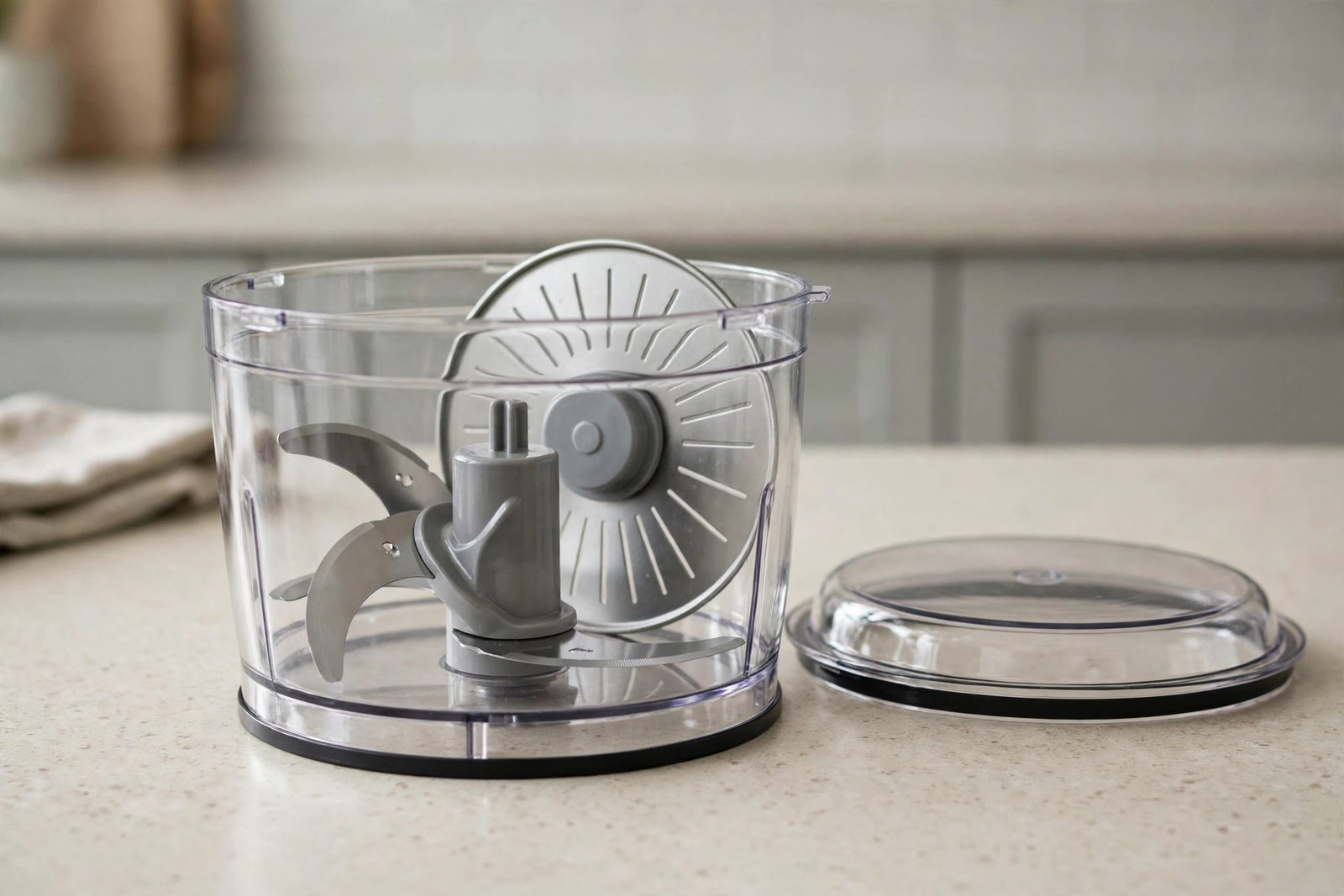
If your batches outgrow the minis, the Elemental is the next size: an 8-cup work bowl with measurement markings, a 350-watt motor, rubberized High/Low/Off/Pulse buttons, and a feed tube in the lid for adding food while it runs. The listing includes a chopping/mixing/dough blade and a reversible slicing/shredding disc (medium to fine) — one disc, two faces, no thickness adjustment — and Cuisinart’s manual says the blades and discs can be stored within the work bowl, keeping storage to one object. Listing dimensions are 7.6 inches deep × 9.58 inches wide × 15.19 inches high; weight conflicts between sources (6 pounds on the listing, 10.2 in one review’s text), so plan on the heavier figure for any shelf. This is also the machine whose manual prints the capacity chart quoted above — 2 cups chopped, 4 cups thin liquid, 2½ cups of flour for dough — so its working batches are the best documented here. Choose it for slaw, salsa and dough in real quantities, not for a counter that barely fits a mini.
Check latest price on Amazon

Side by side
Swipe sideways to see all columns →
| Product | Bowl (rated) | True working capacity (plan on) | Footprint W × D × H (in) | Accessories & storage | Power (brand figures) | Check latest price |
|---|---|---|---|---|---|---|
| Hamilton Beach Stack & Press Mini (72860) | 3 cups, glass | ~1–1½ cups chopped | 5.9 × 5.2 × 8.5 | 1 blade, stores in bowl | 350W | Check latest price on Amazon |
| KitchenAid 3.5-Cup Chopper (KFC3516) | 3.5 cups | ~1½ cups chopped | 7 × 5.95 × 8.74 | 1 locking blade, drizzle basin | 240W | Check latest price on Amazon |
| Cuisinart Mini-Prep Plus (DLC-2ABC) | 3 cups (24 oz) | ~1–1½ cups; liquids ~½ bowl | 7 × 5 × 9.25 | 1 reversible blade, spatula | 250W | Check latest price (24 Nov 2026) — Check latest price on Amazon |
| Ninja Express Chop (NJ110GR) | 2 cups (16 oz) | ~1 cup | 5.75 × 5.75 × 10.13 | 4-blade set, splash guard, storage lid | 200W | Check latest price (24 Nov 2026) — Check latest price on Amazon |
| KitchenAid 7-Cup (KFP0711) | 7 cups | ~2–3½ cups chopped | 10.1 × 9.9 × 14.6 | Blade + adjustable slicing disc + reversible shredding disc; no storage case | 336W (Consumer Reports figure) | Check latest price on Amazon |
| Cuisinart Elemental 8-Cup (FP-8SV/FP-8GM) | 8 cups | 2 cups chopped, 4 cups liquid (manual chart) | 9.58 × 7.6 × 15.19 | Blade + reversible disc; store in bowl per manual | 350W | Check latest price on Amazon |
When to skip a compact food processor
Skip the mini class if you regularly shred cheese by the block, slice vegetables for a crowd, or knead dough — even the 8-cup step-up caps dough at 2½ cups of flour by its own manual, and the minis have no discs at all. Skip any of these if your only storage spot is a high shelf you cannot reach with two hands: the step-up models weigh 6 to 14 pounds by published figures, and a machine you dread lifting is a machine you will not use. Skip the Ninja specifically if your cabinet gap is tight — at 10.13 inches plus hand room for the pod, it is the tallest mini here despite the smallest bowl. And if you already own a blender that handles your sauces and a box grater you actually use, a second chopping appliance only makes sense when the counter space is genuinely free.
Measurement checklist
- Cabinet gap: countertop to the underside of the upper cabinets, at the exact spot — plus hand room for a pusher or a top-mounted pod.
- Footprint: base width and depth at the spot, with the cord’s reach to the outlet.
- Accessory storage: where every blade, disc and pusher will live — inside the bowl, or a measured drawer slot.
- Bowl fill line: find the MAX line on the bowl; plan liquids at or below it (roughly half the rated cups).
- Batch size: your usual batch in cups of chopped food — about a quarter to a half of the rated bowl size per batch.
- Lift test: the machine’s weight against the shelf it will live on, and your willingness to lift it weekly.
- Outlet: standard 120V; every machine here draws 200–350 watts by brand figures.
FAQs
How much can a 3-cup food processor really chop? Plan on about 1 to 1½ cups per batch. Cuisinart’s own manual chart for its 8-cup model caps chopped food at 2 cups — a quarter of the rated size — and the same tumbling physics applies at mini scale. Liquids should stay at or below the bowl’s fill line, roughly half the rated cups.
Will a food processor fit under my cabinets? The minis here stand 8.5 to 10.13 inches tall, so they fit under almost any cabinet run. The 7- and 8-cup models stand 14.6 and 15.19 inches — under a standard roughly 18-inch gap they fit, but measure your exact spot, and remember a feed-tube pusher needs travel room above the lid.
Where do the blades and discs go? Minis have one blade that stores in the bowl. The Cuisinart Elemental’s manual says its blade and disc store within the work bowl. The KitchenAid 7-Cup ships with no storage case, so its two discs and drive adapter need a drawer slot — measure that slot before you buy, not after.
Chopper or full processor — which class do I need? If your jobs are garlic, herbs, onions, nuts and small sauces, a 2- to 3.5-cup chopper is enough and stores as one object. If you slice or shred weekly, or knead small doughs, you need the discs — that means the 7- to 8-cup class, with the height and storage bill that comes with it.
Can I make dough in a compact processor? Only in the step-up class, and only small batches: Cuisinart’s manual caps its 8-cup model at 2½ cups of all-purpose flour for bread or pizza dough. The KitchenAid 7-Cup here includes no dough blade, and the minis are not dough machines at all.
Keep Reading
- Will It Fit? The Cabinet Measurement Worksheet — the measure-first method used throughout this guide.
- Mini Air Fryer Footprint and Storage — the same footprint-first thinking for the other countertop staple.
- Best Instant Pot for a Studio Apartment — if one multi-cooker has to cover prep-adjacent jobs too, start here.
- Organize a Small Kitchen Without Drilling — renter-safe ways to free the counter your processor needs.
- Galley Kitchen Organization Zones — zoning a narrow room so appliances earn their footprint.