

If your studio kitchen has one usable counter outlet, or your RV has exactly one place a burner can sit, a portable induction cooktop looks like the easy answer: no gas line, no 240V outlet, no drilling. Plug it in, put a pan on it, cook. That part is true. The part most roundups skip is that the plug is the whole decision. A full-power portable induction burner draws about 15 amps at 120 volts — the full rating of a standard 15-amp circuit — so what else shares that circuit matters as much as the cooktop itself.
This guide is built around three measurements you can take before you spend anything: your outlet and circuit, the flat base of your smallest pan, and the counter space you can actually give up while cooking. Every product below carries its brand-published wattage, pan-size limits and footprint — including where the sources disagree.
As an Amazon Associate, HomeXWander earns from qualifying purchases made through links on this page — at no extra cost to you.
First, the honest part: two burners do not mean twice the power
Here is the split you need to understand before any product list makes sense.
Single-burner portables put all of their wattage into one zone. On a standard 120V outlet, that ceiling is 1,800 watts — because 1,800 watts at 120 volts is 15 amps, and 15 amps is what a standard household circuit and a standard RV shore-power outlet are built around.
Double-burner portables do not escape that math. None of the dual-zone units here is rated above 1,800 watts total. A second zone divides the same power; it does not add to it. The brands divide it differently: Duxtop’s double caps combined output at 1,800 watts and lowers one zone when you raise the other; NuWave’s double drops to about 900 watts per side when both zones run; some doubles fix the split at the factory (one manual, for example, gives 1,200 watts left and 600 watts right). So the real question is not “one burner or two?” It is: do you want one fast burner, or one burner plus a second zone that simmers while the first one works?
Measure first: three numbers decide everything
1. Your outlet and circuit. Find your breaker box and note which outlets share a circuit with the spot where you would cook. A 1,800W cooktop at full power uses a 15-amp circuit’s full rating, so a microwave, toaster oven or space heater on the same breaker is what trips it. Duxtop’s manuals ask for a dedicated 15-amp outlet. If your circuit is shared, look for a selectable wattage cap: NuWave’s PIC Flex publishes its draw at each setting — 5.0 amps at 600W, 7.5 amps at 900W and 10.8 amps at 1,300W. In an RV, the same math applies to shore power, and on battery power a 1,800W burner needs an inverter whose continuous rating can carry it. Plug directly into the wall outlet — skip power strips and light extension cords for a load this size.
2. Your smallest pan. Induction only heats magnetic cookware: cast iron, enameled iron or steel, and stainless steel with a magnetic bottom. The quick check is a magnet — if it sticks firmly to the flat base, the pan will generally work; aluminum, copper, glass and ceramic will not, and Duxtop names 18/10 and 18/8 stainless as incompatible. Passing the magnet test is not the end of it. Every brand here also publishes a minimum base diameter, and the spread is wide: 3 inches on the NuWave PIC Flex, about 4 inches on the Duxtop 9100MC class, and 5 inches on both Duxtop LCD models. A milk pot with a base under 5 inches is exactly what a Duxtop LCD model is specified to reject and what the NuWave is specified to accept. Measure the flat base of your smallest pot — not the rim — before you compare anything else.
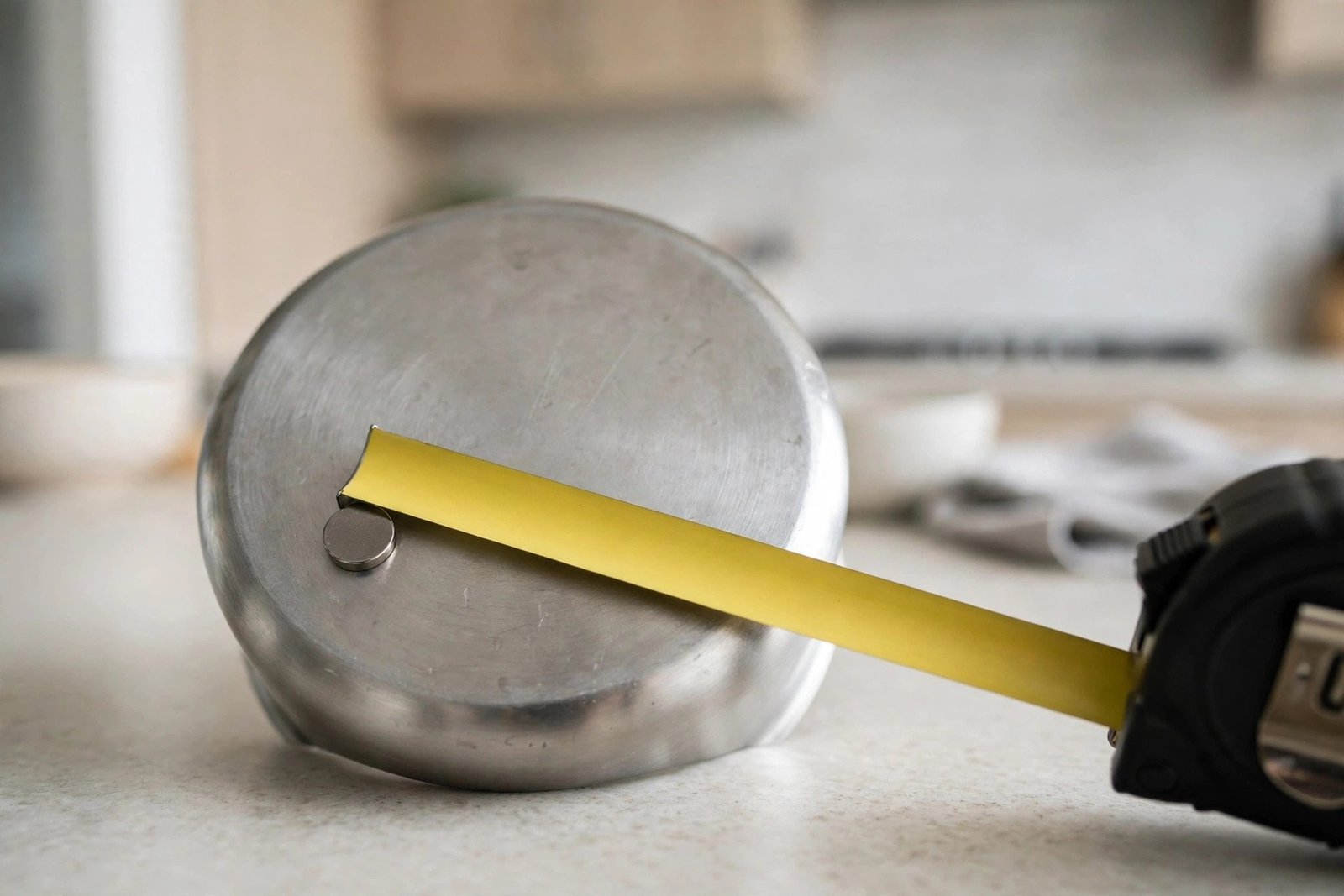
3. Your counter, while cooking. A single burner here is roughly 11 to 14 inches in each direction and about 2.5 inches tall, which stows in a cabinet or a deep drawer. But the operating footprint is bigger: Duxtop’s double-burner manual asks for at least 4 inches of clearance around the unit for ventilation, which turns a 24-inch-wide double into roughly 32 inches of counter while it runs. Measure the run of counter you can give up at mealtime, not the shelf it will live on. Also check the cord — published lengths run from about 3 to 6 feet by model — and weigh your heaviest pan: manuals cap the load on the glass (25 pounds on some models).
The cooktops, measured
1. Duxtop 9600LS LCD Sensor Touch — the full-power single burner
The 9600LS is Duxtop’s LCD single burner: 20 power levels from 100 to 1,800 watts and 20 temperature settings from 100°F to 460°F, on a 120V, 15-amp outlet, with a timer programmable up to 10 hours. The published footprint is about 11.4 × 14 × 2.5 inches at about 5 pounds 12 ounces — the size of a large cutting board, stowing flat. Two numbers decide whether it fits your kitchen. First, the pan rule: Duxtop requires a flat magnetic base of at least 5 inches. Second, the circuit rule: at full power this is a 15-amp load, and the manual asks for a dedicated outlet. If your circuit is yours alone and your pans are 5 inches or more at the base, this is the straightforward full-power pick.
Check latest price on Amazon
2. Duxtop 1800W Portable (9100MC class) — the simpler, cheaper-feeling single
The button-panel Duxtop portable in this class trades the LCD screen for 15 power levels from 200 to 1,800 watts and 15 temperature settings from 140°F to 460°F, with a countdown timer up to 170 minutes. The spec sheet for the 9100MC lists about 14 × 11.4 × 2.5 inches at about 6 pounds, a 6-foot cord, and a cookware base range of 4 to 8.5 inches — a smaller minimum than the LCD models, which helps if your smallest saucepan sits between 4 and 5 inches. Published dimensions conflict between sources (one independent review measures about 11 × 14 × 2.7 inches), so plan on roughly an 11-by-14-inch rectangle about 2.5 to 2.7 inches tall and confirm on the listing. Electrically it is the same story as every 1,800W single: 120V, 15 amps, best on its own circuit.
Check latest price on Amazon
3. NuWave PIC Flex — the shared-circuit and small-pan pick
The PIC Flex is the exception in this guide. Instead of one maximum wattage, it offers three selectable caps — 600, 900 or 1,300 watts — and NuWave publishes the current draw at each: 5.0, 7.5 and 10.8 amps at 120V. On a shared apartment circuit or a modest RV inverter, that cap is the difference between cooking and tripping a breaker. It also accepts the smallest pans here: a 3-inch (76 mm) minimum base, with a 10-inch maximum. The trade-offs are real. The 1,300W ceiling is the lowest maximum in this guide, so a large pot takes longer to boil. And the footprint figures conflict: NuWave’s own store lists 10 × 12.5 × 2.25 inches at 9 pounds for the bundled version, while other sources could not confirm dimensions from NuWave’s documents at all. One more listing conflict: some spec fields show 1,400 watts for this family while the titles and manuals say 1,300. If your circuit or your smallest pot is the constraint, this is the pick built for it.
Check latest price on Amazon
4. NuWave PIC Gold — selectable wattage with a higher ceiling
The PIC Gold (model 30211) sits between the Flex and the full-power singles. NuWave rates it at 1,500 watts maximum with three selectable wattage settings — 600, 900 or 1,500 — so you can cap the draw on a shared circuit and still get more top-end power than the Flex when the circuit is free. Temperature control runs from 100°F to 575°F in 10-degree increments, over an 8-inch heating coil under a 12-inch cooking surface. NuWave’s store lists the body at 13.75 inches deep × 12.375 inches wide × 2.625 inches high and 5.3 pounds. Treat the selectable cap as the feature: on a 15-amp circuit shared with a fridge or a microwave, running at 900W leaves headroom a fixed 1,800W burner cannot. Confirm the exact settings on the live listing — NuWave sells several PIC variants with similar names and different ceilings.
Check latest price on Amazon
5. Duxtop 9620LS Double — one fast burner plus a simmer zone
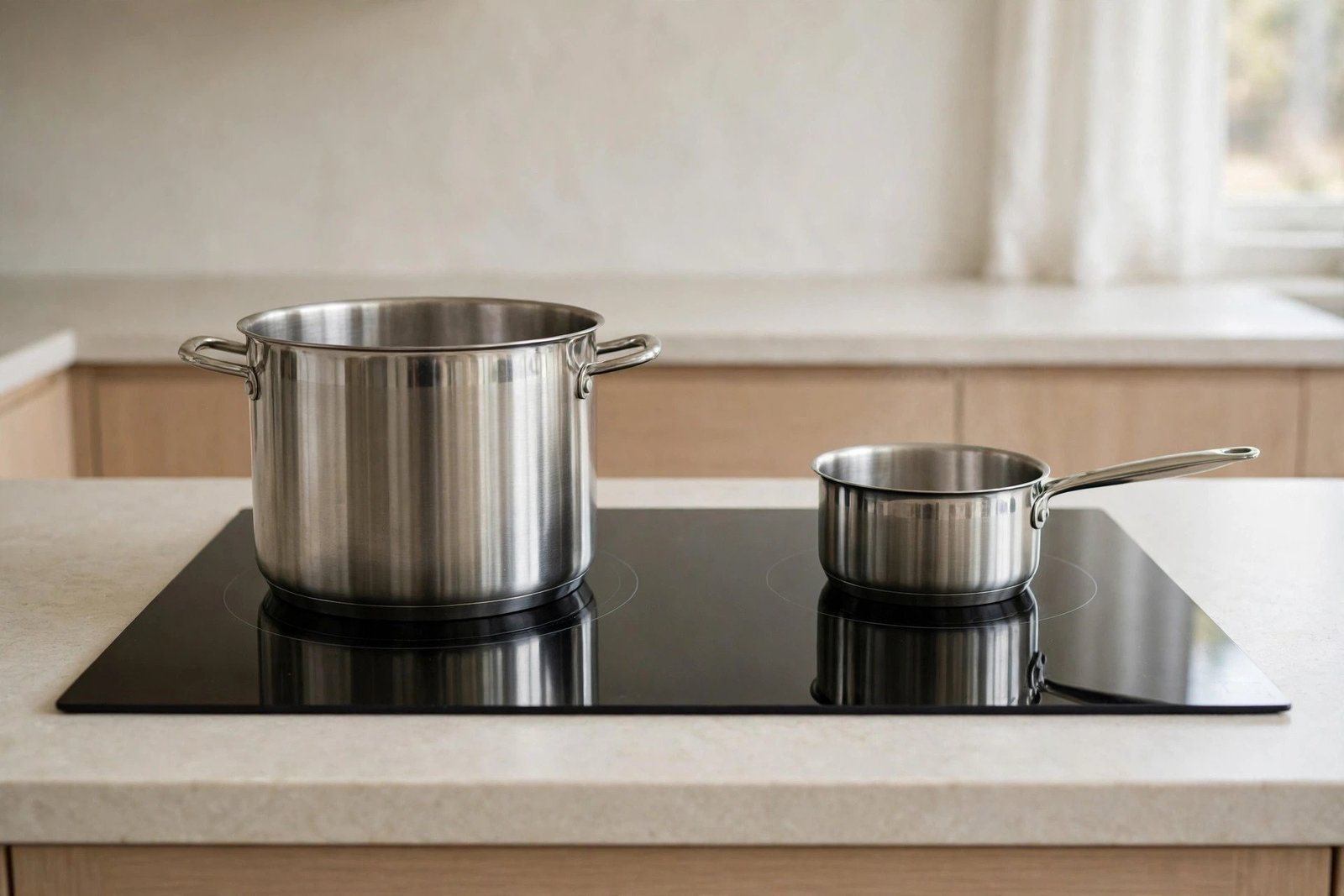
The 9620LS (also sold as model BT-350DZ) is the double to pick when you want one genuinely fast zone. Duxtop’s manual publishes the sharing table: the left zone alone reaches 1,800 watts, the right zone alone reaches 1,000 watts, and combined output is capped at 1,800 watts — raise one zone and the other comes down. The manual lists 23.9 × 14.2 × 2.4 inches at 12 pounds 7.7 ounces, a 5-foot cord, a 5-inch minimum pan base, and at least 4 inches of ventilation clearance. Note the conflict: Amazon’s dimension field for this listing shows the axes scrambled (4 × 17.1 × 25 inches), so plan around the manual’s 23.9-inch width plus clearance — roughly 32 inches of counter while cooking. This is a two-pan setup for a real counter run, not a stow-it-in-a-drawer burner.
Check latest price on Amazon
6. NuWave PIC Double — two equal zones, shared evenly
NuWave’s double takes the even-split approach: two 8-inch heating zones in one body, 1,800 watts total, with wattage options of 900, 1,500 or 1,800. When both burners run at once, published figures put each side at about 900 watts — enough to simmer and hold, not enough for two hard boils at the same time. Temperature control runs from 50°F to 575°F in 5-degree increments (106 settings by the listing), with independent controls per zone. Guide and retailer figures put the body at about 23.6 × 14.2 × 2.6 inches and roughly 14 to 16 pounds depending on source, so it needs the same 24-inch-plus counter run as the Duxtop double. One electrical conflict: some listing fields show 115 volts while NuWave describes the family as 120V — plan on a standard 15-amp circuit and confirm on the live listing.
Check latest price on Amazon
Side by side
Swipe sideways to see all columns →
| Product | Zones | Power (brand figures) | Current draw | Pan base (brand figures) | Footprint (brand/guide figures) | Check latest price |
|---|---|---|---|---|---|---|
| Duxtop 9600LS LCD | 1 | 100–1,800W, 20 levels | 15A at full power (120V) | 5 in minimum | ~11.4 × 14 × 2.5 in, ~5 lb 12 oz | Check latest price on Amazon |
| Duxtop 1800W Portable (9100MC class) | 1 | 200–1,800W, 15 levels | 15A at full power (120V) | 4–8.5 in | ~14 × 11.4 × 2.5 in (sources conflict), ~6 lb | Check latest price on Amazon |
| NuWave PIC Flex | 1 | 600 / 900 / 1,300W selectable | 5.0 / 7.5 / 10.8A published | 3 in minimum, 10 in maximum | ~10 × 12.5 × 2.25 in (brand store; unconfirmed elsewhere) | Check latest price on Amazon |
| NuWave PIC Gold (30211) | 1 | 600 / 900 / 1,500W selectable | Up to ~12.5A at 1,500W (120V) | 8 in coil, 12 in surface | 13.75 × 12.375 × 2.625 in, 5.3 lb | Check latest price on Amazon |
| Duxtop 9620LS Double (BT-350DZ) | 2 | Left 1,800W / right 1,000W alone; 1,800W combined cap | 15A at full combined power (120V) | 5 in minimum | 23.9 × 14.2 × 2.4 in + 4 in clearance, ~12 lb 8 oz | Check latest price on Amazon |
| NuWave PIC Double | 2 | 1,800W total; ~900W per side with both on | 15A at full combined power (120V) | Two 8 in zones | ~23.6 × 14.2 × 2.6 in, ~14–16 lb (sources conflict) | Check latest price on Amazon |
When to skip a portable induction cooktop
Skip it if your lease or dorm rules ban countertop cooking appliances — portable does not mean permitted. Skip it if your only circuit already trips with a microwave and you cannot run the cooktop alone on it. Skip it if none of your pans pass the magnet test and you are not willing to replace cookware — that is the most common reason these burners come back. Skip the doubles if your counter run is under about 24 inches plus clearance. And in an RV, skip full-power cooking on battery unless your inverter’s continuous rating comfortably covers the draw.
Measurement checklist
- Breaker box: which circuit serves the cooking spot, 15A or 20A, and what shares it?
- Outlet: standard 120V, grounded, within cord reach (about 3–6 ft by model) of the spot?
- Smallest pan: flat base diameter measured — 3, 4 or 5 inches decides the model?
- Magnet test: does a magnet stick firmly to every pan you plan to use?
- Counter run: 11–14 in for a single, ~24 in plus 4 in clearance for a double?
- Storage: a cabinet, drawer or RV locker that fits a ~2.5 in tall slab?
- Heaviest pan: full weight under the manual’s glass load limit (25 lb on some models)?
- RV power: shore-power amps, or inverter continuous watts, honestly sized?
FAQs
Will a 1,800W induction cooktop trip my breaker? It can, if the circuit is shared. At 120V, 1,800 watts is 15 amps — the full rating of a standard 15-amp circuit. Run the cooktop alone on its circuit, plug it directly into the wall outlet, and if sharing is unavoidable, pick a model with a selectable wattage cap like the NuWave PIC Flex (5.0A at 600W) or PIC Gold.
Do my existing pans work on induction? Only if the base is magnetic. Cast iron, enameled iron or steel, and magnetic stainless steel work; aluminum, copper, glass and ceramic do not. A magnet stuck firmly to the flat base is the quick check — then measure that base, because the minimum diameter (3 to 5 inches by model) rejects small pots that pass the magnet test.
Is a double burner twice as powerful as a single? No. Doubles here are rated at 1,800 watts total, the same ceiling as a single. The Duxtop double gives one zone up to 1,800W alone but caps the pair at 1,800W combined; the NuWave double runs about 900W per side with both on. A second zone is for simmering alongside, not for two full-power boils.
Can I use one in an RV or a dorm? In an RV on shore power, yes — these are built for standard 120V outlets, and the singles stow flat. On battery power, size your inverter first; 1,800W is a heavy continuous load, and a selectable-wattage model is easier on the system. In a dorm, check the housing rules before you buy: many ban cooking appliances outright, induction included.
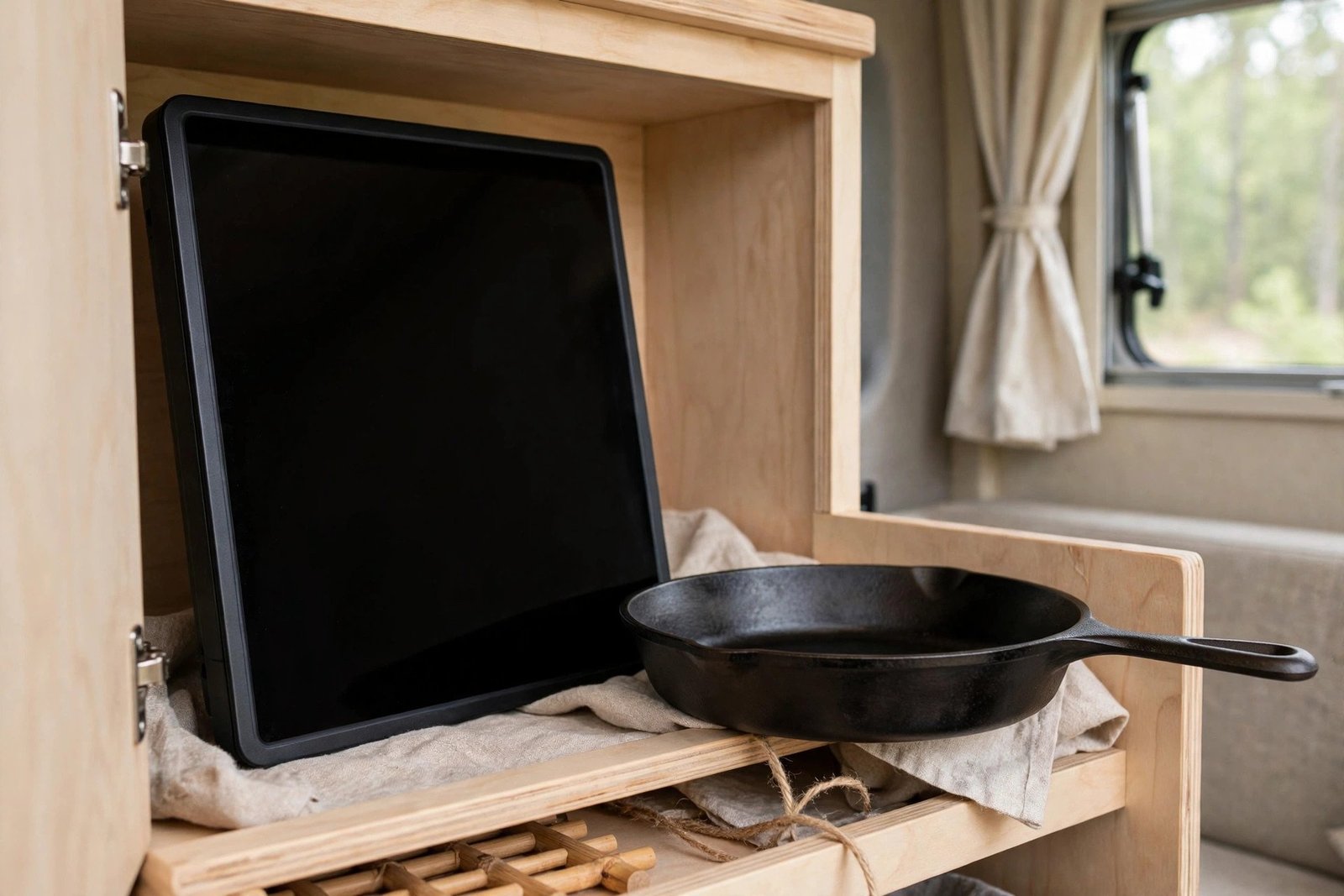
Does it need any installation or drilling? No. Every model here is a countertop unit that sits on a stable, flat surface and plugs in — no cutout, no gas line, no landlord permission for the appliance itself. Keep the manual’s ventilation clearance around it, keep it off wet surfaces, and store it flat when it cools.
Keep Reading
- Will It Fit? The Cabinet Measurement Worksheet — the measure-first method used throughout this guide.
- How to Organize a Small Kitchen Without Drilling — renter-safe fixes that need no landlord permission.
- Galley Kitchen Organization: 5 Zones That Work Without Drilling — zoning a narrow kitchen so a portable burner earns its counter space.
- Best Instant Pot for a Studio Apartment — the other 120V appliance competing for the same outlet and counter.
- Mini Air Fryer Footprint & Storage — where a countertop appliance lives when you are not cooking.