

Most fridge-bin sets are photographed inside a big French-door fridge, clear boxes stretching wall to wall. If your kitchen runs on a 24-inch apartment fridge, those same bins arrive too wide, too deep, or too tall — and end up holding socks in a closet.
The problem is not the bins. It is the shelf. A fridge sold as “24-inch” does not give you 24 inches inside: published interior specs for current 24-inch-wide models put usable width at roughly 20 to 21 inches and depth at about 16.5 to 18 inches, and many models lose the back of the bottom shelf to a raised compressor step. This guide works the other way around: measure the shelf you actually have, then match bins to it — width, depth, height, and door clearance.
As an Amazon Associate, HomeXWander earns from qualifying purchases made through links on this page — at no extra cost to you.
Step 1: Measure the shelf you actually have
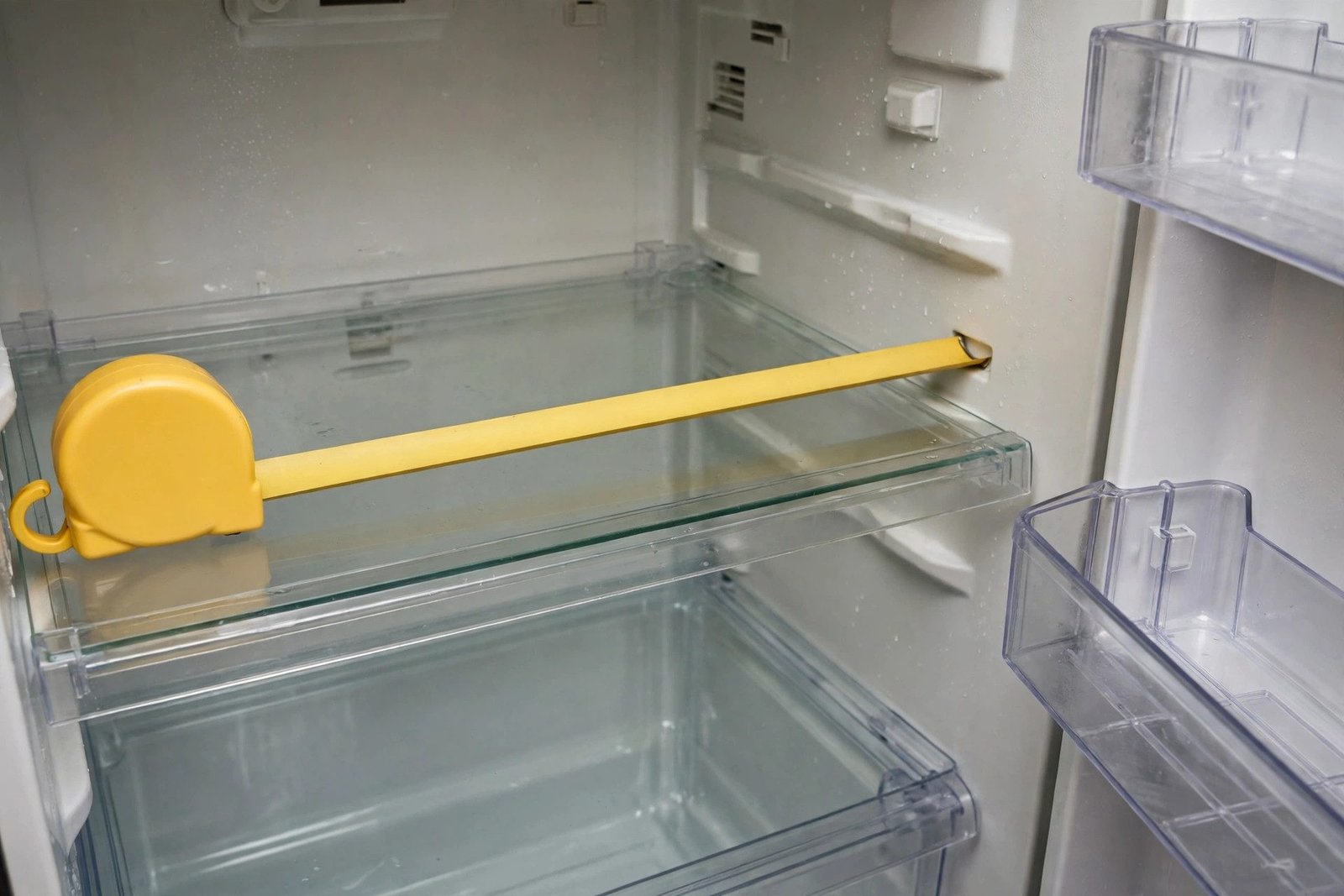
Five minutes with a tape measure decides whether a bin becomes storage or a return label. Write down four numbers for the shelf you plan to organize:
- Shelf width, wall to wall. Measure at the shelf itself, not the door opening. On a 24-inch fridge this is usually 20 to 21 inches — your total budget for everything side by side.
- Usable depth, back wall to closed door. The number people get wrong. The shelf may measure 17 or 18 inches deep, but door bins project inward when the door closes. Put a tall jar at the back, close the door gently, and check the free depth. A bin that fits with the door open can still stop it sealing.
- Shelf-to-shelf height. This decides whether anything can stack and whether a riser has room to work. Measure from shelf surface to the underside of the shelf above.
- The bottom-shelf step. Many compact fridges have a raised step at the back of the bottom shelf, roughly 5 to 6 inches deep on published specs, and a long bin will not sit flat across it. If yours has one, plan shorter bins for that shelf and save long bins for the flat shelves above.
One more check: the door bins. If they already hold your bottles and jars well, shelf bins only need to handle the rest — produce, leftovers, cheese, packets. That usually means fewer, smaller bins than the big sets suggest.
Step 2: Which shelf problem do you have?
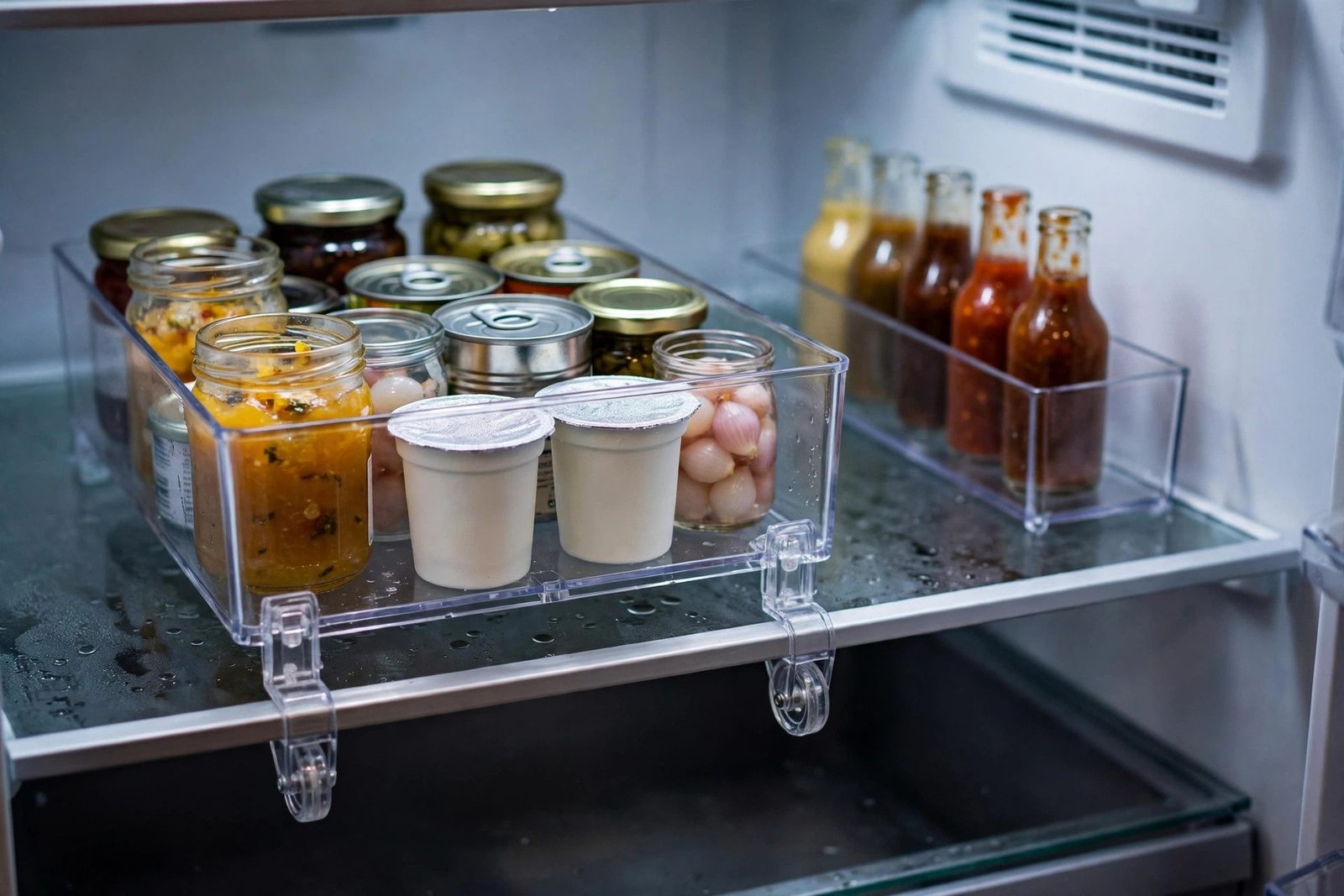
A long, narrow lane of jars and condiments. Sauces and jars in a single row keep getting pushed to the back. A slim, long bin — around 6 inches wide, 15 to 16 long — turns that lane into one pull-out row you can see into. Two side by side use about 12 inches, leaving a lane for milk or a pitcher.
A deep shelf where the back row disappears. If things go to the back to be forgotten, a rolling caddy beats a static bin. It needs a flat shelf and door clearance — your depth measurement confirms both.
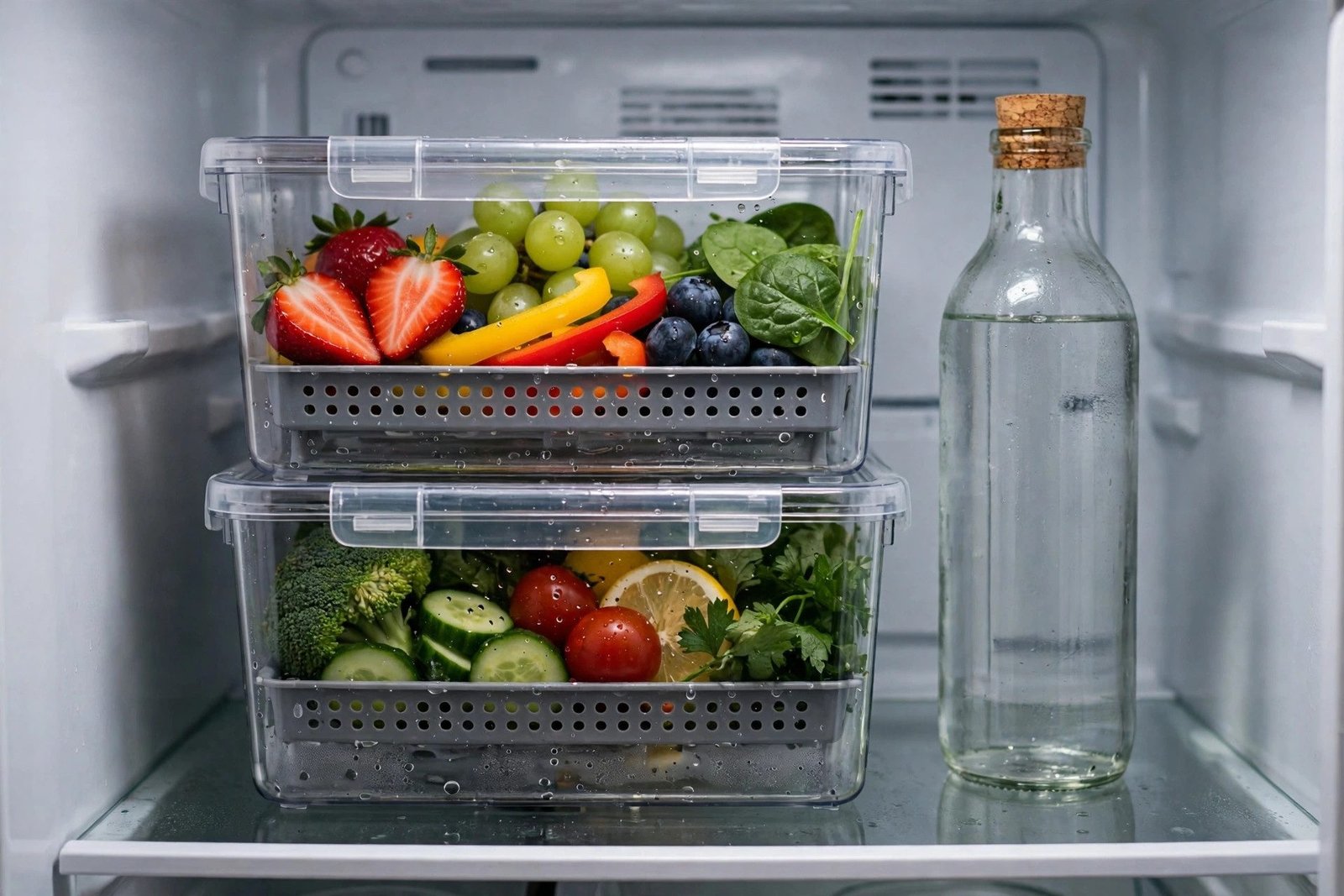
Leftovers and produce with nowhere to stack. Stackable mid-size bins, roughly 12 inches long, leave a strip at the back of a 17- to 18-inch shelf for bottles and give leftovers a defined zone. Lidded versions stack more securely; open ones are quicker to grab from.
One shelf that is too tall. If a shelf has 10-plus inches of height and everything in it is short, a riser splits it into two levels. The riser must be short front-to-back — around 15 inches — and your shelf height must clear it.
Smalls everywhere. Cheese, packets, eggs, half-used tubs. A mixed-size set with genuinely narrow bins — 4 inches wide or less — fills leftover lanes standard bins cannot use.
The bins, sized to the shelf
iDesign Slim Extra Long Clear Storage Bin — best long, slim lane for jars
The classic narrow-fridge bin: a clear tray listed at 16 inches long, 6 wide, and 3 tall. On a 17- to 18-inch-deep shelf, that length leaves an inch or two at the front so the door bins still clear. Two side by side take about 12 inches of width, leaving roughly 8 beside them — enough for a milk carton or pitcher.
It suits jars, sauces, and yogurt cups that migrate to the back. The limits: open top, low 3-inch walls, no lid for stacking — tall bottles will still tip. A slimmer 4-inch version exists in the same line, so confirm the 6-inch width when ordering.
YouCopia RollOut Fridge Caddy, 6-Inch Wide — best for a deep shelf’s lost back row
Where a static bin still asks you to reach, this caddy rolls toward you on small wheels. The 6-inch version is listed at 15 inches long, 6 wide, and 2.3 tall. Fifteen inches fits inside a 17- to 18-inch shelf depth, and the width matches the slim-lane layout — one caddy plus a standing lane beside it.
It earns its keep with small jars, cans, and tubs that hide at the back. Two cautions: the low walls corral smalls, not bottles, and the wheels need a flat shelf — they will not roll happily across a bottom-shelf compressor step. A 9-inch version exists, but in a 20- to 21-inch interior it eats nearly half the shelf.
Utopia Home Stackable Storage Bins, 8-Pack Medium — best stackable set for leftovers
Eight medium bins, each listed at 12.4 inches long, 6.2 wide, and 3.5 tall. The length is the point: on a 17- to 18-inch shelf it leaves a 5-inch strip at the back for bottles, while the bins handle the front zone. Two across use about 12.4 inches of width at the listed size, leaving a usable lane beside them.
Two honest flags. The listing says 6.2 inches wide, but at least one buyer review reports measuring closer to 5.5 — treat the width as approximate and measure on arrival before planning a three-across layout. The same reviews describe stacking as steadier when bins alternate direction. Eight bins is more than one small fridge needs; expect a few in the pantry.
Hudgan 8-Pack Stackable Bins, 3 Sizes — best mixed set for leftover lanes
Three sizes in one set: two extra-large bins listed at 13.5 by 7.5 by 5.5 inches, two large at 11.2 by 6.7 by 3.7, and four small at 10 by 4 by 3. For a narrow fridge the small bins matter most — at 4 inches wide they fit leftover lanes beside a milk carton that nothing else uses. The extra-large bin’s 13.5-inch length still fits a 17- to 18-inch shelf easily.
Straight sides waste less space than tapered bins — every inch counts. The limits: no lids, so stacking means stacking open bins — and confirm the size mix before ordering, because Hudgan sells several similar 8-packs with different combinations.
Check latest price on Amazon
ZIJUND 14-Pack Fridge Organizer Bins With Lids — best lidded set for stacking
Fourteen lidded bins in three sizes: two large listed at 11.8 by 8 by 3.9 inches, four medium at 10.5 by 3.8 by 3.5, and eight small at 5 by 3 by 3. The mediums are the narrow-fridge workhorses — at 3.8 inches wide they slide into lanes standard bins cannot use, and the lids allow stacking where shelf height permits. The large bins include drain trays.
Read the size list first: the large bin is 8 inches wide, which in a 20- to 21-inch interior means one across, not two. The lids are honestly described as not airtight — they keep dust and odors down and allow stacking, but they do not seal food like a storage container. Fourteen pieces is a lot for one compact fridge; it makes sense only if the overflow has a second job in a pantry or freezer.
OXO Good Grips Adjustable Fridge Shelf Riser — best if one shelf is too tall
Not a bin but a fix for the shelf above the bins: a platform about 15.4 inches long whose width adjusts from roughly 5.9 to 8.7 inches, with five height settings and a listed 25-pound capacity. Fifteen inches fits a 17- to 18-inch shelf, and the adjustable width lets it share a shelf with a slim bin beside it. Short items go under and on top; the wasted air becomes a second level.
The catch is height: at its taller settings the riser needs real shelf-to-shelf clearance, which compact fridges do not always have — your Step 1 measurement decides. It is hand-wash only, and it solves one shelf at a time, so start with the shelf that wastes the most air.
Fridge bin fit table
Sizes are as listed (checked November 2026). “Fits” assumes a typical 24-inch interior of about 20 to 21 inches wide by 17 to 18 deep — your Step 1 measurements overrule this table.
Swipe sideways to see all columns →
| Bin | Listed size (L × W × H) | Fits a 20–21″ × 17–18″ shelf? | Best for | Price |
|---|---|---|---|---|
| iDesign Slim Extra Long Bin | 16 × 6 × 3 in | Yes — 2 across = ~12 in wide | Jars, condiments | Check latest price |
| YouCopia RollOut Caddy 6″ | 15 × 6 × 2.3 in | Yes — needs flat shelf to roll | Deep shelf back row | Check latest price |
| Utopia Home 8-Pack Medium | 12.4 × 6.2 × 3.5 in each | Yes — 2 across; width may measure ~5.5 in | Leftovers, produce | Check latest price |
| Hudgan 8-Pack, 3 Sizes | XL 13.5 × 7.5 × 5.5; L 11.2 × 6.7 × 3.7; S 10 × 4 × 3 in | Yes — small bins fill 4-in lanes | Mixed smalls | Check latest price |
| ZIJUND 14-Pack With Lids | L 11.8 × 8 × 3.9; M 10.5 × 3.8 × 3.5; S 5 × 3 × 3 in | Yes — large is 1 across only | Stacking, washed produce | Check latest price |
| OXO Adjustable Shelf Riser | ~15.4 long; width adjusts ~5.9–8.7 in | Yes if shelf height clears it | One too-tall shelf | Check latest price |
When to skip fridge bins
Your shelf depth is under about 15 inches. Some mini fridges are shallower than the 24-inch class covered here. Below that depth, bins become obstacles you lift out to reach anything. One slim tray, or none, serves you better.
You mostly store tall bottles. Door bins already do that job, and 3-inch walls will not stop a tall bottle tipping. Organize the door first; buy shelf bins only for what is left.
Your crisper drawers already work. If produce has a home and leftovers are few, bins duplicate a working system. The honest fix is eating the leftovers, not boxing them.
You are about to move or replace the fridge. Bins are portable, but a 14-piece set bought for one fridge’s lanes may not suit the next. Start with one or two bins matched to your measurements.
Your five-minute measurement checklist
- Shelf width, wall to wall, on your target shelf.
- Usable depth: back wall to door bins, door closed — test with a tall jar at the back.
- Shelf-to-shelf height, for stacking and risers.
- Bottom-shelf step: does one exist, and how deep is it?
- Door-bin depth: what lives there now, and what is left for the shelves?
- Write the four numbers down. Every bin here either fits them or it does not — there is no third option.
Frequently asked questions
Will standard fridge bins fit a 24-inch fridge? Often not. Standard sets are sized for full-width fridges, while a 24-inch model gives you roughly 20 to 21 inches of interior width and 17 to 18 inches of depth. Bins around 6 inches wide and 15 to 16 inches long fit; wide sets built for 30-inch-plus fridges usually do not.
How deep are the shelves in a 24-inch fridge? Published interior depths for current 24-inch-wide models run about 16.5 to 18 inches. Usable depth is less once door bins swing in, and the bottom shelf may lose its back 5 to 6 inches to a compressor step. Measure with the door closed.
Can I stack bins in a small fridge? Yes, if shelf-to-shelf height allows. Lidded bins stack more securely than open ones, and some open bins stack steadier alternated front-to-back. Measure the full stack — bin plus bin plus contents — against the shelf above first.
Do fridge bins block cold air? They can if packed wall to wall. Leave gaps around bins, keep vents and fan outlets clear, and avoid filling every inch of a shelf. Bins organize; they should not seal a shelf into compartments cold air cannot reach.
Are these bins dishwasher safe? It varies, and several fridge bins are hand-wash only — the OXO riser in this guide is, and the ZIJUND set’s listing does not claim dishwasher safety. Check the specific listing before assuming; clear plastic can also warp or cloud with high heat.
Should I organize the door bins instead? Both, in that order. Door bins suit tall bottles and daily jars, and they are already built in. Shelf bins are for what the door cannot hold: produce, leftovers, cheese, packets. Measure door-bin depth before adding anything to the door.
Why do dimensions differ between listings for the same product? Listings mix outside, inside, and package dimensions, and sellers describe multi-size sets in different orders. One bin in this guide is listed at 6.2 inches wide while a buyer measured about 5.5. Treat listed sizes as a starting point and measure on arrival.
Keep reading
- Will It Fit? A Cabinet Measurement Worksheet for Small Kitchens — the same measure-first habit for cabinets.
- Best Pantry Organizer for a Small Kitchen — when the overflow belongs in the pantry, not the fridge.
- How to Organize a Small Kitchen Without Drilling — renter-safe storage for what the fridge cannot hold.
[…] Fridge Bins for a Narrow 24-Inch Fridge: Sized to the Shelf You Have — the same measure-first logic, applied to the shelves inside a narrow fridge. […]