

Bread machines have a reputation problem in small kitchens: they are big, they live in a cabinet, and they come out twice a year. The compact models below are the exception — if you check three numbers first: footprint, height with the lid open, and the loaf size it actually makes. Get those right and a bread machine can live on a small counter full-time. Get them wrong and it becomes an expensive doorstop.
This guide compares six compact bread machines on those three numbers, using the brands’ own published dimensions and capacities. One warning: the brands disagree with themselves. The same machine often carries two or three different dimension sets across its manual, spec sheet and listing. Where sources conflict, this guide says so — measure against the largest figure.
As an Amazon Associate, HomeXWander earns from qualifying purchases made through links on this page — at no extra cost to you.
First, the honest part: nobody publishes the number that matters most
Here is the honest part: no brand in this guide publishes the height of its machine with the lid open. Every dimension below is the closed height. That matters because you load a bread machine from the top, and when the loaf is done you lift a hot pan straight up out of it. Under wall cabinets, the lid needs room to swing up and back, and the pan needs room above the rim. A machine that fits closed can still be unusable there. Plan for it before you buy: pick a spot with no cabinet above, or slide the machine forward to open it.
Two more honesty notes. Loaf size is a dough-weight setting, not a supermarket loaf: a “2-pound” machine bakes from roughly four cups of flour, and the loaf comes out tall and vertical, not long and sandwich-shaped. And “compact” is a marketing word, not a standard — these machines range from about 8.5 inches wide to more than 14. Measure your counter, not the adjective.
Measure first: three numbers decide everything
1. Footprint — width times depth. Tape the machine’s outline on your counter with painter’s tape and live with it for a day. Depth is the number people forget: machine, cord bend at the back, and a little breathing room must all fit between wall and counter edge. A typical counter is about 24 to 25 inches deep — measure yours. Published cord lengths run around 40 inches.
2. Lid-open height. Measure from the counter to the underside of the wall cabinet above your spot. Compare that gap with the closed height, then add room for the lid swing and the hot pan lift. Since no brand publishes a lid-open figure, treat the closed height as a floor, not a fit guarantee. Manuals also ask for open space around the machine while it bakes — never run one inside a closed cabinet or appliance garage.
3. Loaf size — pick by household, not by appetite. Recipes scale roughly with the setting: about 2 cups of flour for a 1-pound loaf, 3 for 1.5 pounds, 4 for 2 pounds. One or two people who eat toast a few mornings a week are well served by a 1- or 1.5-pound machine. A family that finishes a loaf every day or two should start at 2 pounds. Most offer several settings, so a 2-pound machine can bake a 1-pound loaf — but its footprint does not shrink.
All six run on a standard 120V outlet at roughly 450 to 650 watts — no special circuit needed. Most include a 13-hour-plus delay timer, one more reason the machine needs a permanent, ventilated spot.

The machines, measured
1. Zojirushi BB-HAC10 Home Bakery Mini — the smallest footprint here
The true mini of this group: a 1-pound machine with a manufacturer-listed footprint of 8.5 inches wide × 11.25 inches deep × 12.25 inches high. The manual rounds those to 8 × 11 × 12 inches — plan around the larger set. Weight also disagrees (12 pounds in the manual, 12.45 at one retailer, 15 in one review), so expect roughly 12 to 13 pounds. The pan is about 4.5 × 4.5 inches inside and 5.7 inches deep: a small, tall loaf. You get a 450-watt heater, 13-hour delay timer, quick-bake under two hours, three textures with crust control, a viewing window, a carry handle and a one-year warranty. For one or two people in a small kitchen, this is the pick — the 1-pound loaf is the limit, and the point.
Check latest price (checked 24 Nov 2026) — Check latest price on Amazon
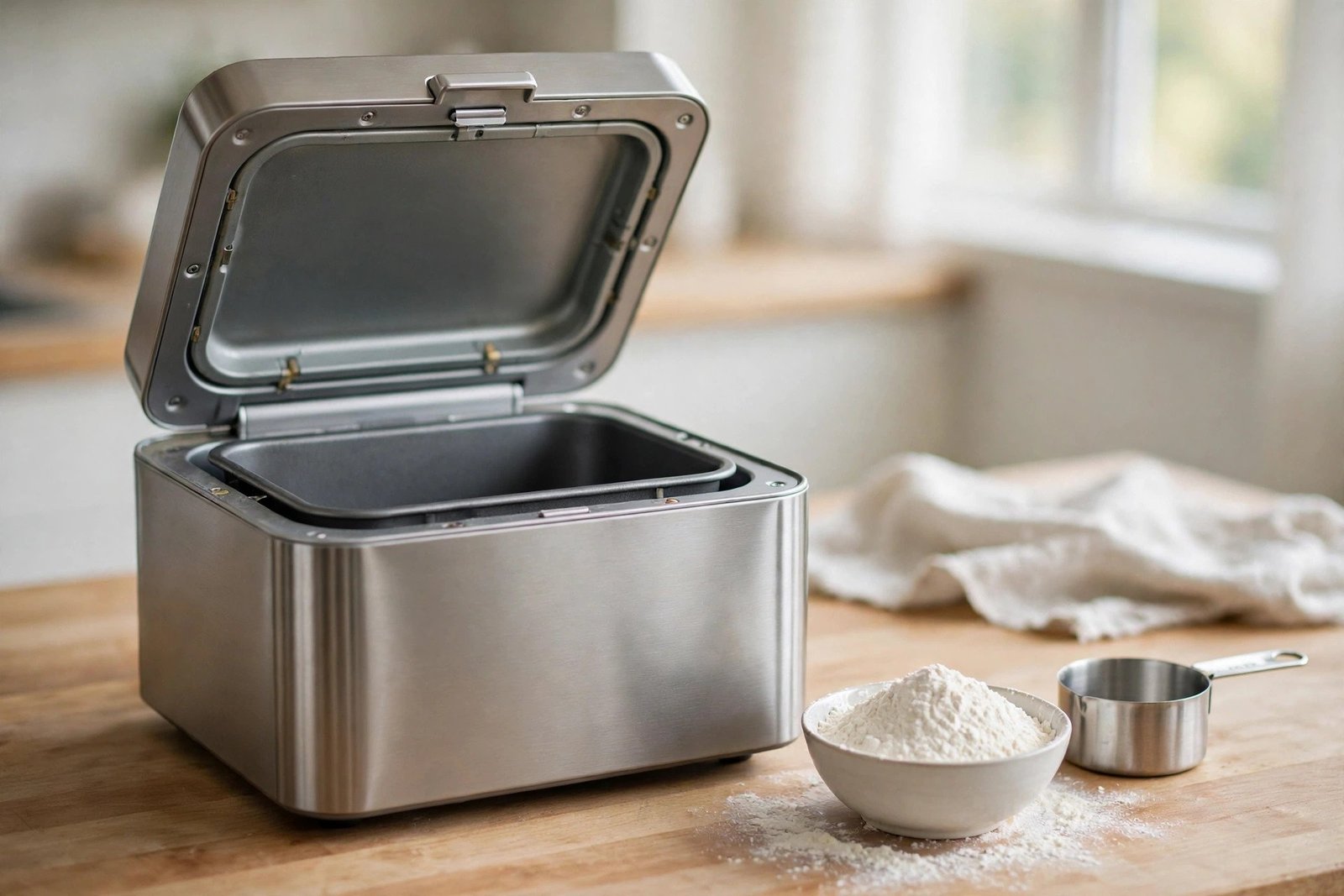
2. Dash Everyday Bread Maker — 1.5 pounds with an automatic dispenser
Dash’s Everyday bakes up to 1.5 pounds, with 1.0- and 1.5-pound settings, 12 programs including gluten-free, a 13-hour delay start, and a lid dispenser that drops in nuts or dried fruit automatically. Its dimensions are the messiest in this guide. Dash’s own website lists 11.0 × 9.1 × 10.4 inches at 9.5 pounds; listing-derived specifications give 9.5 inches deep × 10.5 inches wide × 12 inches high; one hands-on review measured 13.4 × 12.2 × 11.7 inches at 10.24 pounds. Those cannot all be right. Plan around the largest set, and measure the unit on arrival if the fit is tight. Warranty is one year, or two with registration. For mix-in loaves without babysitting the machine, the dispenser earns its space.
Check latest price on Amazon
3. Cuisinart CBK-110 — a 2-pound vertical loaf with the longest warranty
The Cuisinart CBK-110 bakes a 2-pound vertical loaf with 1-, 1.5- and 2-pound settings, 12 programs and three crust shades. Its spec sheet lists 10.25 inches long × 13.25 inches wide × 11.25 inches high, and the metric specification agrees. Some listings shuffle those numbers into a different order, making the machine look taller and narrower than it is — trust the spec sheet and plan on a 13.25-inch width. Weight is 10.75 pounds on the spec sheet, 11 in one manual summary and about 12.1 in the metric spec, so expect 11 to 12 pounds. The three-year warranty is the longest here. The balanced 2-pound choice for a kitchen with a 13-inch-wide stretch of counter — slice the tall loaf across, not along.
Check latest price (checked 24 Nov 2026) — Check latest price on Amazon
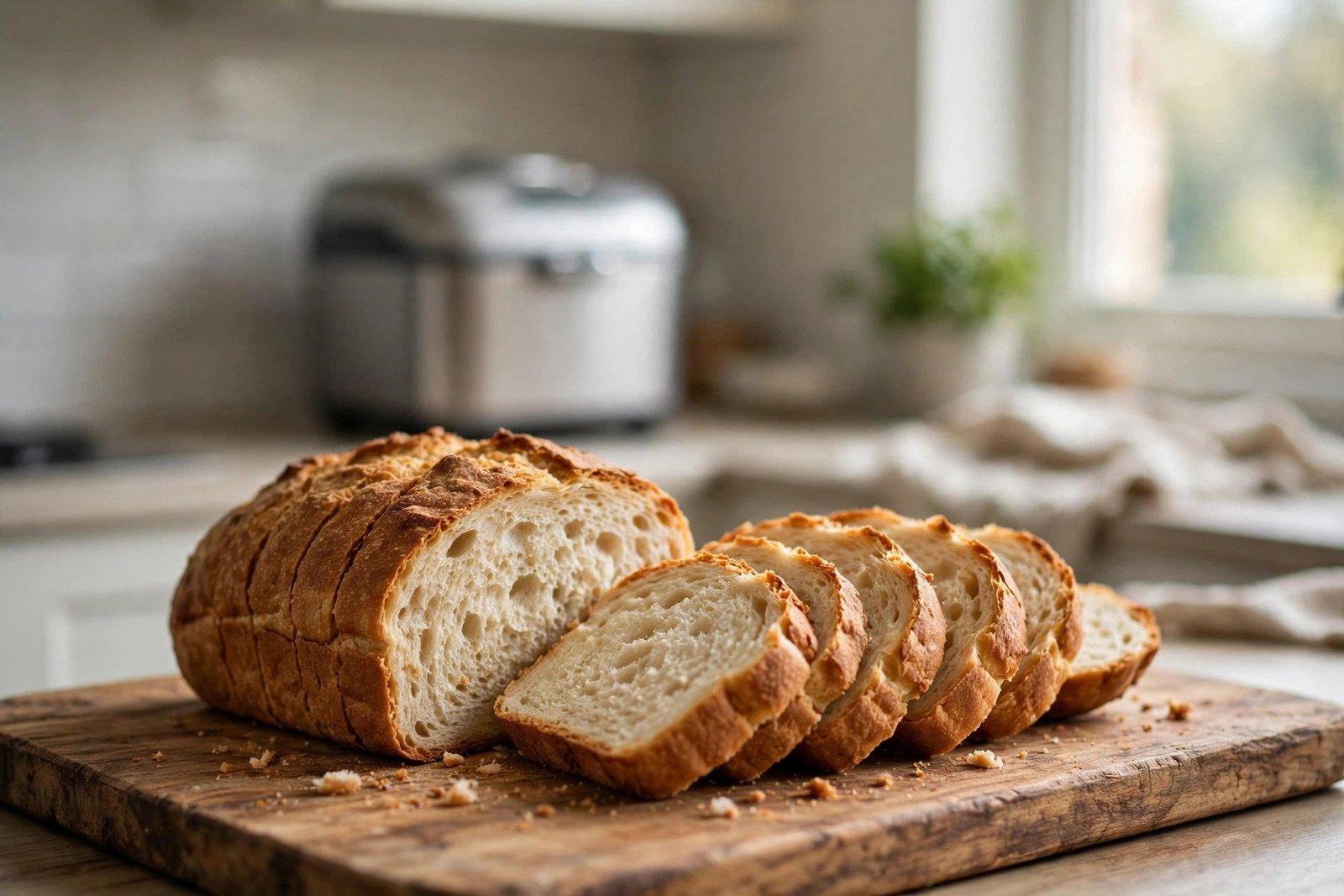
4. Elite Gourmet EBM8103B — tall, narrow, and the most programs
A 2-pound machine with 1-, 1.5- and 2-pound settings, 19 programs — the most here — and 550 watts. Listing dimensions are 9.45 inches deep × 11.89 inches wide × 13.98 inches high: the tallest machine here and one of the narrowest. Good where counter width is tight, bad under low wall cabinets. Weight is 10.73 pounds in one listing snapshot and 10.58 in another. One caution: the stainless-steel variant lists the same numbers with depth and height swapped — confirm which is the height on the live listing before measuring your cabinet gap. For program variety in a narrow footprint, this is the one to look at.
Check latest price on Amazon
5. Hamilton Beach HomeBaker 29882 — the widest footprint, check stock first
A 2-pound, 600-watt machine with 12 programs and 1.5- and 2-pound settings — no 1-pound setting, so small households bake at 1.5 pounds minimum. Listing dimensions are 10.43 inches deep × 14.13 inches wide × 12.2 inches high, already the widest footprint here, and two review sites publish larger figures: 16.38 × 12.3 × 12.75 inches and 12.4 × 16.4 × 12.8 inches. Weight is 11.88 pounds on the listing against 12.75 in a review. Plan around a 16.4-inch length. One source puts the pan at about 6 inches high × 7 inches wide × 5 inches deep, suggesting a somewhat more horizontal loaf. Availability needs a check too: a recent listing snapshot showed this model unavailable, so confirm stock first. For a family with width to spare, the capacity is right — the footprint is the price.
Check latest price on Amazon
6. Oster Expressbake CKSTBRTW20 — the budget classic nobody can measure twice the same way
The long-running budget pick: 2-pound, 1-, 1.5- and 2-pound settings, 12 programs, an express cycle under an hour, 650 watts. At 8 pounds it is the lightest machine here, easiest to move between storage and counter. Its dimensions, though, are the worst-documented in this guide. The Amazon listing gives only “14 inches wide × 14 inches high” with no depth; one retailer lists 14 × 14 × 13 inches; two review sources give roughly 12 × 11 × 11 inches and 13.8 × 13 × 14.1 inches. Nobody agrees, so plan for the largest figure — about 14 inches each way — or measure the unit on arrival. On sale since 2010, so expect a basic control panel, not a touchscreen. If budget and light weight matter more than exact dimensions, it is a sensible first machine.
Check latest price on Amazon
Side by side
Swipe sideways to see all columns →
| Machine | Footprint (W × D) | Height (closed) | Loaf sizes | Programs | Weight |
|---|---|---|---|---|---|
| Zojirushi BB-HAC10 | 8.5″ × 11.25″ | 12.25″ | 1 lb | 3 textures + quick bake | ~12–13 lb |
| Dash Everyday | 11.0″ × 9.1″ (sources conflict) | 10.4″ (sources conflict) | 1 / 1.5 lb | 12 | 9.5 lb |
| Cuisinart CBK-110 | 13.25″ × 10.25″ | 11.25″ | 1 / 1.5 / 2 lb | 12 | ~11–12 lb |
| Elite Gourmet EBM8103B | 11.89″ × 9.45″ | 13.98″ | 1 / 1.5 / 2 lb | 19 | ~10.6–10.7 lb |
| Hamilton Beach 29882 | 14.13″ × 10.43″ (sources conflict) | 12.2″ | 1.5 / 2 lb | 12 | ~11.9–12.8 lb |
| Oster Expressbake | ~14″ × ~14″ (sources conflict) | ~13–14″ | 1 / 1.5 / 2 lb | 12 | 8 lb |
Two things this table cannot show: lid-open height (no brand publishes it — every height above is closed) and loaf shape (compact machines bake tall, vertical loaves, not long sandwich loaves). Measure the space, and pick the loaf size by how much bread your household eats.
When to skip a bread machine
Skip it if you bake twice a year — a loaf pan and your oven will do, at no new counter cost. Skip it if your only counter spot sits under cabinets with a gap too small for the machine plus its open lid; a machine you cannot load comfortably will not get used. Skip it if you want long, sandwich-shaped loaves with a crisp crust — that is oven territory. And skip it if your household eats a full loaf every day and hates baking on a schedule: even the largest machine here tops out at 2 pounds per cycle, so daily bread means daily baking. In all four cases, the counter space is worth more than the machine.
Measurement checklist
- Tape the footprint. Outline the width × depth with painter’s tape, using the largest published figure where sources conflict. Live with the outline for a day first.
- Measure the cabinet gap. Counter to cabinet underside at the exact spot. Compare with the closed height, then add room for the lid swing and pan lift.
- Check the pan-lift path. The pan lifts straight up, mitts on. Make sure nothing — cabinet, shelf, hanging rail — sits in that path.
- Confirm outlet reach. Measure to the outlet the machine will use. Published cords run around 40 inches; a longer run means a different spot, not an extension cord.
- Leave heat clearance. Keep open space around the machine while it bakes, per the manuals. No closed cabinets or appliance garages; nothing stored on the lid.
- Pick the loaf size by household. About 2 cups of flour for 1 pound, 3 for 1.5, 4 for 2. Match it to what your household eats in two or three days.
FAQs
Can a bread machine fit under kitchen cabinets? Sometimes — but the closed height is only half the answer. The lid must swing open and the hot pan must lift straight out, and no brand publishes the lid-open height. Measure your gap, compare it with the closed height, and leave extra room above the rim. If it is tight, pick a spot with no cabinet above, or slide the machine forward. By published figures the Cuisinart is shortest here at 11.25 inches closed, the Zojirushi mini close behind at 12.25 — both still need lid room.
What does a 1-pound or 2-pound loaf actually mean? It is the recipe size the machine is set for: roughly 2 cups of flour for 1 pound, 3 for 1.5, 4 for 2. A 1-pound loaf suits one or two people for a couple of days; a 2-pound loaf suits a family or a week of toast. Compact machines bake tall, vertical loaves — expect square slices, not sandwich-length ones.
Can I bake a small loaf in a 2-pound machine? Yes, where smaller settings exist. The Cuisinart, Elite Gourmet and Oster list 1-, 1.5- and 2-pound settings; the Dash lists 1- and 1.5-pound. The Hamilton Beach starts at 1.5 pounds; the Zojirushi mini is 1-pound only. The footprint never shrinks with the setting.
How much counter depth do I need? The machine’s depth, plus the cord bend, plus a little clearance. These run about 9.5 to 14 inches deep depending on model and source, so even the deepest leaves room on a typical 24- to 25-inch counter — measure yours, and tape the outline first.
Do bread machines need ventilation space? Yes. They get hot while baking, and manuals ask for open space around the machine. Never run one inside a closed cabinet or appliance garage. A permanent open counter spot suits a delay-timer machine best.
Which compact bread machine is the smallest? By footprint, the Zojirushi BB-HAC10: 8.5 × 11.25 inches by the manufacturer’s figures, 1-pound loaf. The Dash lists a smaller height on its own website, but its dimensions conflict — measure before relying on them. For a 2-pound loaf in the narrowest body, the Elite Gourmet is narrowest here, and tallest.
Keep Reading
- Will It Fit? The Cabinet Measurement Worksheet — the measure-first method used throughout this guide.
- Best Mini Air Fryer for a Small Kitchen — the same footprint-first approach for air fryers.
- Galley Kitchen Organization Zones — zoning a narrow kitchen so appliances earn their footprint.